

Packaging with care: General Industry Coverage
Most aerospace, defense and medical companies have packaging specifications their parts suppliers must follow to help ensure parts arrive undamaged. But should shops that don't have to follow such requirements ship parts in a similar way?
There’s nothing worse than pouring time and effort into a batch of parts only to have them become damaged during shipping. At the very least, the nicks, dents and scratches that can occur because of inadequate packaging must be reworked, disrupting schedules and frustrating customers. In the worst-case scenario, damaged parts are scrapped and must be machined again, seriously impacting the bottom line with unexpected overtime and the expense of expedited material—not to mention the damage to a shop’s reputation.
Most aerospace, defense and medical companies have packaging specifications their parts suppliers must follow to help ensure parts arrive undamaged. But should shops that don’t have to follow such requirements ship parts in a similar way? Treating parts like family heirlooms can be a big commitment, especially with deadlines looming and customers unwilling to foot the bill for specialized packaging.
Jim Carr considers such arguments specious. The president of CARR Machine and Tool Inc., Elk Grove Village, Ill., believes that quality packaging is relevant.
Around 7 years ago, he said, the company decided to upgrade its packaging. “Any shop can procure material, machine a part and ship it, but high-end packaging helps us differentiate ourselves from the competition. It’s a little like going to Nordstrom’s and buying a pair of jeans or an item for the house. They wrap it up in tissue, maybe put it in a nice bag. You feel like you’ve bought something special. That’s the philosophy I wanted for our shop.”
Review the print ads from this magazine to continue
This quick advertiser review unlocks the rest of the article and keeps the full-screen reader focused on the ads instead of the page chrome.
Advertisers included in this article experience
Print placements connected to this article
Yg1usa
BEST VALUE IN THE WORLD OF CUTTING TOOLS!
COATED SOLID CARBIDE END MILLS Coated Ultra Micro Grain Solid Carbide End Mills with Variable Helix High Volume Cutting with Quality Surface Finish For Steels (up to HRc40), and also Excellent in Stainless Steels YG-1 TOOL CO. 730 Corporate Woods Parkway Vernon Hills, IL 60061 U.S.A.
BEST VALUE IN THE WORLD OF CUTTING TOOLS! www.yg1usa.com COATED SOLID CARBIDE END MILLS Coated Ultra Micro Grain Solid Carbide End Mills with Variable Helix High Volume Cutting with Quality Surface Finish For Steels (up to HRc40), and also Excellent in Stainless Steels YG-1 TOOL CO. 730 Corporate Woods Parkway Vernon Hills, IL 60061 U.S.A PHONE: 800-765-8665, Technical Assistance: 888-868-5988
Visit Yg1usa View this placement in the issue recordPrint ads from this magazine
COATED SOLID CARBIDE END MILLS Coated Ultra Micro Grain Solid Carbide End Mills with Variable Helix High Volume Cutting with Quality Surface Finish For Steels (up to HRc40), and also Excellent in Stainless Steels YG-1 TOOL CO. 730 Corporate Woods Parkway Vernon Hills, IL 60061 U.S.A.
BEST VALUE IN THE WORLD OF CUTTING TOOLS! www.yg1usa.com COATED SOLID CARBIDE END MILLS Coated Ultra Micro Grain Solid Carbide End Mills with Variable Helix High Volume Cutting with Quality Surface Finish For Steels (up to HRc40), and also Excellent in Stainless Steels YG-1 TOOL CO. 730 Corporate Woods Parkway Vernon Hills, IL 60061 U.S.A PHONE: 800-765-8665, Technical Assistance: 888-868-5988
Continue reading
March 2017
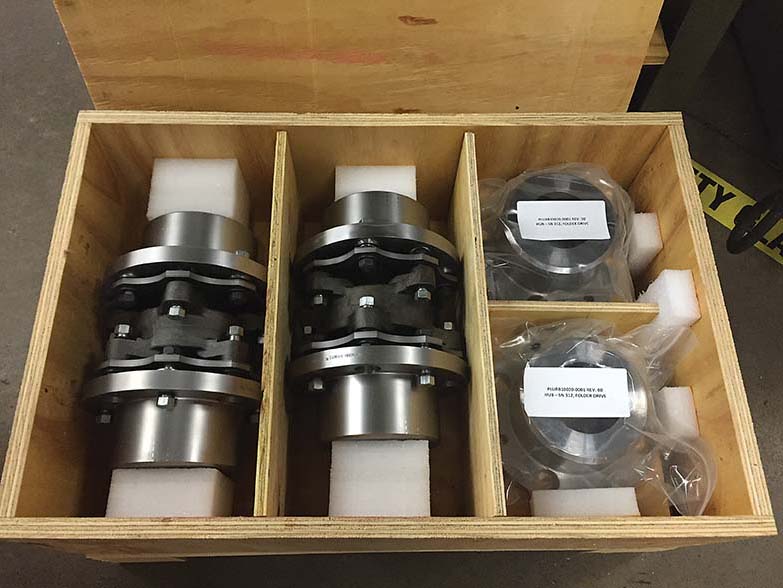
Products CARR Machine and Tool ship are bagged, tagged, surrounded with Styrofoam
and often placed in specially built crates. Image courtesy of CARR Machine and Tool.
In most instances, the packaging process at CARR Machine begins by sealing a machined part in a thick plastic bag; a steel part first receives a shot of WD-40 to prevent rust. A pressure-sensitive label with the required part information is applied to each bagged part before it’s placed inside a cardboard box lined with adhesive-backed Styrofoam. For a freight shipment, or when rough handling is anticipated, custom boxes are often built of 1⁄2″- or 3⁄4″-thick (12.7mm to 19mm) plywood, encasing each part in its own made-to-fit compartment.
“You can’t have parts bouncing around on the back of an 18-wheeler headed to California or Detroit,” Carr said. “They have to fit like gloves inside their packaging, otherwise they’ll end up damaged. I figure it adds an extra couple percent to the price of a typical part, but it’s well worth it to have everything arrive in pristine condition. For example, we do a lot of work with an OEM in Boston and they always tell me how much they appreciate getting a package from CARR, because they know there won’t be any problems. It adds a lot of value to what we do.”
Related

 MFGAxis Discussion
Be part of the shop-floor conversation
Like, save, or comment on this CTE story.
MFGAxis Discussion
Be part of the shop-floor conversation
Like, save, or comment on this CTE story.


MFGAxis Discussion