A Positive Change: Medical Manufacturing
Poor tool life and problems with chip control and surface finishes can be particularly consequential for medical manufacturers.
Poor tool life and problems with chip control and surface finishes are not desired by any parts manufacturer but can be particularly consequential for medical manufacturers because of the high demand for aesthetically pleasing parts while they closely watch the bottom line. An Illinois manufacturer was experiencing these issues when machining an orthopedic surgical instrument made of 304L stainless steel on a Swiss-style machine, said Tyler Lipsky, specialist, on-site metalworking for Melville, New York-headquartered MSC Industrial Supply Co. Inc. For example, chips wrapped around the part when the subspindle transferred the part to the main spindle.
The manufacturer was using a standard single-sided DCGT with a negative cutting action and achieved 9,000 parts per each of its two cutting edges, Lipsky added. “It’s a very thin-walled tube, so putting too much force into the part is a big concern.”
Andy Wasilewski, manufacturers’ representative at Chief Engineering Group in Indianapolis, explained that a negative insert does not have a relief angle and therefore exerts more cutting force than a positive one.
Lipsky added that he has considerable experience with cutting tools from Tungaloy-NTK America Inc. in Arlington, Heights, Illinois, and suggested the MiniForce-Turn double- sided positive insert, specifically the AH8015-grade DXGU 070302 L-SS insert, to overcome the issues. “I said, ‘Hey, I think this product is great, offers better productivity, can run faster and last longer.”
The grade has a thin PVD coating, which is effective for turning high-temperature superalloys and exotic materials such as stainless steel, Wasilewski noted, and receives a premium surface treatment to minimize built-up edge. “It’s got a great balance of wear resistance and fracture resistance.”
Prior to switching inserts, the end user performed a capability study and then a test run to establish tool life, Lipsky said. “Once everything is agreed upon, once all the engineering documentation is in place, it’s fully implemented.”
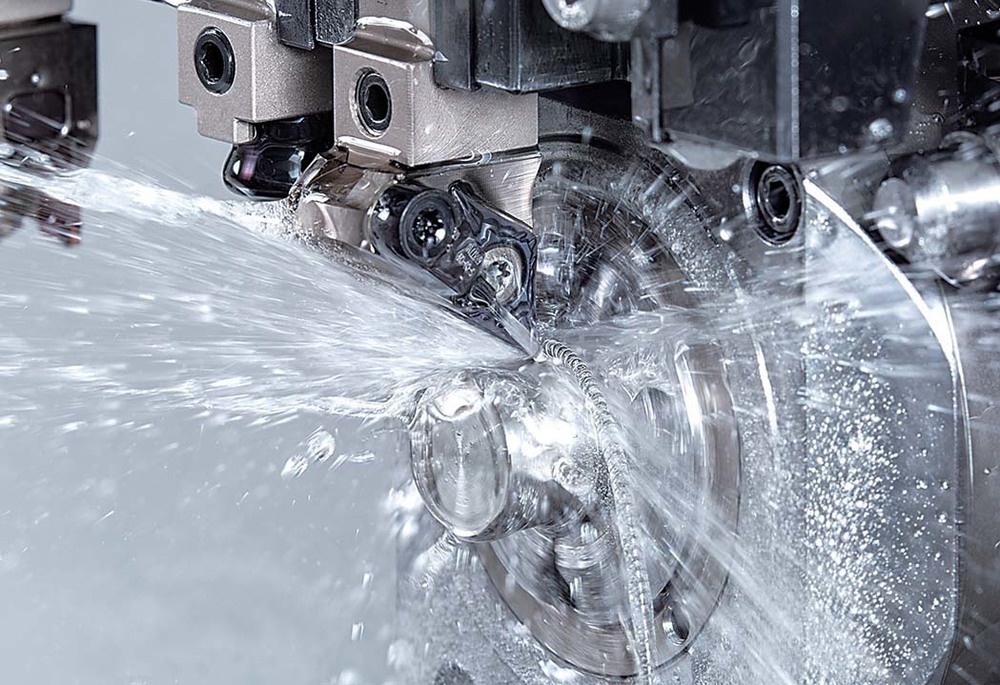
The MiniForce-Turn AH8000 series insert features the JS chipbreaker, which has a large inclination angle on the cutting edge to ensure free cutting. Tungaloy-NTK America
Positive tools are used in about 90% of the applications for Swiss-style machines, according to Lipsky, but it is rare to have a double-sided positive insert. Having four cutting edges per insert reduces the cost per edge compared to an insert with two. “This being a tool that offers the productivity of a double-sided insert with the positive cutting action, it’s just a win in all regards.”
To ensure stability and a high level of cutting performance, Wasilewski pointed out that the MiniForce-Turn insert has a built-in dovetail so that the insert sits in the tool body pocket securely and doesn’t move while cutting. “It gives extra stability basically.”
Review the print ads from this magazine to continue
This quick advertiser review unlocks the rest of the article and keeps the full-screen reader focused on the ads instead of the page chrome.
Advertisers included in this article experience
Print placements connected to this article
mtseries.com | 800.733.3976
FOUR STRATEGIC EVENTS.
ONE TRANSFORMATIVE EXPERIENCE. Experience the top regional manufacturing technology events where thousands of industry-leading companies and thought leaders gather to drive local innovation, network, and explore the latest advancements in manufacturing. West Springfield, MA Anaheim, CA Greenville, SC Dallas, TX May 13-15 Oct. 7-9 Oct. 21-23 Nov. 4-6.
FOUR STRATEGIC EVENTS. ONE TRANSFORMATIVE EXPERIENCE. Experience the top regional manufacturing technology events where thousands of industry-leading companies and thought leaders gather to drive local innovation, network, and explore the latest advancements in manufacturing. West Springfield, MA Anaheim, CA Greenville, SC Dallas, TX May 13-15 Oct. 7-9 Oct. 21-23 Nov. 4-6 mtseries.com | 800.733.3976
Visit mtseries.com | 800.733.3976 View this placement in the issue recordPrint ads from this magazine
ONE TRANSFORMATIVE EXPERIENCE. Experience the top regional manufacturing technology events where thousands of industry-leading companies and thought leaders gather to drive local innovation, network, and explore the latest advancements in manufacturing. West Springfield, MA Anaheim, CA Greenville, SC Dallas, TX May 13-15 Oct. 7-9 Oct. 21-23 Nov. 4-6.
FOUR STRATEGIC EVENTS. ONE TRANSFORMATIVE EXPERIENCE. Experience the top regional manufacturing technology events where thousands of industry-leading companies and thought leaders gather to drive local innovation, network, and explore the latest advancements in manufacturing. West Springfield, MA Anaheim, CA Greenville, SC Dallas, TX May 13-15 Oct. 7-9 Oct. 21-23 Nov. 4-6 mtseries.com | 800.733.3976
Continue reading
March 2025
He noted that the way the insert is oriented in the pocket along with the design of the chipbreaker, the insert is a negative-style shell but with a positive cutting action.
The insert features Tungaloy’s light cutting JS chipbreaker, which reportedly provides excellent chip control in a range of applications and has a large inclination angle on the cutting edge to ensure free cutting.
Once the medical manufacturer implemented the MiniForce-Turn insert, Lipsky said tool life increased from 9,000 parts per edge to 35,000 parts, or 140,000 parts for the total insert.
Wasilewski added that the Mini-Force-Turn line includes both ground inserts and molded inserts.
To leverage the tool life gain into more throughput by decreasing the cycle time, Lipsky said the end user is increasing cutting parameters in a still ongoing process.
He added that the medical manufacturer switched another insert to the MiniForce-Turn and experienced a similar increase in tool life and is looking for additional opportunities. However, because of the critical nature of medical components, the parts manufacturer is proceeding with caution. “Medical improvement can be a slow process.”
For more information about Tungaloy-NTK America Inc., call 888- 554-8394 or visit www.tungaloy.com/us.
— Alan RichterGlossary terms in this article