

Silencing Chatter & Closing the Loop
Boring as a mature process continues to evolve to meet the demands of the 21st century.
Machine boring dates back to the late 18th century with John Wilkinson’s cannon barrel boring machine. The English industrialist’s invention rotated a solid barrel stock around a fixed boring bar on an extendable shaft. Though revolutionary for its ability to machine a uniform diameter, the machine lacked meaningful efficiency. Demand for wartime materials during the 20th century’s two world wars, however, provided industry the impetus to develop horizontal and vertical boring mills capable of improved output and accuracy. Some three decades later, as the digital revolution transformed machine tool controls, NC and, later, CNC systems became increasingly common on boring machines.
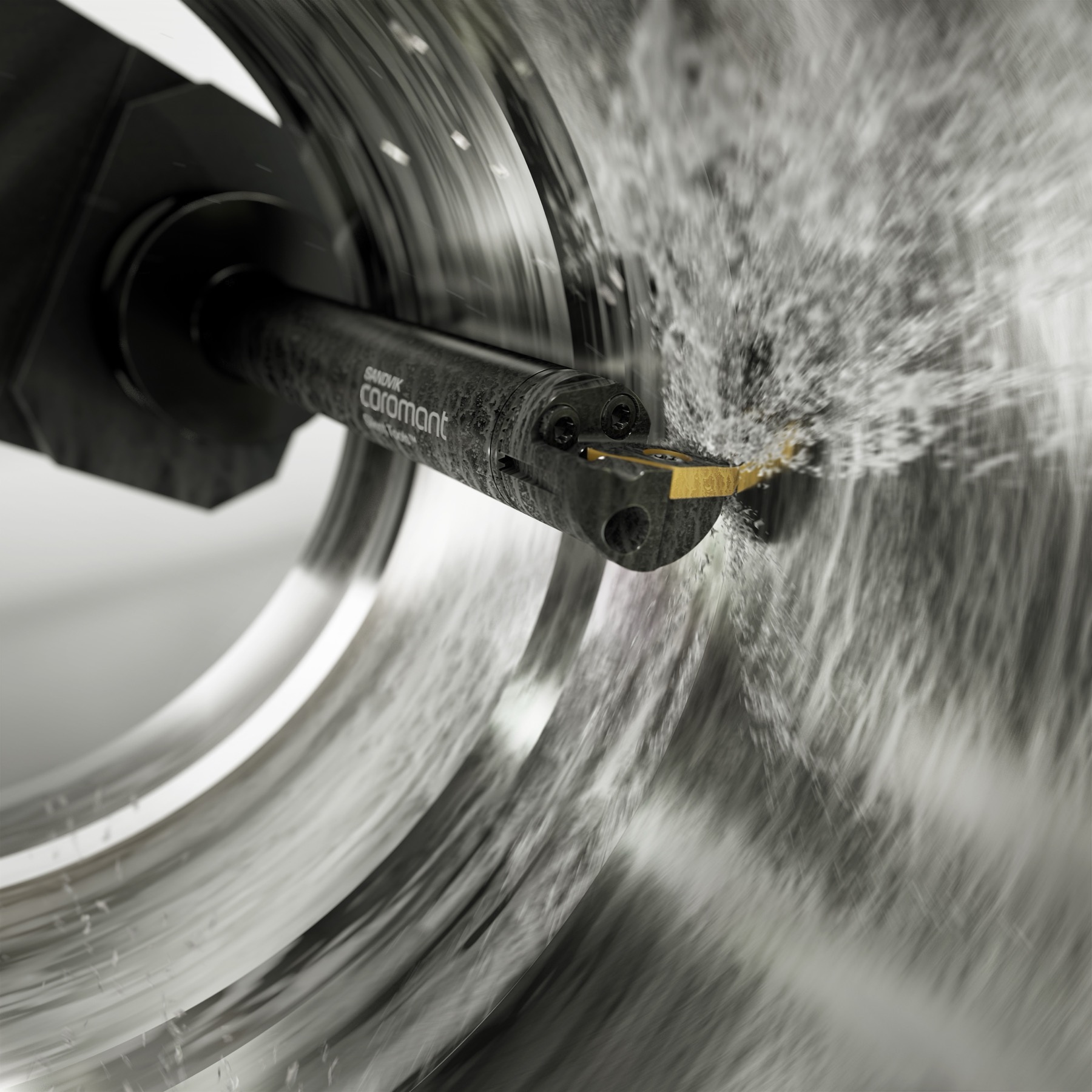
Boring remains manufacturing’s benchmark internal turning operation for finishing holes to exacting tolerances, improving surface finish, and compensating for geometric inconsistencies or taper from initial drilling or roughing. Though the underlying concept remains generally the same, increasing quality, precision and productivity demands are driving innovation in a mature field.
Aviation, oil and gas, and medical device manufacturing pose significant obstacles for boring shops. Aviation combines the tightest tolerances with difficult-to-machine materials. Oil and gas demands massive components made from materials that must reliably perform in harsh, unforgiving conditions. Medical device makers require micron-level tolerances in titanium and cobalt-chrome alloys, both of which present thermal and work-hardening difficulties.
Moreover, regardless of the industry served, shops face tighter delivery windows, higher material costs and a skilled labor shortage that will not abate.
Yet, boring technology has advanced to keep pace with the increasing load of material improvements and economic pressures.
Extending sometimes deep into a hole of varying diameters, boring by its very nature is susceptible to chatter and vibration, the archenemies of the process. Vibration and tool deflection ruin surface finishes, increase tool wear and produce a dimensional inaccuracy that can compromise the process.
“Chatter, vibration, not meeting tolerance requirements and having to recut the bore multiple times to get it within tolerance, these are all time-killers in production,” said Brent Godfrey, industry and applications specialist for Sandvik Coromant.
To combat chatter, advanced damped boring bars use an internally tuned mass damper to cut vibration for improved surface finish and tolerances. Operators can also run higher speeds and feeds without creating tool resonance, boosting productivity and throughput. Additionally, damped bars absorb kinetic shock, which helps insulate the machine spindle from wear and damage.
Passive damping boring tool systems, such as Sandvik Coromant’s Silent Tools line, include sensors near the cutting point to help operators improve quality and performance. The sensors feed temperature, vibration and deflection data back to an operator’s screen or tablet, allowing the operator to adjust cutting parameters in real time.
Boring operations are less sensitive to runout than other processes, such as reaming. However, boring requires extremely precise setup and alignment. Gauging and setting the tool is critical and often requires a senior machinist with a high level of expertise. Shops can’t leave such tasks to an inexperienced operator. Unfortunately for the industry, machinists at advanced skill levels are becoming harder and harder to find.
In addition to setting the tool, adjustments must be made in-process to compensate for insert wear. Repeated stops for adjustments drastically reduce cycle time and throughput. What’s more, attempting to automate the process is difficult because the repeated interruptions are caused by a human bottleneck.
“As the inserts wear, there is this need to adjust the tool to diameter,” said Anthony Bassett, president of Rigibore North America. “Those adjustments have always been accomplished with some sort of manual movement. Somebody has to adjust something on the tool, get it to size and then continue production.”
To overcome production breaks caused by tooling adjustments, toolmakers like Rigibore have developed and refined closed-loop boring head systems that allow machinists to track and analyze cutting parameters remotely. Initially, operators could control the head via the machine control with an app or tablet using the data collected by the tool.
The latest iteration of these systems uses a feedback network that performs automatic adjustments based on real-time data from in-process monitoring and measurement. Systems like Rigibore’s ActiveEdge interface connect to a CNC machine equipped with probing and/or gauging capabilities. The system collects and transmits bore measurement data to the machine control, which calculates any necessary adjustments. The machine control transmits adjustment data wirelessly to the boring tool, and the insert automatically moves to the required position to resume cutting.
Closed-loop technology dramatically increases output without sacrificing precision, Bassett said.
“It moves to a micron in diameter, so we’re talking about a half-micron, which is about a 20-millionth radial move,” he said.
Closed-loop systems are bridging the current gap to fully automating a precision boring operation, even though the prospect of automating micron-level boring on an expensive workpiece can be off-putting for some.
“I think if people could really understand that they could make a part with a critical bore diameter lights-out with a closed-loop option, it would be a massive, massive step forward,” Bassett said. “The hard part is getting people to know this actually is possible.”
Regarding tool wear and insert management challenges when boring, closed-loop systems can monitor tool wear and let operators know when an insert is reaching the end of its optimal cutting life.
Given the delicate nature of high-precision boring required by the aviation, medical, nuclear and high-volume automotive sectors, even small changes in tool wear can affect diameter and surface finish. Frequently dialing in offsets manually is a time-consuming process — an efficiency killer.
Tooling innovations, such as carbide grades and advanced coatings, are helping shops overcome heat, extend tool life and improve performance, particularly when working with hard alloys and complex geometries. Carbide-based boring bars are some three times stiffer than steel and retain their hardness at temperatures often exceeding 1,000° C.
Carbide-based bars also enable manufacturers to cut six to eight times their diameter — about twice that of steel bars. Carbide bars held 62% of the 2025 revenue share across industries.
Review the print ads from this magazine to continue
This quick advertiser review unlocks the rest of the article and keeps the full-screen reader focused on the ads instead of the page chrome.
Advertisers included in this article experience
Print placements connected to this article
Voestalpine High Performance Metals LLC
Voestalpine High Performance Metals LLC print ad
Print ad listed on page 26 of the August 2026 issue.
View this placement in the issue recordBeckett Packaging
Beckett Packaging print ad
Print ad listed on page 27 of the August 2026 issue.
View this placement in the issue recordTransor Filter USA
Transor Filter USA print ad
Print ad listed on page 28 of the August 2026 issue.
View this placement in the issue recordTransor Filter USA
Transor Filter USA print ad
Print ad listed on page 29 of the August 2026 issue.
View this placement in the issue recordContinue reading
August 2026
Additionally, cutting tool and insert coatings have advanced with multi-layer profiles and micro-textures that improve tool life significantly.
“The coatings have changed quite a bit, and that area continues to evolve,” said Adrian von Rohr, senior product manager for CERATIZIT USA. “In the past you had a single titanium nitride (TiN) coating. Now we’ve figured out how to have multi-layered nano-tech coatings that make a huge difference in getting the best out of your cutting edge and your inserts.”
Advances in physical vapor deposition (PVD) and chemical vapor deposition (CVD) coating provide toolmakers with significantly more layering capability for improved surface finishes and to prevent thermal breakdown of the substrate.
Silicon nitride coatings and aluminum chromium nitride (ALCrN) are seeing increasing use on carbide inserts, and diamond-like carbon (DLC) ranks among the latest advances for aluminum and non-ferrous material applications, von Rohr said.
Through-body coolant delivery systems that deliver coolant directly to the cutting edge, deep-hole chip evacuation for high depth-to-diameter applications and continued IoT integration with Industry 4.0 are also advancing the boring ecosystem to meet the ever-growing challenges of the industry.
Boring continues its evolution from the digital revolution of the 1970s, as demands of 21st century manufacturing push the sector’s limits in terms of accuracy, productivity and throughput with hard-to-machine materials. To remain successful, shops must not only stay abreast of advances in boring technology but be ready to adopt new innovations as they are developed. Reducing chatter and vibration for fine accuracy in the boring process, adopting the latest in cutting tools, grades and coatings as well as automated setup and operation for improved throughput will drive that success.
about the author: Jim Mayfield is an Indianapolis-based freelance writer covering manufacturing, technology and business for national publications and wire services. He can be reached at jimmayfield.writer@gmail.com.
Contributors
Rigibore Inc.
262-363-3922
CERATIZIT USA
800-783-2280
cuttingtools.ceratizit.com
Sandvik Coromant US
800-Sandvik (726-3845)
Image file names, credits and captions:
Sandvik-Coromant_Silent-Tools-Turning-Adapters_IMAGE.jpg
Or
Sandvik-Coromant_Silent-Tools-Action_IMAGE.jpg
Credit: Sandvik Coromant
Caption: Advanced damped boring bars use an internally tuned mass damper to cut vibration and chatter for improved surface finish and tolerances, especially in applications that require long overhangs.
Related

 MFGAxis Discussion
Be part of the shop-floor conversation
Like, save, or comment on this CTE story.
MFGAxis Discussion
Be part of the shop-floor conversation
Like, save, or comment on this CTE story.


MFGAxis Discussion