

So cool it’s crazy
Solid-carbide end mills with unique cooling channels to enable significant productivity gains.
The poor heat conductivity of stainless steel, titanium, cobalt-chrome and nickel-base alloys makes them difficult to machine and causes a cutting tool to become extremely hot when machining them. To prevent that heat from prematurely damaging a tool’s cutting edges when machining these challenging materials, coolant must be applied, according to Mikron Tool SA Agno.
As a result, the Swiss toolmaker developed the CrazyMill Cool solid-carbide endmill with internal cooling channels that are large in relation to the cutting diameter, noted Markus Schnyder, Mikron founder and president. The design provides a high-volume coolant flow rather than a high-pressure stream to remove heat from the cutting zone while clearing chips to prevent recutting them and damaging the tool. The recommended coolant pressure is from 400 to 500 psi (29 to 35 bar).
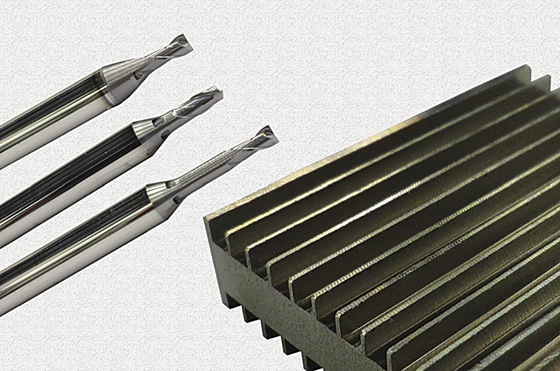
Courtesy of Mikron Tool
Three versions of CrazyMill Cool through-coolant milling cutters are available for different maximum milling depths from 1.5 to 5 diameters deep.
“We have seen that using more than 1,000 psi makes no sense, because there is no change in the results,” he said, noting the coolant keeps the tool/workpiece interface below 1,112° to 1,292° F (600° to 700° C)—the “green range.”
The tools have three to five channels, depending on the cutter diameter. The diameter range is from 0.3mm to 6mm (0.012 ” to 0.236 “). “We think we could start at 0.1mm,” Schnyder said, “but we are not there yet.”
Because the cooling channels are optimally sized to achieve maximum flow, standard coolant filtration of 10µm to 15µm (0.0004 ” to 0.0006 “) is suitable, according to Alberto Gotti, who’s in charge of R&D at Mikron.
Review the print ads from this magazine to continue
This quick advertiser review unlocks the rest of the article and keeps the full-screen reader focused on the ads instead of the page chrome.
Advertisers included in this article experience
Print placements connected to this article
Cutting Tool Engineering
COMMAND MORE
ATTENTION WITH COLOR. Call your CTE rep today to incorporate color into your ad program! North/Southeast W. Central E. Central/Far West Scott Beller Marc Condon Bill Klingler Scan to view the Readex Research report on the impact of color in ads
COMMAND MORE ATTENTION WITH COLOR. Call your CTE rep today to incorporate color into your ad program! North/Southeast W. Central E. Central/Far West Scott Beller Marc Condon Bill Klingler 847-714-0183 847-714-0185 847-714-0186 [email protected] [email protected] [email protected]
Visit Cutting Tool Engineering View this placement in the issue recordSecotools
With tangentially mounted
inserts, the Square T4-08 offers smooth cutting action with high rigidity and excellent surface finish. Cutting forces are directed to the thickest part of the inserts, allowing you increase cutting data and obtain superior part quality. Incorporate Square T4-08 into your applications requiring a small-diameter milling cutter.
With tangentially mounted inserts, the Square T4-08 offers smooth cutting action with high rigidity and excellent surface finish. Cutting forces are directed to the thickest part of the inserts, allowing you increase cutting data and obtain superior part quality. Incorporate Square T4-08 into your applications requiring a
Visit Secotools View this placement in the issue recordPrint ads from this magazine
ATTENTION WITH COLOR. Call your CTE rep today to incorporate color into your ad program! North/Southeast W. Central E. Central/Far West Scott Beller Marc Condon Bill Klingler Scan to view the Readex Research report on the impact of color in ads
COMMAND MORE ATTENTION WITH COLOR. Call your CTE rep today to incorporate color into your ad program! North/Southeast W. Central E. Central/Far West Scott Beller Marc Condon Bill Klingler 847-714-0183 847-714-0185 847-714-0186 [email protected] [email protected] [email protected]
Continue reading
September 2014
In addition to the coolant channels, Schnyder emphasized that designers optimized the entire tool—substrate, geometry and coating—to tackle materials with poor heat conductivity. The carbide grains are smaller than 0.5µm (0.00002 “) and are distributed and anchored in a cobalt binder to provide the required combination of hardness and toughness, he noted.
Prior to coating, a pretreatment process polishes the substrate and radiuses the cutting edges. “The radiusing is very soft and gentle for the smaller sizes and more intense for the larger diameters,” Schnyder said. The tools are also available with a 45° protection face, instead of a corner radius, to stabilize the cutting edges.
Gotti indicated that the aluminum-chromium-nitride base coating is modified by other coating elements to provide a low affinity with nickel, chrome and the other alloying elements in challenging workpieces, such as stainless. “It’s like using Teflon on your cooking pan,” he said. “We reduce the risk that material will stick to the cutting edges.”
The coating is polished, which, in combination with the cooling effect, reduces the risk of built-up edge, Gotti added.
When a machine tool spindle with through-coolant capability can rotate at speeds that enable microscale endmills to cut effectively, the CrazyMill Cool is 10 to 20 times more efficient than conventional cutters, according to Schnyder. And with the enhanced chip evacuation, such as when machining deep slots, the toolmaker reports that the tool imparts surface finishes two to three times finer—”the cherry on the cake.”
For more information about Mikron Corp. Monroe, based in Monroe, Conn., call (203) 261-3100 or visit www.mikron.com/tool-us.
Related




Subscribers can use MFGAxis notes, saves and discussion tools with their innoNET account.


