


Stamping out excess costs: Medical Manufacturing
END USER: Aragon Surgical Inc., (650) 543-3100, www.aragonsurgical.com. CHALLENGE: Reduce costs when procuring a stainless steel part for a laparoscopic surgical device. SOLUTION: A contract manufacturer that stamps some previously machined part features and machines only the critical features.
—————
END USER: Aragon Surgical Inc., (650) 543-3100, www.aragonsurgical.com. CHALLENGE: Reduce costs when procuring a stainless steel part for a laparoscopic surgical device. SOLUTION: A contract manufacturer that stamps some previously machined part features and machines only the critical features. SOLUTION PROVIDER: Connecticut Spring & Stamping, (860) 677-1341, www.ctspring.com
—————–
Machining metal can achieve tighter tolerances and finer surface finishes than other metalworking processes, but that level of precision comes with a cost. Aragon Surgical Inc., a Palo Alto, Calif.-based medical device firm, discovered that fact when having a job shop machine a stainless steel jaw housing for a laparoscopic surgical device from a solid, circular workpiece. In addition to wanting to reduce its cost per part, Aragon Surgical was having problems getting a sufficient number of parts, according to Brandon Loudermilk, the company’s senior R&D engineer.
At a trade show, Aragon Surgical made initial contact with Connecticut Spring & Stamping, Farmington, Conn., and discussed stamping most of the part’s features. “Our expertise is not machining from solid stock,” said Steve Dicke, vice president of sales and marketing for CSS. “It’s taking a part that is fully machined [and instead] stamping the basic part features to reduce costs and then machining the critical features.” He noted that CSS has seven machining centers and is buying two more.
However, Loudermilk was skeptical that the stamping process was suitable. “When we started, I thought there was no way anyone could stamp this part to be perfectly round and make it function properly,” he said.
To help convince him about the viability of stamping noncritical features into flat stock before the part is rolled round, CSS presented a lock tumbler for a door lock, which has features similar to those on the jaw housing. “When I saw how they could produce that part, how round it was and how good the finish was, it made me consider stamping this part,” Loudermilk said.
Being able to stamp and machine a part provides a different manufacturing perspective, according to Lou Morelli, senior member of CSS’ engineering department.
CSS engineers then hosted several conversations and went through numerous steps to determine the most important part features and figure out how the part could be stamped to achieve the tolerance requirements. Web conferencing helped enable the two companies to interact quickly and remain on the same page. In a few weeks, the companies came to an agreement and work began on production tooling for the stamping.
View print ads from this spread
Review the ads on this magazine spread to continue reading. Each ad takes two seconds; a two-page ad counts once.
Advertisers on this magazine spread
Print placements on this magazine spread
Aeroconshows
Accelerate Your Projects into the Future
SEPTEMBER 20–22, 2011 McCormick Place North Chicago, Illinois The exhibition for the aerospace and defense industries Featuring suppliers for the design and production of aerospace and defense products, including: f Software f Components f Electronics f Machinery f Sub-Assemblies f Testing f Materials f Contract Services …and much more!
Accelerate Your Projects into the Future SEPTEMBER 20–22, 2011 McCormick Place North Chicago, Illinois The exhibition for the aerospace and defense industries Featuring suppliers for the design and production of aerospace and defense products, including: f Software f Components f Electronics f Machinery f Sub-Assemblies f Testing f Materials f Contract Services …and much more!
Visit Aeroconshows View this placement in the issue recordPrint ads from this magazine
SEPTEMBER 20–22, 2011 McCormick Place North Chicago, Illinois The exhibition for the aerospace and defense industries Featuring suppliers for the design and production of aerospace and defense products, including: f Software f Components f Electronics f Machinery f Sub-Assemblies f Testing f Materials f Contract Services …and much more!
Accelerate Your Projects into the Future SEPTEMBER 20–22, 2011 McCormick Place North Chicago, Illinois The exhibition for the aerospace and defense industries Featuring suppliers for the design and production of aerospace and defense products, including: f Software f Components f Electronics f Machinery f Sub-Assemblies f Testing f Materials f Contract Services …and much more!
Continue reading
August 2011
Courtesy of CSS
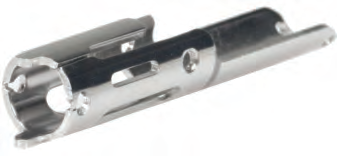
Aragon Surgical reduced its cost for this stainless steel jaw housing for a laparoscopic surgical device by having Connecticut Spring & Stamping stamp most of the part’s features and machine only the critical ones instead of machining the part from a solid, circular workpiece.
Tooling costs can be significant, and, being a startup firm, Aragon Surgical is conservative with its capital. However, CSS was confident the project would be successful, so it offered to amortize the tooling costs into the first production run, according to Morelli. “A portion of that cost was amortized into each part, so they didn’t have to pay for any of the tools until they were receiving parts,” he said.
Loudermilk added: “We paid up front for a certain quantity of parts, with the additional cost going toward paying for the tool costs. This enabled us to get cheaper parts quickly, without putting our capital up front. After the initial run was completed, the tooling came out of the piece price, making it that much more attractive and profitable.”
Compared to $40 for a fully machined part, the initial run at CSS was 20 to 30 percent cheaper and 50 to 60 percent less after Aragon Surgical finished paying for the tooling costs, Loudermilk estimated.
Although the tolerances for the previously machined features were ±0.001″, the tolerances are ±0.002″ for the stamped noncritical features, ±0.002″ for the milled critical slot dimensions and ±0.001″ for the machined critical hole dimensions. Nonetheless, the part is fully functional.
CSS performs 5-axis milling of the parts after stamping using a rotary head on a CNC machine. “We take the part in the barrel shape, put it onto an arbor and rotate the part in different directions, putting all the slots, holes and necessary geometry on it,” Dicke said.
He noted that CSS produces about 500 jaw housings a week and can increase capacity if needed.
A lot of designers think a part has to be either machined or stamped, but there are limitations to both, Morelli noted. “When you combine them, it really opens up a new world.”
Related

Subscribers can use MFGAxis notes, saves and discussion tools with their innoNET account.