A tale of two cutting tools: solid and indexable-insert drills
A look at the strengths and weaknesses of solid and indexable-insert drills.
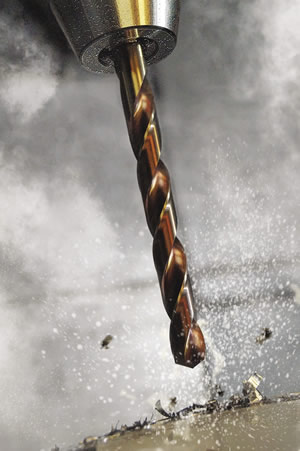 A solid drill is a rotating end- or side-cutting tool with one or more cutting edges and one or more straight or helical grooves for the passage of chips and the admission of coolant. An indexable-insert drill accepts inserts that clamp into a tool body designed to accept them. A cutting edge of an insert is used until it becomes dull, then it is indexed, or turned, to expose a fresh cutting edge. When all cutting edges of an insert are dull, it is usually discarded and replaced with a new one.
Hole Diameter
Solid and indexable-insert drills each have advantages and disadvantages, and the type selected for the job depends on the application. Hole diameter is one consideration. Toolmakers can produce indexable drills with much larger diameters than solid tools, while solid drills can be made with significantly smaller diameters.
The diameter of a solid-carbide drill will typically range from about 3mm (0.118″) to 20mm (0.787″). A solid-HSS drill can be larger than 20mm in diameter, but it will not be as accurate as a solid-carbide tool. When an application calls for hole diameters larger than 20mm, explore indexable options.
A factor to remember is that the horsepower required for drilling will increase as the drill diameter increases. If a parts manufacturer is purchasing a machine that it knows will be used to drill large diameters, the company must check that the machine has the required horsepower.
Horsepower concerns really come into play when switching to an indexable drill from a solid drill, whether HSS or carbide. With two inserts in use, users must reference the torque and horsepower charts that come with every machine. For example, the charts on machines at Dormer Pramet clearly state that a machine can run at 40 to 45 hp for 15 minutes. Going beyond that point can cause the machine to stop and trigger an alarm.
Tolerances are another differentiator between solid-carbide and indexable drills, with the former able to achieve tighter tolerances than the latter. Using the ISO 286 hole-tolerance scale, where the smaller the number, the more precise a hole’s diameter, a solid-carbide drill can deliver an H9 tolerance while an indexable drill can only reach H10 to H12. So, for example, an 18mm-dia. (0.709″) hole that’s H9 on the ISO scale will have a tolerance of 43µm (0.0017″), whereas an H11 hole’s tolerance for the same size hole would be 130µm (0.005″).
Investment and Maintenance
From a cost perspective, indexable inserts and their holder—the cutter body that accommodates the inserts—represent a significant investment. However, when a cutting edge is worn and needs replacement, the ease of replacing an insert is more efficient than exchanging a solid tool because only the insert needs to be indexed or changed. A solid drill, on the other hand, usually requires removal from the toolholder and resetting the depth of the drill after the tool is changed.
To help support the long-term investment of indexable inserts, they are interchangeable and versatile. Machinists can reuse the cutter from one job while easily switching out the inserts for another job that requires machining a different workpiece material.
Solid drills offer a long-term investment advantage of their own because they can be reground, sometimes seven to 10 times. On the other hand, indexable inserts are typically not reground.
Performance Standards
The geometry, substrate and coating of a solid drill determine its performance. Drills that optimize each element for a specific application have the potential to be more accurate than general-purpose tools.
Looking at geometry, the 118° conical point is the most common drill point. When properly produced, it will effectively drill a variety of materials. The drill point may require some form of web thinning when used on a drill whose web thickness has increased because of repeated resharpenings or on a drill with a heavy web construction.
In addition, the split point was originally developed for use on drills designed for producing deep oil holes in automotive crankshafts. Today, the split point is used on many designs of drills for cutting various hard and soft materials. The split point can be applied to a variety of drill point angles, with the most common being 135°. The main benefits of the split point are that it enables self-centering of a drill and prevents the tool from “walking” before penetrating a part’s surface.
Review the print ads from this magazine to continue
This quick advertiser review unlocks the rest of the article and keeps the full-screen reader focused on the ads instead of the page chrome.
Advertisers included in this article experience
Print placements connected to this article
TwistPack Plus
There’s a New Twist
rose plastic introduced the TwistPack, an innovative two-parts plastic tube, used worldwide as a packaging solution for precision tools. There were imitations of the product throughout the years but none surpassed our quality and construction of our original design. Until now. There’s a new twist in packaging. rose plastic’s TwistPack Plus offers a.
There’s a New Twist TwistPack Plus rose plastic introduced the TwistPack, an innovative two-parts plastic tube, used worldwide as a packaging solution for precision tools. There were imitations of the product throughout the years but none surpassed our quality and construction of our original design. Until now. There’s a new twist in packaging.
Visit TwistPack Plus View this placement in the issue recordIndextraub
More operations. Less handling.
MORE Turn, mill, drill, grind, hob, tap, groove and more in a single setup. Even 6 -sided machining. DONE More precision. Accuracies to microns – best possible turned surface finishes. More profit for you. IN ONE. With our precision turning solutions, you can cut your cycle times dramatically. Up to 60% or more. Less really is more
MORE More operations. Less handling. Turn, mill, drill, grind, hob, tap, groove and more in a single setup. Even 6 -sided machining. DONE More precision. Accuracies to microns – best possible turned surface finishes. More profit for you. IN ONE.
Visit Indextraub View this placement in the issue recordPrint ads from this magazine
rose plastic introduced the TwistPack, an innovative two-parts plastic tube, used worldwide as a packaging solution for precision tools. There were imitations of the product throughout the years but none surpassed our quality and construction of our original design. Until now. There’s a new twist in packaging. rose plastic’s TwistPack Plus offers a.
There’s a New Twist TwistPack Plus rose plastic introduced the TwistPack, an innovative two-parts plastic tube, used worldwide as a packaging solution for precision tools. There were imitations of the product throughout the years but none surpassed our quality and construction of our original design. Until now. There’s a new twist in packaging.
Continue reading
September 2016
The split point greatly reduces thrust and adds a positive-rake cutting edge, which extends to the center of the drill. The split point also acts as a chipbreaker to produce small chips, which can be effectively evacuated through the flutes. This is beneficial in most applications, but especially when using a portable drill or a drill press where bushings cannot be used.
Conversely, indexable drills offer a versatility that is beyond the capability of solid tools. Inserts can provide stable results even in adverse conditions and are able to perform multiple operations beyond the scope of solid drills. These operations include plunging, helical interpolation, profiling and enlarging a hole.
For example, when a manufacturer needed to remove material as fast as possible, it plunged with an indexable drill. The company applied a 1″-dia. (25.4mm) drill that plunged straight up and down, then moved it more than ¾” (19.05mm) and plunged straight up and down again. For quickly removing material, it was a great solution—and one a solid drill couldn’t accomplish.
Both solid drills and indexable-insert ones have distinct advantages and disadvantages based on workpiece material, the application and operational requirements. They complete a toolmaker’s standard offering by providing users overlapping diameters so tooling engineers can assess applications and advise parts manufacturers where and when it is appropriate to apply each.

Material differences
HSS is a very tough, but not very wear-resistant, material. HSS tools are applied in many common, demanding applications.
Carbide is the most widely used wear-resistant cutting tool material and is suitable for making solid tools and indexable-insert tools. Approximately 85 percent of all carbide indexable inserts are coated.
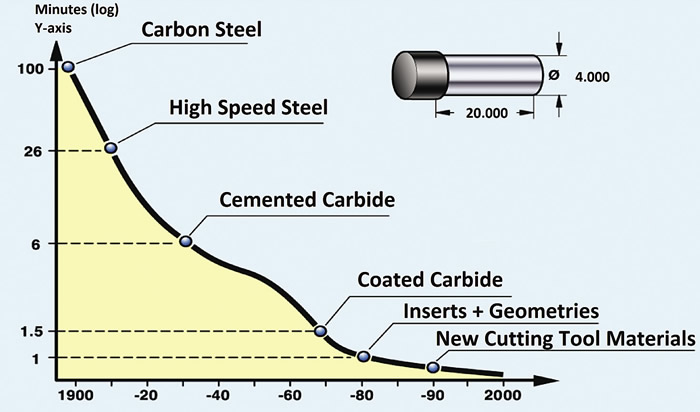
Indexable inserts are made of cermet, ceramics, polycrystalline cubic boron nitride (PCBN) or polycrystalline diamond (PCD).
Cermet provides effective flank- and crater-wear resistance and is not prone to built-up edge. Because of this, the cutting edge maintains its sharpness for a long time.
Ceramic has a wide application area in cutting materials hardened to 45 to 55 HRC and has a high resistance to abrasive and thermal conditions.
PCBN offers an extremely high thermal resistance, and PCBN tools are applied for cutting challenging materials such as hardened steels and cast iron.
There are two types of PCD: natural and industrial diamond. PCD tools are suitable for machining nonferrous materials, such as aluminum, because of PCD’s high resistance to wear. Because PCD is extremely hard and brittle, it is not a good choice for high-hardness or high-impact applications.
Development is ongoing for new geometries, new coatings, new substrates and advanced manufacturing processes, including edge preparations, surface finishing and other treatments.
—G. Kirchoff and J. Nava
Related Reading
- For more on indexable cutting tools, see this related guide.