

Tip Top Tap: Medical Manufacturing
High-performance cut taps are effective for demanding threading applications and can be suitable for less challenging scenarios as well.
Review the print ads from this magazine to continue
This quick advertiser review unlocks the rest of the article and keeps the full-screen reader focused on the ads instead of the page chrome.
Advertisers included in this article experience
Print placements connected to this article
Sandvik
Time for change
Time for change Visit sandvik.coromant.com to learn more.
Visit Sandvik View this placement in the issue recordPrint ads from this magazine
Time for change Visit sandvik.coromant.com to learn more.
Continue reading
March 2026
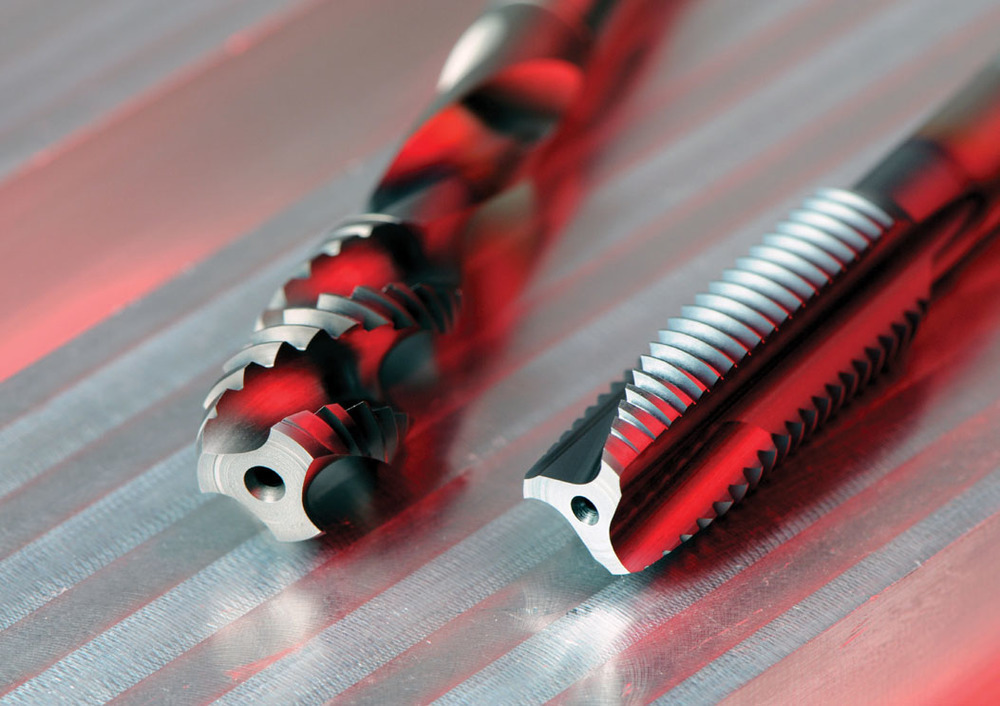
Based on a geometric modification, the company reports that the contact surface between a Pionex tap has been optimized to reduce torque by up to 30%. A reduction in torque minimizes tool breakages so that the tensile strength of the tool is not exceeded.
“It does not only reduce tool breakages, but at the same time increases tool life,” Mintrone said, adding that tool life is extended about 30% to 50%. With that capability, an end user can choose to run a Pionex tap at least 25% faster than a conventional tool.
To boost productivity, end users sacrifice some tap life. Stephen Putek, product engineer I for OSG USA Inc. in St. Charles, Illinois, noted that he heard from one customer who prioritized productivity over tool life by tapping twice as fast while losing about 40% of the tap life. “But they’re happy to get these parts out the door a lot quicker. Then there are others who just need the thing to last as long as humanly possible, and they’ll do whatever it takes to make it last.”
The substrate options include HSS, powdered metal HSS and carbide, with powdered metal providing some of the benefits of both HSS and carbide, he explained. Mintrone advises against the use of a carbide tap to cut high-tensile steel because of its enhanced brittleness. A carbide tap is a better choice for threading aluminum and titanium aerospace and medical parts.

About 95% of the taps are coated, Mintrone said, mainly with TiN or TiAlN, as well as AlCrN and TiCN. The specific coating needs to provide hardness and smoothness to prevent material from sticking to the tap. “I personally advise against using an uncoated tool, mainly because of tool life reasons and chip evacuation reasons.” However, an uncoated tool is suitable when cutting a thread by hand.
Prior to coating, the taps are wet blasted with a mixture of water and sand and then dry polished with natural ingredients, as well as diamond dust, he noted. The special finishing processes impart a fine surface finish to reduce tapping friction and torque, which improves chip evacuation.


Geometry at Work
High-performance taps have geometric features to boost their capabilities. One feature is a larger core to strengthen and stabilize the tool, Mintrone noted. Another is a thread relief that’s designed to reduce contact between the flanks of the thread lands and the workpiece, preventing the chip from getting between the workpiece and the cut tap.
“It usually depends on the pitch of the tool, but we’re talking about like 0.02 mm. It sounds like it’s not much, but it is,” he said. “We can’t go too large with the relief because we want to make sure the tool keeps its self-guidance ability.”
The helix also plays a significant role, and the angle depends on the application. “When it’s a long chipping material, we usually go with a 25° up to a 45° helix to ensure good chip evacuation,” Mintrone said. “When it’s short chipping materials like cast iron or bronze, we usually go with a straight-fluted tool or maybe up to a 15° helix.”
For OSG’s A-Tap cut taps, the helix is 45° at the chamfer and transitions to 15° toward the shank. Putek described the A-Tap as the toolmaker’s go-to cut tap and “our best option on the market” for threading steel, stainless steel, cast iron and aluminum, As the helix transitions to 15°, the flute space widens to enhance chip evacuation compared to a constant 45° helix where there is more physical distance to disengage chips from the top.
“The 45° helix at the chamfer helps you increase the rake angle up front towards the chamfer, and that’s going to make it very easy for the chip to start working its way up the flute,” he said. “Then as we get farther and farther back, we want to get those chips away from the flute, and the flute space on our A-Tap actually widens towards the back.”
When it comes to the size of the chips, Jun Ahiko, product engineer II for OSG, explained that a tap with a low rake angle generates large chips while a sharp rake produces smaller chip shapes. “A-Tap has a sharp rake angle on the cutting edge. Generally speaking, a sharp cutting edge is weak and doesn’t have enough wear resistance, but the A-Tap has a V coating and a powder metal substrate in order to keep the wear resistance. A-Tap has a good balance between wear resistance and the sharp cutting edge.”
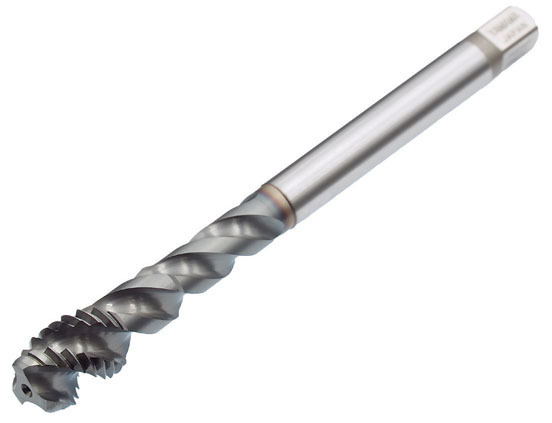
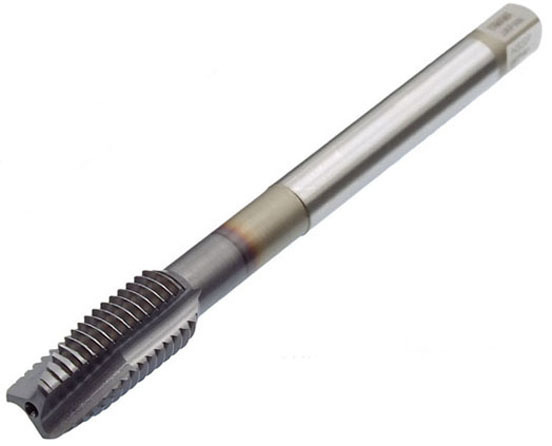
Putek added that the V coating is based off of a multilayer TiCN coating to enhance the wear resistance and extend tool life.
Regarding the substrate, Ahiko noted that the powdered metal, sintered with cobalt and vanadium, balances wear resistance and toughness. “That’s also heat treated to a hardness of approximately 65 Rockwell just to make sure that it is going to give you the maximum wear resistance.”
Carbide is still used as a substrate, Putek said, but the lower toughness and the higher price make it more suitable for niche applications, such as when tapping cast iron to resist wear because the workpiece can be quite abrasive due to its high carbon content.
Another application is tapping aerospace components made of carbon fiber-reinforced composites — another abrasive material. “We have diamond-coated carbide taps in order to maximize the life of the tap in those applications.”
Primarily, however, end users typically gravitate toward the A-Tap series for production environments where they are looking to minimize the cost per unit as much as possible, where you are dealing with potentially millions of holes, Putek said.
Another suitable application is in difficult-to-tap materials where issues with chip entanglement occur, such as gummy stainless steel like 304L, according to Putek. “We find that some people gravitate towards the A-Tap just because it’s able to control that chip formation and minimize any sort of troubleshooting issues on the spindle regarding chip entanglements or chipping of the tap due to poor chip evacuation.”
Material Specific
Another high-performance option is the ZELX taps from YMW Taps USA in Santa Ana, California, which are manufactured by Yamawa Manufacturing Co. Ltd. in Japan. The series includes the ZELX SS taps for stainless steel and other materials, ZELX NI taps for cobalt and nickel-and iron-base exotic materials, as well as stainless, mold and tool steels harder than 30 HRC, ZELX TI taps for titanium alloys, and ZELX AL for zinc die cast aluminum, wrought aluminum, silicon die cast, copper and magnesium.
Based on over 100 years of research and development into threading tools, YMW has set the optimal rake angle for each of the many materials, Helfer said. “The lower rake angle would be for the hardened materials like nickel-base alloys. The higher rake angle is for softer materials. “The ZELX SS is what we call our bread-and-butter tap designed for stainless and below,” Helfer added. “It will do low-to high-carbon steels, cold-rolled steels all the way up to 304 and some soft A286.”
The ZELX SS and AL taps are made with a custom blended high vanadium HSS and the ZELX NI and TI taps are made with powdered metal HSS. “We do make some carbide taps but they are mostly straight-fluted taps,” he said.

Helfer pointed out that the TI taps have a large OD and pitch diameter relief. “Titanium alloys have a memory to it, so when the tap backs out it will shrink back down, and we solved that by putting those reliefs on there.”
YAMAWA’s latest tap offering is the Z-PRO series, which has an extended length to make it easier to evacuate chips and feed coolant, according to Helfer. It makes the chips come out in a wide fan, so they are not tangling up on the taps — a benefit that’s increasing in demand as many manufacturers are introducing high-performance machining centers and promoting automation to improve production efficiency.
“Adoption of the Z-PRO series, which prevents chip related problems and enables stable, continuous machining, is rapidly expanding,” Helfer said.
The Z-PRO includes VUSP spiral-fluted taps and VUPO spiral-pointed taps, which come standard with a TiCN coating, he said. “We can make the best recommendations to customers according to what their application is.”
Yamawa builds its own thread grinding machines to make taps, Helfer added. “This is because taps for tapping highly reliable screw threads require even higher precision, and our machine tool manufacturing department can carry out maintenance at the appropriate timing to constantly keep the high precision of our thread grinding machines so that we can continue to produce these high-precision taps stably.”
Ultimately, a high-performance tap is not necessarily designed to last longer or thread faster than a conventional tool; it is meant to produce reliable screw threads. “We try to sell taps for the high precision internal threads by price per hole and not price per tool,” Helfer said.

about the author: Alan Richter, a 40-year veteran journalist, has spent the last 25 years covering the metalworking industry for Cutting Tool Engineering and currently serves as its editor-at-large. Contact him at alan@ctepubs.com.
Related



Subscribers can use MFGAxis notes, saves and discussion tools with their innoNET account.


