

Welcome Additive to the Toolbox
Metal additive manufacturing continues to complement traditional production processes while making technological strides.
While additive manufacturing, such as metal AM, rarely replaces large-scale traditional production, it can provide organizations with greater flexibility to produce certain parts domestically, reduce dependence on long and vulnerable supply chains, and respond more quickly to disruptions, according to a statement from AMT – The Association for Manufacturing Technology published in its recent AM booklet titled, “The Additive Manufacturing Report 2026.” In addition to broader reshoring efforts, the U.S. Department of Defense has been actively investing in advanced manufacturing technologies, including additive manufacturing, as part of a broader effort to strengthen the defense industrial base. These investments are intended to address long-standing supply chain vulnerabilities, modernize production capabilities and improve reliable access to critical components. The DOD’s AM strategy specifically identifies 3D printing as a technology that can improve materiel readiness, modernize defense systems and strengthen the defense industrial base.
One organization serving the defense sector with metal AM services is Concurrent Technologies Corp. (CTC) in Johnstown, Pennsylvania, an independent, nonprofit R&D firm that focuses on supporting national security and U.S. warfighters in part through advanced manufacturing and metal AM parts production. CTC’s in-house metal AM processes include laser powder bed fusion (LPBF), hybrid manufacturing with a directed energy deposition machine and high-pressure cold spray.
The LPBF machines that CTC operates are from Nikon SLM Solutions, and range in build volume from about 280 mm (11.0″) by 280 mm by 365 mm (14.3″) to 600 mm (23.6″) by 600 mm on the XY plane by 1,500 mm (59.0″) on the Z plane, said Matt Criado, manager, advanced manufacturing for CTC. “We never have a big-enough machine. When we initially bought what we thought would be a big-enough machine, I figured there wouldn’t be a need for anything larger, but we’re already getting designs that must be broken down into pieces to fit.”
He added, “Because we are an applied research organization, we’re always trying to push the limits of what is possible. We’re already seeing the need to go bigger, and we’re starting to have those conversations about what the next bigger machine looks like.”
According to “AMPOWER Report 2026” from AMPOWER GmbH & Co. KG in Hamburg, Germany, LPBF remains the revenue-dominant technology in metal AM, holding a market share of over 80% compared to all other metal AM technologies.
The top 10 powder bed fusion OEMs — such as Nikon SLM Solutions, EOS, Colibrium Additive, and Chinese OEMs — account for 78% of the market and continue to play a leading role in the industry’s development. In 2025, the number of active players offering solutions for laser powder bed fusion technology increased again, growing from 96 companies in 2024 to 107 in 2025. China, in particular, saw a surge of new market entrants.
All About Optics
With expertise in optical, optomechanics, precision manufacturing and system integration technologies, Tokyo-based Nikon Corp. established Nikon Advanced Manufacturing Inc. to leverage synergies resulting from strategic investments, including the acquisition of laser powder bed (L-PBF) AM equipment maker SLM Solutions Group AG and Morf3D Inc., an AM services provider. For the first time in the company’s history, a business unit has its headquarters outside of Japan, with Nikon Advanced Manufacturing based in Belmont, California.
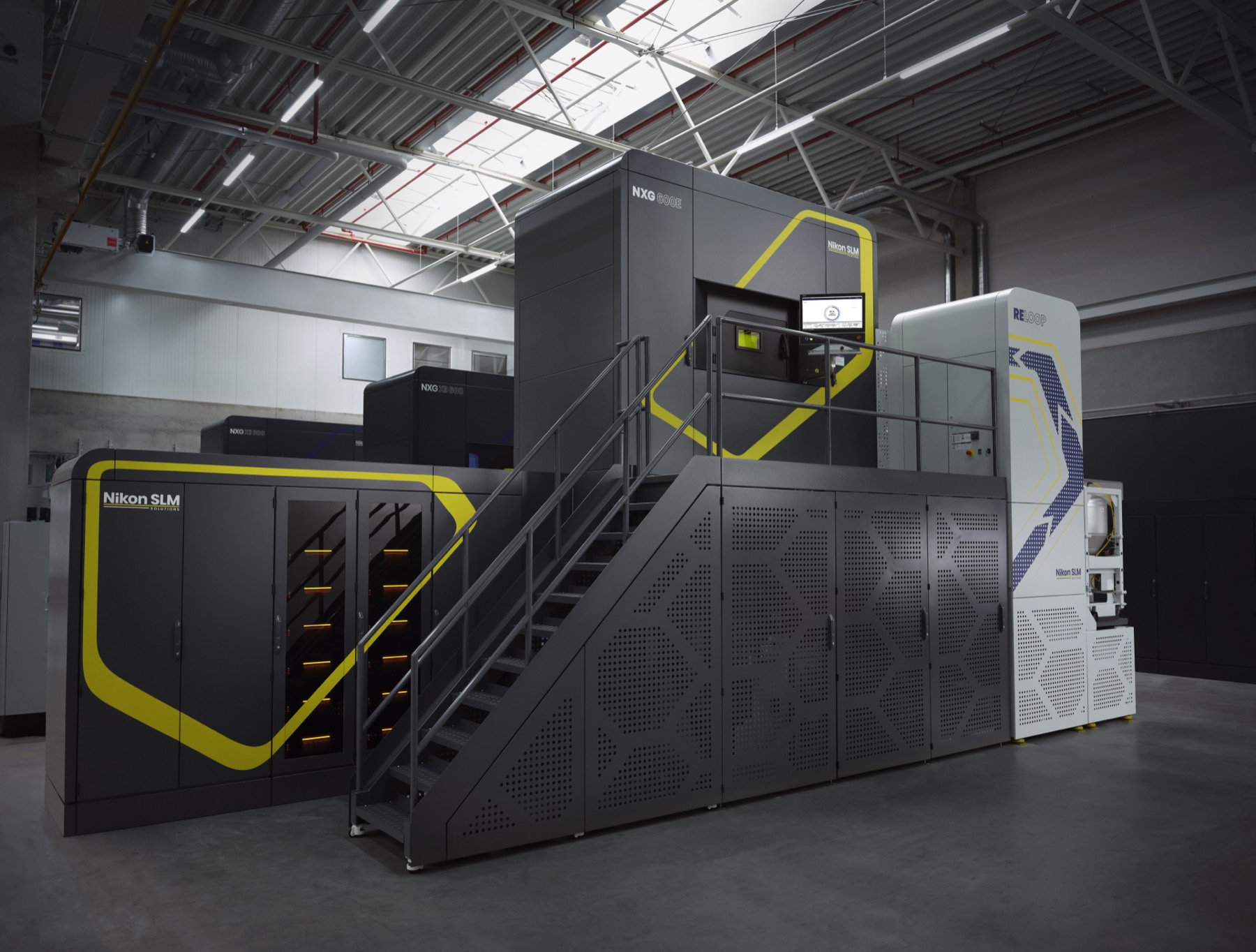
Dr. Behrang Poorganji, Nikon Advanced Manufacturing’s vice president of technology, said the company’s flagship L-PBF machines are the NXG XII 600 and the NXG 600E, with the latter having a larger build envelope. “The build envelope of two feet by two feet by two feet and two feet by two feet by five feet brings a lot of opportunity specific to aerospace and defense applications, and that’s why we are seeing a lot of customers showing interest. In total, more than 1,000 machines are out in the field.”
Metal AM systems, such as L-PBF machines, create new capabilities and options for design engineers, Poorganji said, enabling them to develop more optimized designs that offer the benefits of part consolidation, inventory reduction, enhanced part performance and lightweighting. “Especially lightweighting for new weapons systems or defense applications means you could have a higher payload, or, with the same payload, you can have more fuel so you can go further out.”
With this type of manufacturing methodology, end users can produce parts faster, make them with higher functionality and at a lower cost than previously, according to Poorganji. “Whereas historically, we often have to sacrifice one for the other.”
Metal AM is not only used to create highly complex structures that would otherwise be impossible, he added, it is also being used to produce less intricate parts. “It makes sense because of the lead time, because of the availability, because of the accessibility, because the time from design to production is very short, and this is not something that in casting and forging and machining work we are able to achieve.”
The capability to quickly and economically produce parts is particularly advantageous in a time of conflict when blueprints, CAD files or even drawings are unavailable, Poorganji said. “You can do reverse engineering. You can make those parts with AM significantly faster — significantly cheaper — than if you go to a casting or start grinding down material out of a rod or forged bar.”
Nonetheless, he emphasized that metal AM is not a replacement for conventional production that satisfies all manufacturing needs. “Additive manufacturing is more of a tool in a toolbox for us when we do manufacturing. We just need to know how to use it to our benefit to expand capacity and capabilities.”
Mixed Manufacturing
CTC’s Criado concurred that metal AM and conventional manufacturing methods are great technologies that augment each other. “Additive manufacturing is good because you can build something from nothing, but currently most AM machines can’t compete with the surface finishes that a subtractive machine can offer without including additional post-process steps.”
In its 2026 AM report, AMT stated that few additive parts exit a machine ready for deployment. In many industrial applications, AM functions as a near-net-shape process. The printed part forms the base geometry, while conventional manufacturing methods complete critical surfaces, tolerances and material properties. As a result, AM often becomes one step within a larger production workflow rather than a stand-alone manufacturing solution. Typical post-processing operations may include:
- build plate separation using wire EDM, band saws or similar cutting tools;
- powder evacuation, often performed using depowdering systems or manual finishing processes;
- thermal processing — such as stress relief, heat treatment, debinding or sintering using industrial furnaces;
- densification processes — such as hot isostatic pressing — for certain metal components;
- CNC machining operations to achieve final tolerances and critical surfaces, and
- surface finishing or coating processes, such as blasting, polishing or protective coatings.
These steps extend the overall production workflow beyond the build itself and may introduce additional capital equipment requirements. For organizations that already maintain machining and finishing infrastructure, these processes may integrate naturally. For others, AM can trigger secondary equipment investments that rival or exceed the cost of the printer itself.
With hybrid AM, in which material is added and subtracted in the same process, CTC can reduce secondary machining operations when producing and repairing parts, but the uniqueness of the process is the combination of the two technologies. CTC’s hybrid AM technology, or directed energy deposition (DED), employs the AMBIT system from Hybrid Manufacturing Technologies. This enables a CNC machine (CTC’s version) or a robot variant to use nontraditional laser-based additive processing heads in the spindle and changes between them and the more traditional cutter heads. The hybrid laser-based additive equipment uses a combination of a laser as the energy source to deposit metal powder. Other variations include laser and wire as the feedstock, along with electrical arc, such as MIG welding, among others, to deposit material during the additive phase.
Criado explained that the DED process enables CTC to add material to a workpiece and then switch to subtractive machining during the process and achieve the specified surface finishes and tolerance requirements, as well as create smooth internal passages and features.
To repair expensive and/or difficult-to-acquire components, Criado said CTC utilizes several processes, including a high-pressure cold spray system. This process deposits metal powder with temperatures below the material melting point via a supersonic flow created by a pressurized and heated inert gas stream. CTC has a Gen III Max cold spray system from VRC Metal Systems, which is primarily used on a programmable robotic arm, but can be manually operated to do one-off sprays and area-based cladding work. “It doesn’t really make sense to go ahead and write a lengthy program for a one-off unique repair.”
As the cold sprayed powder particles plastically deform upon impact with the workpiece, they interlock into the different features creating the bond to the substrate and surrounding particles, he explained. Because the particles are kept below the melting temperature, unlike when thermal spraying, a wide range of different materials can be combined, such as depositing aluminum or copper onto steel.
While improvements are being made through technological developments and powder control, the potential for internal porosity is an issue for metal AM, according to Criado. Porosity could act as a stress concentrator, create surface roughness or generate small surface fissures, areas that are prone to crack and corrosion propagation.
Random porosity is a big downfall, but Criado said part designers can engineer voids into a build to create a gradient structure. This design feature can offer a dense and hard surface structure that can handle any impact with another segment behind that one made of the same material at the same time, but with voids able to offer some elastic deformability to arrest shocks or connected channels for heat removal. “You can start using the same build to not only be structurally strong but also remove heat while maintaining a lightweight structure.”
Metal AM’s Place in the Toolbox
In its 2026 report, AMT stated that AM adoption is no longer a question of hype or inevitability. It’s a question of fit. Manufacturers are dealing with unstable supply chains and limited domestic capacity, made worse by reshoring efforts. These pressures are exposing gaps in traditional production systems. AM stands out because it can fill some of those gaps in ways conventional processes were never designed to address. The most successful manufacturers won’t ask whether AM can replace what they already do well. Instead, they focus on where their systems start to break down — where tooling slows progress, lead times create risk or design limits performance — and apply AM in those situations. AM delivers value not as a universal solution, but as a targeted capability that expands what’s possible within a broader production system. For some manufacturers, AM will remain a targeted solution for legacy and bridge production. For others, it will become integrated into capital planning and new product development workflows. And for others still, it simply won’t fit their needs. The determining factor is alignment between operational pressures and technology deployment.
Criado emphasized that metal additive manufacturing is growing rapidly as more types of powder materials are being developed and more capable machines are being introduced, leading to broader adoption across industries.
Previously, a lot of ambiguity and uncertainty hovered around metal AM, while at the same time proponents heaped on hype and unachieved promises, Nikon’s Poorganji said. “We passed those times. We have more use cases, successful demonstrations of AM. We have higher productivity machines, higher reliability machines with greater repeatability in terms of performance. Those are helping realize the value proposition of additive manufacturing by many more companies and many more applications.”
about the author: Alan Richter, a 40-year veteran journalist, has spent the last 25 years covering the metalworking industry for Cutting Tool Engineering and currently serves as its editor-at-large. Contact him at alan@ctepubs.com.
contributors
AMPOWER GmbH & Co. KG
+49 40 99999 578
Review the print ads from this magazine to continue
This quick advertiser review unlocks the rest of the article and keeps the full-screen reader focused on the ads instead of the page chrome.
Advertisers included in this article experience
Print placements connected to this article
Star Cutter
Star Cutter print ad
Print ad listed on page 19 of the August 2026 issue.
View this placement in the issue recordGreenleaf Corp.
Greenleaf Corp. print ad
Print ad listed on page 20 of the August 2026 issue.
View this placement in the issue recordGreenleaf Corp.
Greenleaf Corp. print ad
Print ad listed on page 21 of the August 2026 issue.
View this placement in the issue recordContinue reading
August 2026
AMT – The Association For Manufacturing Technology
703-893-2900
Concurrent Technologies Corp. Inc.
866-404-3463
Nikon Advanced Manufacturing Inc.
650-508-4674
captions:
(11 – Nikon SLM Manufacturing Floor.jpg) Credit: Nikon Advanced Manufacturing
The manufacturing area at Nikon SLM Solutions.
(IMG_2621A – sample (2).jpg) Credit: Nikon Advanced Manufacturing
A sample 3D-printed part from Nikon Advanced Manufacturing.
(10 – Nikon SLM NXG600E (1).jpg) Credit: Nikon Advanced Manufacturing
The NXG 600E selective laser melting machine from Nikon SLM Solutions includes a dozen 1,000-watt lasers.
(DLA picture2 – for 4_14 post.jpg) Credit: Nikon Advanced Manufacturing
Behrang Poorganji is vice president of technology for Nikon Advanced Manufacturing.
(CTC AMBIT-2446.jpg) Credit: Concurrent Technologies
CTC’s AMBIT direct energy deposition system is paired with a Haas VF-11 five-axis milling machine. The working envelope is approximately 120″ × 40″ × 30″ for large part repair or feature addition.
(CTC Eash-SLM-5934.jpg) Credit: Concurrent Technologies
With the SLM 280HL 3D printing machine, CTC creates metal parts using various materials, including aluminum, titanium, stainless steel and cobalt-chromium.
(CTC Matt Criado-5506.jpg) Credit: Concurrent Technologies
Matt Criado is manager, advanced manufacturing at CTC.
Pull quotes:
‘Additive manufacturing is more of a tool in a toolbox for us when we do manufacturing.’
‘Additive manufacturing is good because you can build something from nothing, but currently most AM machines can’t compete with the surface finishes that a subtractive machine can offer.’
Related



 MFGAxis Discussion
Be part of the shop-floor conversation
Like, save, or comment on this CTE story.
MFGAxis Discussion
Be part of the shop-floor conversation
Like, save, or comment on this CTE story.


MFGAxis Discussion