Skip to content
Operation / Process

Fabrication & Cutting

Optional: narrow results to one content type.
Select one or more.
Select one or more.
Select one or more.
Reset

Latest in Fabrication & Cutting

Machinability of Sintered Steel: Drilling Performance
Article February 1, 1999 E. Gorzkowski
Machinability of Sintered Steel: Drilling Performance
Researchers from Lehigh University report the results of drilling tests conducted using sintered steel samples. The samples were prepared using different machinability-improving additives. The results showed that sintered steel with low-alloy steel and resulferized sintered steel are nearly as machinable as wrought steel.
PVD Coatings for Turning
Article February 1, 1999 P.C. Jindal
PVD Coatings for Turning
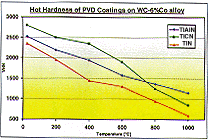
Researchers report on their study of coating performance. Their tests of TiN, TiCN and TiAlN coatings involved turning Inconel 718, medium-carbon steel and ductile cast iron. The wear rates and failure mechanisms of the coated tools are compared.
Use a Saw to Upgrade Your Cutoff
Article March 1, 1998 Friedhelm Greulich
Use a Saw to Upgrade Your Cutoff
Rotary saw cutting (RSC), using a self-contained, motorized attachment that is mounted in a machine's standard cutoff position, can provide an alternative to single-point tooling for cutoff operations. This article details the ways that RSC provides results that are better than single-point tooling while advising readers on ways to optimize the operation.
Harder, Faster: Turning Performance
Article March 1, 1998 Tim Malone
Harder, Faster: Turning Performance
The growing use of difficult-to-machine materials has driven the metalcutting industry to high-performance tools. This article reviews the trends that are behind most cutting tool research today, and it looks at the state-of-the art results of that research.
Top-Form Geometry: Turning Performance
Article March 1, 1998 Karl Katbi
Top-Form Geometry: Turning Performance
This article makes the argument that an insert is really a system made up of a combination of factors. The focus of the article is on one of these factors: the top-form geometry, which has evolved from the chipbreaker designs used primarily on turning inserts.
Good News About Eta Phase
Article February 1, 1998 Michael Weiner
Good News About Eta Phase
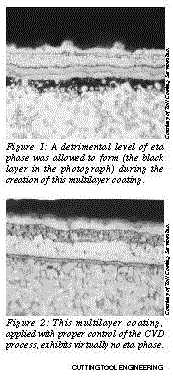
The presence of an eta phase between a coating and the substrate is generally considered harmful to coating adhesion. However, this article argues that when the formation of the eta phase is carefully controlled, it can actually enhance adhesion. The conditions that promote the formation of beneficial eta phase are explained.
Amorphous Diamond Shapes Up: Drilling Performance
Article August 1, 1997 Richard Horsfall
Amorphous Diamond Shapes Up: Drilling Performance
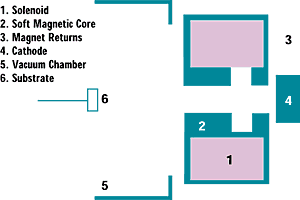
Amorphous diamond coatings can offer performance close to that of CVD diamond film at a fraction of the cost. This article describes the amorphous diamond coating process and the coating that is produced. A comparison to CVD diamond coatings is also presented.
Behind the Carbide Curtain
Article August 1, 1997 Phillip Craig
Behind the Carbide Curtain
Many end users would like to see carbide tool standards that would ensure consistent quality in tools from shipment to shipment or between manufacturers. Today's C and ISO designations do not provide this assurance, according to this article.
Consider the Source: Drilling Performance
Article April 1, 1997 John Pfeiffer
Consider the Source: Drilling Performance
This article discusses the various sources of machining information available, and the body of knowledge on which each type of source bases its recommendations. Emerging sources that make use of such innovative media as the Internet also are discussed.
Grinding Your Teeth
Article March 1, 1997 John Whalen
Grinding Your Teeth
CNC bandsaws are designed to run for long periods unattended. This is only possible if the blades used are reliable and long lasting. According to this article, bimetal blades with ground teeth fit the bill. The article describes how these blades are made and what makes them different from conventional blades with milled teeth.
Should You Try Dry?: Drilling Performance
Article February 1, 1997 Christina Dunlap
Should You Try Dry?: Drilling Performance
Cutting without metalworking fluid is looking increasingly attractive to U.S. shops hit with the high cost of fluid maintenance and disposal. This article discusses the benefits and drawbacks of dry machining and outlines the tools and equipment needed to machine successfully without the benefits of a coolant or lubricant.

Keep exploring