
Skip to content
Operation / Process

Fabrication & Cutting

Optional: narrow results to one content type.
Select one or more.
Select one or more.
Select one or more.
Reset

Latest in Fabrication & Cutting

Consider the Source: Drilling Performance
Article April 1, 1997 John Pfeiffer
Consider the Source: Drilling Performance
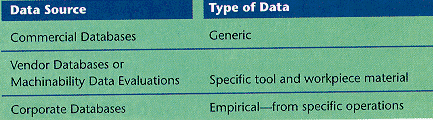
This article discusses the various sources of machining information available, and the body of knowledge on which each type of source bases its recommendations. Emerging sources that make use of such innovative media as the Internet also are discussed.

Grinding Your Teeth
Article March 1, 1997 John Whalen
Grinding Your Teeth
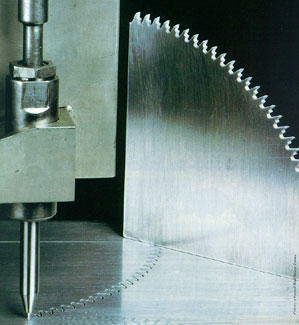
CNC bandsaws are designed to run for long periods unattended. This is only possible if the blades used are reliable and long lasting. According to this article, bimetal blades with ground teeth fit the bill. The article describes how these blades are made and what makes them different from conventional blades with milled teeth.
AWJ Options: 5-Axis Machining
Article February 1, 1997 Richard Ward
AWJ Options: 5-Axis Machining
There are many good reasons a shop might choose to purchase an abrasive waterjet machine. However, as this article explains, many factors must be considered to determine if the investment makes economic sense. The article discusses how and when a shop can adopt AWJ profitably and it explores the possibility of achieving the same results more cost effectively by subcontracting the work to an AWJ specialty house.
New Coatings Meet New Challenges
Article February 1, 1997 Don Graham
New Coatings Meet New Challenges
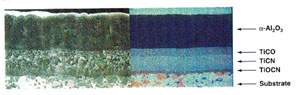
As the use of hard-to-machine work materials grows, the need for high-performance tool coatings increases. This article discusses developments in coatings that have increased their usability. Among the coatings discussed are medium-temperature CVD coatings and multilayer PVD coatings.
Should You Try Dry?: Drilling Performance
Article February 1, 1997 Christina Dunlap
Should You Try Dry?: Drilling Performance
Cutting without metalworking fluid is looking increasingly attractive to U.S. shops hit with the high cost of fluid maintenance and disposal. This article discusses the benefits and drawbacks of dry machining and outlines the tools and equipment needed to machine successfully without the benefits of a coolant or lubricant.
Beyond Cool: Turning Performance
Article September 1, 1996 K.P. Rajurkar
Beyond Cool: Turning Performance
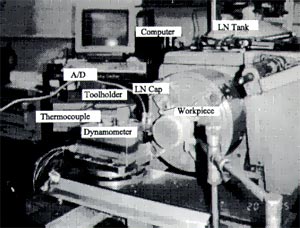
Researchers tried bathing inserts in liquid nitrogen to keep them cool while cutting hard-to-machine materials. This article reports the results of this experiment. It shows how the use of cryogenic coolant can keep temperatures down and prolong tool life while machining titanium aluminum vanadium and reaction-bonded silicon nitride.
Ceramics Get Tough: Turning Performance
Article September 1, 1996 Joseph Halloran
Ceramics Get Tough: Turning Performance
Improvements in cermet and ceramic inserts have made them a good choice for high-speed milling. This article describes how the compositions and designs of these newer inserts make them tough enough to withstand the punishment of a milling operation while maintaining the hardness that makes them wear-resistant.
Powder Particulars: General Industry Coverage
Article June 1, 1996 Norman Rohr
Powder Particulars: General Industry Coverage
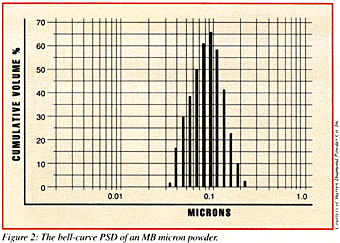
This article describes the shapes and sizes of diamond particles produced through standard manufacturing processes. The uses for these different types of particles are also explained, with an emphasis on particles used in superfinishing powders and slurries.
Saw Change: General Industry Coverage
Article March 1, 1996 Ann Marie Rooke
Saw Change: General Industry Coverage
Blades for contour bandsawing vary in their materials, their tooth set and selection, their width and the way they are welded. This article discusses how each of these variables contributes to the blades' ability to cut intricate shapes without seizing or wearing prematurely. Blade lubrication is also covered.
Stress Management: General Industry Coverage
Article March 1, 1996 Louis Caldarera Jr.
Stress Management: General Industry Coverage
High-performance aluminum-alloy workpieces are prone to residual stresses that can lead to part distortion. This article reviews the milling tools and practices that affect these stresses. Some tools and practices alleviate the stress, while others allow the machinist to mill the part without adding more stress.
The Time is Right for Cermets
Article March 1, 1996 Ronald Biagiotti
The Time is Right for Cermets
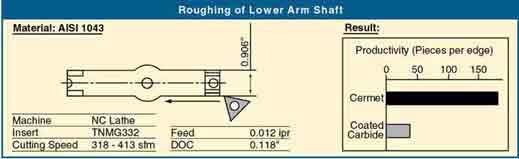
Cermet inserts have evolved into cutting tools capable of finish-turning steel reliably at high speeds. This article traces the developments that have led to modern cermets and describes the properties that enhance the performance of these tools. The development of coatings for cermets is also covered.
A Bend in the Stream
Article February 1, 1996 John Olsen
A Bend in the Stream
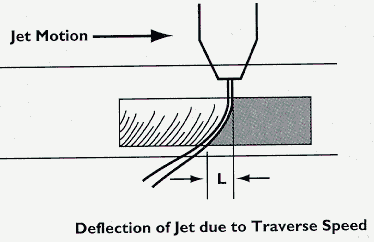
Programming a cut with an abrasive waterjet is complicated by the fact that the stream of water deflects as it passes through the workpiece. This article describes newer controller technology that can adjust the traverse speed to minimize deflection at corners and curves.

Keep exploring