After acquiring my first iPhone, I searched the Internet for apps to use in the shop. I found 70 hits for "machinist" or "machining" and 45 for "cutting tool." Conversely, there were 11,169 hits for movie apps and 37,616 for music apps.
A shop I once worked at had a beautiful cast iron welding table. It was 5' wide × 12' long and had started life as a surface plate for assembling diesel engines. The owner bought it at auction for $100. With a screen in the middle, two guys could work on it at once.
I strive to start each year on a positive note, but 2015 sure hasn't taken long to throw us our first challenging management scenario. It requires immediate oversight of rapidly changing economic conditions.
The cutting zone in a machine tool is dangerous. Hot chips and large quantities of coolant are often safety threats, but a tool rotating at a high speed is an even greater one.
When an endmill efficiently makes chips, everybody is happy: the end user, the parts buyer, and the cutting tool manufacturer and distributor. Achieving that by having the tool follow the correct toolpaths and run at productivity-boosting parameters, however, requires an endmill with optimized geometry, substrate and coating.
Efficient removal of heat from the tool/workpiece interface is the main route to high-productivity machining. Several conventional methods are available to accomplish that -- dry machining, minimum-quantity lubrication, flood coolant and high-pressure coolant -- but cryogenic machining can be added to the list.
Dear Doc: I battle burn and long cycle times when grinding ODs in bearing. The wheel manufacturer has specified a series of wheel changes to solve the problem, but it means buying a lot of new wheels. What's your take?
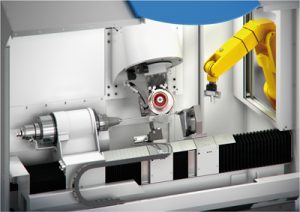
Schütte announces the introduction of its new 325<em>linear </em>machine, a 5-axis CNC grinder with extended X- and Y-axis movement plus two auxiliary slides for workpiece clamping and improved grinding wheel guidance over the entire machining envelope.