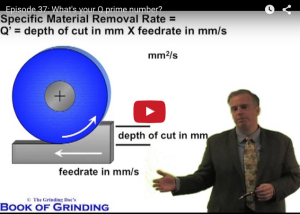
A shop that grinds tungsten-carbide endmills using a resin-bonded diamond wheel turned to Dr. Jeffrey Badger for the 37th episode of Cutting Tool Engineering magazine's Grinding Doc Video Series because one of the shop's wheel suppliers was talking about Q prime values. According to the supplier, the shop should be using a Q prime value of 6 or 7. So the shop asked the Grinding Doc, "What's up with Q prime values?"
When I read about The Brookings Institution's proposal to develop 20 U.S. manufacturing universities, my first thought was "what will the mascots be for the football teams?" Purdue already has the time-honored "Boilermakers" moniker but what about the others? Would they be the Michigan Machinists, the Caltech CAD/CAMs, the Lehigh Lasers or, maybe, the Fightin' Facemills?
High-performance cutting tools can provide increased efficiency and productivity, but they can also be a drain on tooling budgets. Cost-justifying these tools often requires regrinding and reconditioning them when they are worn or damaged. A successful reconditioning program reduces tooling costs by extending life as long as possible.
Continuing and concluding the theme of my previous two columns, this month's installment provides additional tips for enhancing the operation of a manual milling machine.
Provide centerless grinding machines that can produce parts with continually tightening size and surface finish requirements. Customized coolant filtration equipment.
Milling sounds range from loud to quiet, and experienced machinists <br />often use those sounds to judge what is occurring in the cutting zone. It is difficult to position a sensor such as an accelerometer or a displacement probe close to the cutting zone, and it is often a challenge to see the cutting zone, but the sounds are pervasive.
Drilling cross-holes in some parts is no big deal. These are often simple parts, such as aluminum valve bodies, where the holes aren't too deep and meet on-center, and the customer can live with a small burr at the intersection.
Imagine a gear milling method where the toolpath -- not the tool shape -- determines gear characteristics such as diametral pitch or pressure angle. A new concept, involute milling, provides that functionality while delivering machining efficiency and production versatility. The result is a "democratization" of gear milling, moving the process from single-purpose, dedicated machine tools to multipurpose machines that can produce small batches economically because no costly hobs or gashers are needed.