Blind Resources
Resources
Blind Resources
Explore 35 published CTE resources related to Blind across 4 articles, 25 products, 2 videos, and 4 news items.
4
Articles
25
Products
2
Videos
4
News
Articles
4 articles
Products
25 products
Videos
2 videos
News
4 news items
Browse
Browse all Blind resources
Browse results
Eyes wide open: General Industry Coverage
Several weeks ago, my wife and I attended a dinner party at her sister's home. One of the guests heard I was in manufacturing and introduced himself. He's 48, married and has five children and a mortgage. He's a pleasant individual, and we spoke about his trials and tribulations over the last few years. He lost his job during the Great Recession and has since been struggling to find a steady job. Unemployment checks and odd jobs, as well as assistance from their church and friends, have helped his family muddle along. His experience is in customer service and sales.
Measuring performance in real time
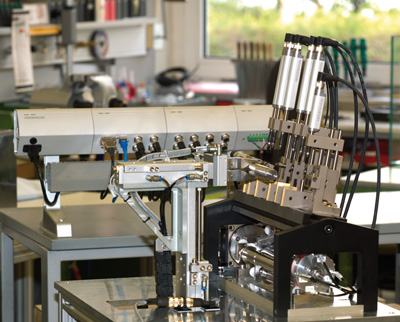
Real-time measurements during metalcutting can offer significant insight into machine tool performance. The parameters to be measured include position, velocity and acceleration of the axes; cutting force; sound; temperature; and acoustic emission, which is not the same as sound, but rather a high-frequency, structure-borne vibration.
Metal on metal: General Industry Coverage
A pump on a waterjet machine generates the high-pressure water needed for cutting by taking low-pressure water into a cylinder, compressing the water with a plunger and then pushing the high-pressure water out of the cylinder. During a pressure cycle of intake, compression and expulsion, high-pressure components and polymer seals see the water pressure jump from two-digit inlet pressures to outlet pressures in the tens of thousands of psi.
Compensation without cables: CMM Inspection
Thermal compensation of a coordinate measuring machine's principle structural components and the part being measured helps ensure measuring accuracy over an extended temperature range when the CMM is installed outside of a temperature-controlled area. Such a temperature-compensation system is comprised of temperature sensors and cabling running through the machine to its controller. The more sensors there are the more accurate the system, but these cables can cause mechanical issues and will eventually fray or break because of the constant CMM motion.
Going toe to toe on robotics
One fond memory from my long-ago youth was playing Rock'Em, Sock'Em Robots with my next-door neighbor. My parents wouldn't get me the game, for reasons I forget, but my friend Ronnie, who always got the latest, greatest games and toys, had a brand-new version. The objective was to manipulate your plastic robot to knock out the other robot by hitting his spring-loaded head, making it pop up.r In January, the robotics industry was playing Rock'Em, Sock'Em Robots with CBS's "60 Minutes." The news program broadcast a segment called "Are robots hurting job growth?" based in large part on an interview with Erik Brynjolfsson and Andrew McAfee of the Massachusetts Institute of Technology, and co-authors of the 2011 book, "Race Against the Machine."
Picking low-hanging CNC ‘fruit’: 5-Axis Machining
As someone who visits job shops and manufacturers almost daily, I know why some are thriving, while others struggle. The ones that are thriving have invested and continue to invest in equipment, software, training and consulting services. Those struggling often say, "I would invest more in these areas, but I can't afford them because my competitors keep underbidding me. They must be giving parts away."r More often than not, owners of thriving shops are not underbidding their competitors -- they're out-machining them. They are taking full advantage of all the competitive benefits made available by their machining systems and advice from consultants to operate more profitably. In short, they've learned to pick the low-hanging fruit available to them and reinvest their profits to bring even higher fruit within easier reach.
Hard metal machines
All metals are not created equal. Therefore, neither are the machine tools for cutting them. Parts for extreme aerospace applications, such as in engines, landing gear and flap tracks, must be made of a heat- and corrosion-resistant metal, which typically has a high Young's modulus of elasticity and is difficult to machine. These include titanium, stainless steel and high-nickel alloys.r The "hard metal" machines that process the parts must be stiff, typically requiring a large mass, and have a large servomotor to create lots of thrust. They also need a high-torque spindle to effectively move the cutter through the material and a high thrust load on the axes of the ballscrews, which often have a low 8mm pitch, to offer an effective mechanical advantage, according to Scott Walker, president of machine tool builder Mitsui Seiki USA Inc., Franklin Lakes, N.J. He explained that the machines are built that way because aerospace customers typically run them slower than 600 rpm, require around 2,000 ft.-lbs. of torque and take maximum chip loads from 0.002 to 0.006 ipt. "So you build this big, rugged machine," Walker said.
Chuck the chips: Turning Performance
The process of displacing metal instead of cutting it is called many things. But whether they call it form tapping, cold form tapping, thread forming, cold roll forming, roll forming, thread rolling, roll tapping or cold roll tapping, many metalworking professionals are unfamiliar with it, according to Peter Gennuso, applications engineering supervisor for OSG Tap & Die Inc., Glendale Heights, Ill.
Trending toward productivity: Medical Manufacturing
The U.S. economy appears to be on the mend. In January, the Manufacturers Alliance for Productivity and Innovation gave a tentative thumbs up to sustained business expansion through the first half of 2013. And the Institute for Supply Management's manufacturing index rose again in January, painting an optimistic picture. Maybe it's time to buy that machining center you've been thinking about.r Before you whip out your checkbook, though, some homework is in order. There's a lot more to machining centers than spindle speeds and rapid traverse rates. Sure, you've had good results over the years buying machines based on that, but that might be the wrong criteria in this brave new manufacturing world. You're facing growing competition from overseas and down the street, so you owe it to yourself to take a look at what's changed in the years since you bought your tried and true 20"×40" vertical machining center.
Gap guidance: General Industry Coverage
The spark gap is the physical distance the electric current has to jump off the wire to burn the workpiece when wire EDMing. Controlling the spark gap is critical to achieving required part dimensions and surface finishes. Variables that impact the spark gap include the workpiece material and thickness, wire diameter and type, and part tolerance and surface finish requirements.r The wire EDM process is physically unstable because of the constant advancement and retraction of the axes. "Wire EDMing does not have or function with a set feed rate like a milling operation," said Brian Pfluger, EDM product manager for Makino Inc. at the company's Auburn Hills, Mich., facility. Wire EDMing requires a combination of small mechanical and, especially, electrical changes to occur thousands of times per second to be stable and consistent, he added. Makino is headquartered in Mason, Ohio.
Power play: Turning Performance
Like most machine tool builders, Mori Seiki Co. Ltd. is focused on making its machines more energy efficient. In addition, the company is focused on making the factories that make those machines more energy efficient. For example, Nagoya, Japan-based Mori Seiki is implementing energy-reduction programs and equipment at its operations in Iga, Japan.r The Iga campus' goal is to reduce electricity consumption by 30 percent in 2013 compared to 2012. The campus has already reduced energy consumption 10 percent by installing high-efficiency air conditioners, switching from mercury lamps to high-efficiency fluorescent lamps and operating compressors more efficiently.
Machine Tool product review for March 2013
A collection of machine tool products compiled by the editors of Cutting Tool Engineering magazine.