

Laser power is clean, precise and versatile
Even with its drawbacks, laser machining will continue to find new industrial applications.
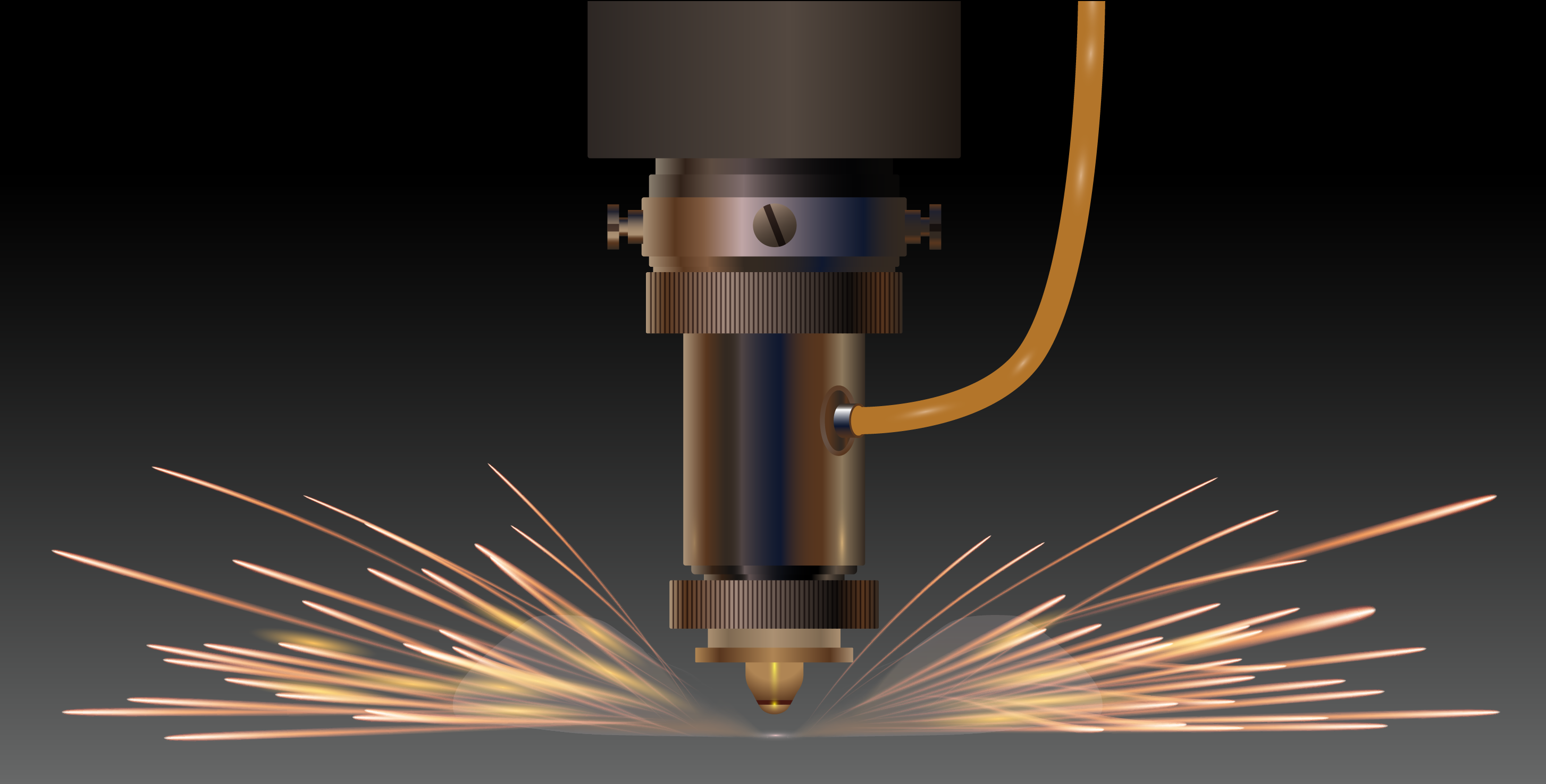
In 1917, Albert Einstein published the first paper recognizing the science behind lasers. After several decades of research and development, Theodore Maiman demonstrated the first functioning laser at Hughes Research Laboratories in 1960. By 1967, lasers were being used to drill holes in diamond dies and cut metals. Laser power offers benefits that have made its use common in modern manufacturing.
Lasers are used to cut many types of materials besides metals, and laser cutting has become an important part of the modern sheet metal shop. Before the technology was readily available, most shops relied on shearing and punching to create workpieces from flat materials.
Shears come in several styles, but all make single, linear cuts, requiring multiple setups to create a part. When curved shapes or holes are needed, shearing is not an option.
Punching is the operation of choice when a shear cannot be used. Standard punches come in various round and rectilinear shapes, and when the desired shape is nonstandard, specials can be made. For complex shapes, a CNC turret punch would be used. The turret holds a few different types of punches that, when combined in sequence, give the desired shape.
Unlike shearing, laser cutters can generate any desired shape in a single setup. Programming a modern laser cutter is only slightly more difficult than using a printer. Laser cutters eliminate the need for dedicated tools like special punches. Removing special tools decreases lead times, inventories, development costs and the risk of obsolete tooling. Laser cutting also eliminates the costs associated with sharpening and replacing punches and maintaining the cutting edge of a shear.
Laser cutting is a noncontact activity as well, unlike shearing and punching. Forces generated during shearing and punching cause burrs and part deformation, which must be treated with secondary operations. Laser cutting does not apply any force to the raw materials, and many times laser-cut parts do not require deburring.
Other flexible thermal cutting methods like plasma and oxyfuel are available, and they are generally less costly than laser cutters. However, in all thermal cutting operations there is a heat-affected zone, or HAZ, in which the chemical and mechanical properties of the metal have changed. The HAZ can weaken materials and cause issues with other operations, such as welding. When compared with the other thermal cutting technologies, laser-cut parts have a tiny HAZ and reduce or eliminate the secondary operations needed to treat it.
Lasers are good for not only cutting but joining. Laser welding offers many advantages as opposed to more conventional welding processes.
Review the print ads from this magazine to continue
This quick advertiser review unlocks the rest of the article and keeps the full-screen reader focused on the ads instead of the page chrome.
Advertisers included in this article experience
Print placements connected to this article
mtseries.com | 800.733.3976
THE MANUFACTURING TECHNOLOGY SERIES:
FOUR REGIONS. ONE MISSION. The Manufacturing Technology Series connects decision makers from diverse industries with leading suppliers of advanced manufacturing technology, equipment and tooling. Don’t miss the most important manufacturing technology events in the U.S. Oct. 5-7, 2021 Oct. 19-21, 2021 Oct. 26-28, 2021 Nov. 16-18, 2021.
THE MANUFACTURING TECHNOLOGY SERIES: FOUR REGIONS. ONE MISSION. The Manufacturing Technology Series connects decision makers from diverse industries with leading suppliers of advanced manufacturing technology, equipment and tooling. Don’t miss the most important manufacturing technology events in the U.S. Oct. 5-7, 2021 Oct. 19-21, 2021 Oct. 26-28, 2021 Nov. 16-18, 2021 Houston, TX West Springfield, MA Greenville, SC Long Beach, CA mtseries.com | 800.733.3976 produced by
Visit mtseries.com | 800.733.3976 View this placement in the issue recordPrint ads from this magazine
FOUR REGIONS. ONE MISSION. The Manufacturing Technology Series connects decision makers from diverse industries with leading suppliers of advanced manufacturing technology, equipment and tooling. Don’t miss the most important manufacturing technology events in the U.S. Oct. 5-7, 2021 Oct. 19-21, 2021 Oct. 26-28, 2021 Nov. 16-18, 2021.
THE MANUFACTURING TECHNOLOGY SERIES: FOUR REGIONS. ONE MISSION. The Manufacturing Technology Series connects decision makers from diverse industries with leading suppliers of advanced manufacturing technology, equipment and tooling. Don’t miss the most important manufacturing technology events in the U.S. Oct. 5-7, 2021 Oct. 19-21, 2021 Oct. 26-28, 2021 Nov. 16-18, 2021 Houston, TX West Springfield, MA Greenville, SC Long Beach, CA mtseries.com | 800.733.3976 produced by
Continue reading
October 2021
As with cutting, welding creates a HAZ. Controlling its size, shape and properties is a must when making welds on critical components like those found in gas turbines or aerospace parts. Like laser cutting, laser welding has a very small HAZ, giving a distinct advantage compared with other welding technologies.
The nearest competitor to laser welding, tungsten inert gas, or TIG, welding, uses a tungsten electrode to create an electric arc that melts the metal being welded. The extreme conditions found around the arc cause the tungsten to deteriorate over time, resulting in varying weld quality. Laser welding is not subject to electrode wear, so the weld quality is more consistent and easier to control. Laser welding is the first choice for critical components and difficult-to-weld materials because the process is robust and repeatable.
Industrial use of lasers is not limited to cutting and welding. Lasers are used to create very small parts with geometry that is only a few micrometers in size. Laser ablation is used for removing rust, paint and other things from the surface of parts and for preparing parts for painting. Part marking with lasers is eco-friendly (there are no chemicals), fast and permanent. Laser technology is exceptionally versatile.
Everything comes with a price, and lasers are no different. Industrial laser applications can be very expensive compared with other processes. Although not as good as a laser cutter, a high-definition plasma cutter can create the same shapes and deliver clean edges with a small HAZ for a fraction of the cost. Entry into laser welding is also more expensive than other automated welding systems. A turnkey laser welding system easily can exceed $1 million.
Like all trades, it is difficult to attract and retain skilled craftspeople. Finding qualified TIG welders is a challenge. Finding welding engineers with laser experience is also difficult, and finding qualified laser welders approaches the impossible. It takes both experienced engineers and welders to develop robust welding operations.
Maintenance also can be very costly. Laser power generation and delivery require complex electronics and optics. Finding people capable of troubleshooting laser systems is not easy. It’s usually not a skill that can be found at a local trade school, so service can necessitate a visit from the manufacturer’s technician. Original equipment manufacturer technicians are busy, and long lead times are a common issue that hurts production schedules.
Although industrial laser applications can be expensive, the cost of ownership will keep improving. The number of small, inexpensive desktop laser engraving machines and the do-it-yourself plans for laser cutters are indicators that the cost of ownership is decreasing.
Laser power is clean, precise and versatile. Even when considering the drawbacks, it is easy to understand why we will continue to see new industrial applications.
Glossary terms in this article
Related


 MFGAxis Discussion
Be part of the shop-floor conversation
Like, save, or comment on this CTE story.
MFGAxis Discussion
Be part of the shop-floor conversation
Like, save, or comment on this CTE story.


MFGAxis Discussion