Taming data overload: People & Companies
Company turns to TDM Systems to control and optimize its tooling data.
When a company is part of one of the largest tool manufacturers, merely employing good technology is not enough. That is why Fair Lawn, New Jersey-based Sandvik Coromant Co. needed to more efficiently track and manage tools and streamline production at its Mebane, North Carolina, plant.
Julio Vasconcelos, engineering manager at the facility, said Sandvik Coromant, which belongs to Stockholm-based industrial engineering group Sandvik AB, emphasizes the requirement to control costs and optimize processes.
“We value digital solutions, lean manufacturing and efficiency,” he said.
The site employs 130 people in design, management, programming, engineering and production. There are approximately 20 five-axis machines, 10 lathes and two multiple-axis grinders in nearly 8,083 sq. m (87,000 sq. ft.) of manufacturing space. The plant produces about 3,000 tools — mostly standard rotary ones — each month and maintains data on tools that already were made and shipped. Over 2,000 primary tool assemblies, including tools, collets and holders, are used. Vasconcelos said this translates to a tremendous amount of data, and keeping track of it was increasingly a headache.
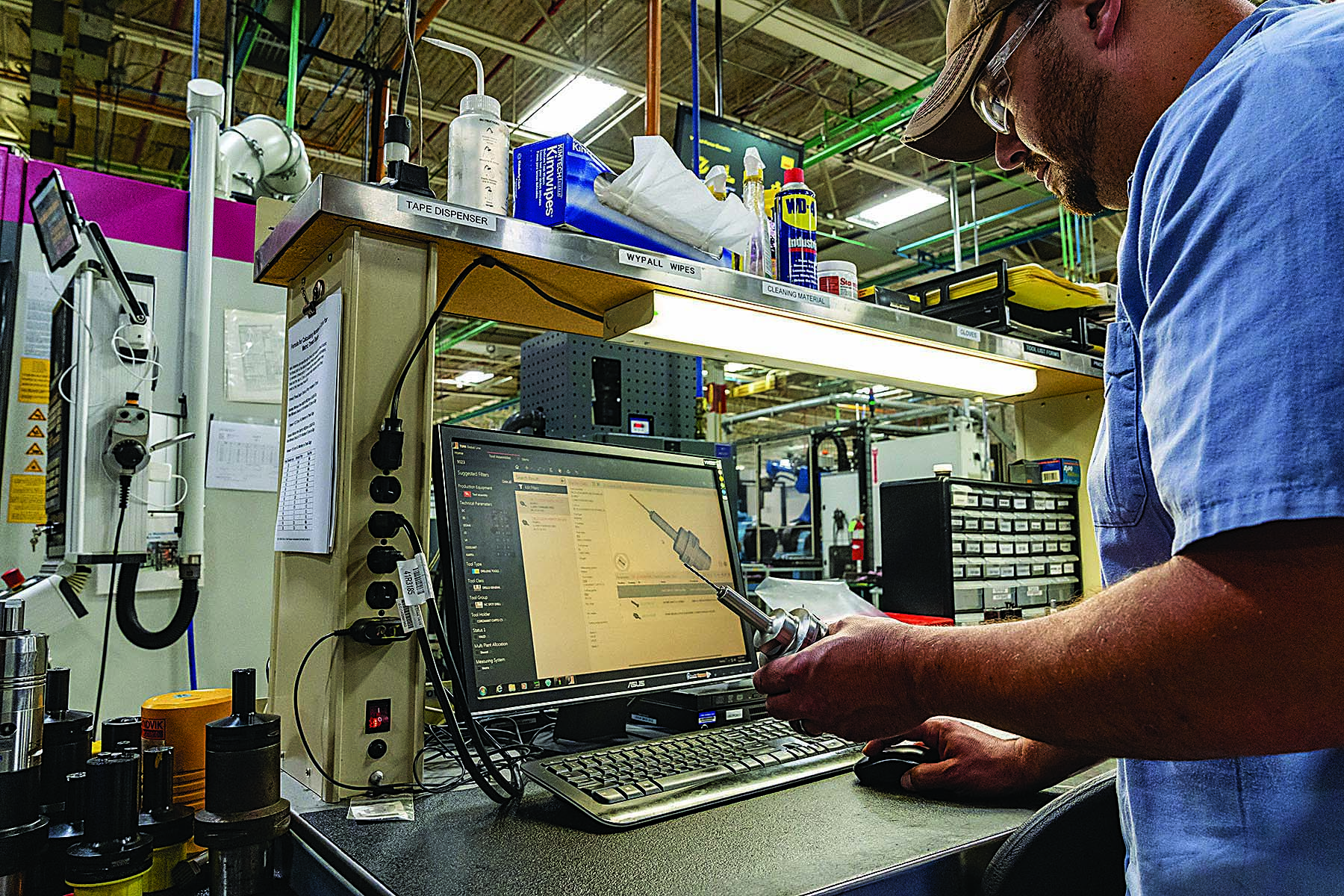
With tool data management software, Denny Page, machine operator at Sandvik Coromant, knows that the tool he is about to use is correct. Image courtesy of TDM Systems
“It became clear we needed a better way of managing that growing mountain of data and controlling the tools at the machine,” he said. “Historically, each engineer had their own way of controlling the tools and evaluating and presenting the info to the operators.”
Engineers frequently had to stop to check the tool assembly in the CAM system and at the machine tool, Vasconcelos said. The tool assembly often was different than expected because someone had failed to document a change or inform a manager that a change had occurred.
“Along with downtime, which of course translates into extra cost, at a certain point we realized just how much money we were spending on lost information,” he said. “There was some information stored in process documents for particular product lines, and there was information that resided in our CAM system, and there was also some information that resided only in Excel spreadsheets. Keeping track of that information was difficult. It just wasn’t efficient. It was challenging for our people to remember where to put everything, and everybody seemed to have a little bit different take on how particular tools were used. This too was a situation that was costing us time and money.”
Leandro Pereira, automation engineer at the site, remembers the situation well.
“Perhaps most detrimental was the fact that the information wasn’t necessarily being shared among different users,” he said. “For instance, information wasn’t always adequately communicated between NC programming and the shop floor. We didn’t have a database where the native information resided, so it would get changed or cloned or mutated. People were running off of secondhand information instead of the nativeinformation.”
Change obviously was needed, and identifying a solution fortunately was not difficult. Seven years ago, Sandvik started an extensive study on tool management and determined that tool data management software from Schaumburg, Illinois-based TDM Systems Inc., a subsidiary of the Sandvik Group, was the best choice for controlling and optimizing tooling data.
Review the print ads from this magazine to continue
This quick advertiser review unlocks the rest of the article and keeps the full-screen reader focused on the ads instead of the page chrome.
Advertisers included in this article experience
Print placements connected to this article
Cutting Tool Engineering
®
OPTIMIZED A COMPLEX ROUGHING PROCESS MADE SIMPLE.
® OPTIMIZED A COMPLEX ROUGHING PROCESS MADE SIMPLE. Visit ctemag.com to learn more.
Visit Cutting Tool Engineering View this placement in the issue recordPrint ads from this magazine
OPTIMIZED A COMPLEX ROUGHING PROCESS MADE SIMPLE.
® OPTIMIZED A COMPLEX ROUGHING PROCESS MADE SIMPLE. Visit ctemag.com to learn more.
Continue reading
January 2020
“Tool life cycle management ensures that tool data is available where it is needed, when it is needed,” said Robert Auer, director of business development for North America at TDM Systems. “It links CAM systems, presetting and crib systems, as well as machine controls, but it can also extend upstream to the planning and execution level, such as PPS, ERP and MES systems.”
He said TDM Systems’ software collects data from production and makes that data available to other systems.

Leandro Pereira, automation engineer at Sandvik Coromant, reviews TDM Systems’ tool data management database. Image courtesy of TDM Systems
“Sandvik Coromant Mebane is a very well-run facility, but they still had room for improvement,” Auer said. “The difference is that Mebane was determined to do something about it. The key driver for them was that they realized they needed to become more organized in terms of their tooling information.”
Becoming organized began with defining the tools. This was no easy task for the site with its thousands of tools and tool assemblies. But if NC programmers couldn’t search the database for information about the contents of the toolcrib, then they would have to go look for the tool or tools in question. The result would be lost time and increased costs.
After implementing tool data software, the facility found that those worries were gone.
“Using TDM tool graphics and equipment production modules takes the guesswork and uncertainty out of tool creation,” Vasconcelos said. “TDM allows managing the tool data from the CAM software to simulation through to the machine and operator. We needed a simulation system that sent info into CAM and ultimately to the machine tool operator. From TDM, we export files to our simulation program. Now the programmer can trust the tools he’s using and be confident that what is passed on to the operator from simulation is correct. In addition, TDM enables the operator to confirm that the tool assembly he plans to use is the correct one.”
Other issues arise during tool selection, such as determining which tools are best suited for different process steps. The tool data software helps engineers and designers quickly answer these questions by providing basic information about tools and potential applications. Besides aiding with tool selection for each NC operation, the software stores geometry and cutting data for each tool assembly, makes 3D tool graphics available for NC programs and simulation analyses and saves tool lists from the NC programs for future use.
“Keeping track of our thousands of tools and tool components used to be a headache and consume needless people hours,” Vasconcelos said. “Now we know what we need to stock in terms of cutting tools, tool assemblies, you name it, so that’s streamlined the purchasing function. TDM has become a vital part of our successful operation and an element in our vision of the future.”
— Article by TDM Systems Inc.
For more information about how Sandvik Coromant managed tool data and increased production, view a video presentation at www.ctemag.com.