

Take Back Time: 5-Axis Machining
Cavalier Tool & Manufacturing's investment in new capabilities pays off with benefits in cost cutting and increased productivity.
Cavalier Tool & Manufacturing’s investment in new capabilities pays off with benefits in cost cutting and increased productivity.
When times are tough, there’s only one way for manufacturers to get ahead: be aggressive and forward thinking in their business planning and investments. Cavalier Tool & Manufacturing Ltd. took this approach and has reaped the rewards ever since.
Courtesy of All images: Makino
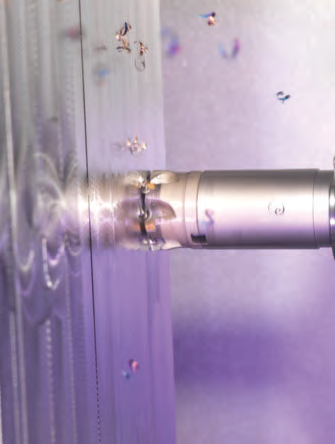
The Makino a92’s 10,000-rpm spindle, 1,969-ipm rapid feed rate and 0.4G acceleration/deceleration rate offer Cavalier Tool nearly three times the productivity compared to the moldmaker’s previous technology.
Established in 1975, Cavalier Tool, Windsor, Ontario, is a global manufacturer of mid-sized to large plastic injection molds for the automotive, commercial, recreational, medical and aerospace industries. It specializes in tooling for injection molding applications that use materials with high glass filler content, including fans, shrouds, radiator intakes, lighting tools, door carrier plates and door panels. The high glass content enhances stiffness, noted Brian Bendig, company president. Because the molding material is abrasive, the tooling is typically made of H-13 and sometimes S-7 tool steels.
“It’s important to know the capabilities you’re strong at and those where you could use some improvement,” Bendig said. “For the longest time, hardened material machining wasn’t our strong suit, and as such we relied heavily on outsourcing. However, once the economy took a turn for the worse, we decided it was time to regain control by investing in hard milling capabilities.”
Hard Milling, Easy Choice
Cavalier Tool was previously outsourcing machining of tool steel hardened to 48 to 52 HRC to a shop with a Makino A100 horizontal machining center, and Bendig was impressed with the machine’s speed, accuracy and finishing capability. So when it came time to reevaluate the company’s machining capabilities to recapture the hard milling work it was outsourcing, Bendig eyed Makino’s selection of HMCs.
“We had a lot of work coming through and had been researching machines for a couple of months,” Bendig said. He noted that the company has been happy with the results of its Makino SNC 86 graphite electrode mill. “Another reason we wanted a Makino was longevity and reliability. We knew a Makino HMC would be able to support our business well into the future. Our SNC 86 has been on the floor for 17 years, and it’s still very accurate and reliable.”
In June 2010, Bendig purchased a Makino a92 HMC based on its similar characteristics to the A100. The a92’s 10,000-rpm spindle, 1,969-ipm rapid feed rate and 0.4G acceleration/deceleration rate enhance productivity when producing large parts, according to Bendig. Its rigid construction provides positioning tolerances as tight as ±0.00010 “, with ±0.00006 ” repeatability.
The machine has a 31 “×39 ” pallet and X-, Y- and Z-axis travels of 59 “, 49 ” and 53 “, respectively, to handle workpieces up to 59 ” in diameter and height and weighing up to 6,600 lbs. Its automatic pallet changer switches a pallet in 46 seconds, achieving spindle runtime of 92 to 96 percent on a 24/7 basis.
A Welcomed Addition
After the a92 arrived on the shop floor, Cavalier Tool saw an immediate impact because the machine enables quick setups. “A lot of times, the orientation of the glass in the molding process is an unknown during tool production,” Bendig said. “As a result, we have to be prepared to handle any engineering changes from the OEM that occur during our production process. This makes it critical for us to be able to setup and tear down parts as quickly as possible without disrupting our overall workflow.”
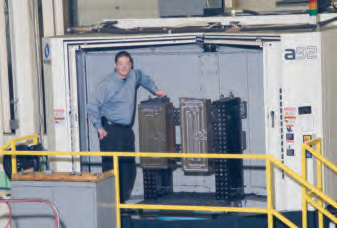
Brian Bendig, Cavalier Tool president, with his a92 horizontal machining center.
The a92’s automatic pallet changer and a rear-clamping fixture coordinate system enable the moldmaker to set up several parts on a tombstone without interrupting the current machining processes or losing positioning accuracy. The rotary B-axis table increases flexibility much like that of a 5-axis machining center but without the inherent reduction in accuracy, according to Bendig.
He added that because it’s difficult to predict the “warp and windage” of molded parts, Cavalier Tool often needs to put the mold back on the a92 several times to recut it and having two pallets enables a mold to be prepared on one pallet while the other pallet is in the machine. When a mold is ready for recutting, which usually takes an hour or two, that pallet is positioned in the machine and, after recutting is completed, the pallet with the original workpiece is swung into place. “It’s difficult to predict what shape the final molded part will take,” Bendig said. “We can get it very close but often need to tweak the mold 1mm or 2mm—sometimes as little as 0.2mm. Sometimes we cut the tool ‘wrong’ to make the part right.”
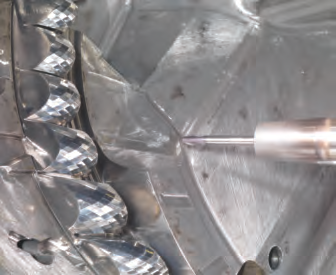
Every mold tool coming out of the a92 is pretapped, chamfered, engraved and with machined finishes that require little to no manual labor.
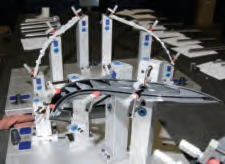
Cavalier specializes in applications with high glass filler content, including fans, shrouds, radiator intakes, door carrier plates, door panels and lighting tools, such as this one for an automotive head lamp.
Mike McNaughton, the shop’s machining supervisor, said: “The combination of programmable through-spindle coolant technology, 92-capacity automatic tool changer and B-axis rotary table enables us to perform several types of operations with fewer setups. This configuration allows us to do drilling, boring, thread milling, tapping, 2-D and 3-D machining without the operator ever touching the part. With jobs we’ve transferred to the a92, we’re typically seeing a 50 percent reduction in the number of setups and up to three times the productivity of previous processing techniques.”
The shop also tracks spindle utilization through “Pulse” machine monitoring software from Lemoine Multinational Technologies Inc. “All of our machines are monitored day in and day out through our Pulse monitor for performance tracking,” Bendig said.
Review the print ads from this magazine to continue
This quick advertiser review unlocks the rest of the article and keeps the full-screen reader focused on the ads instead of the page chrome.
Advertisers included in this article experience
Print placements connected to this article
Hornusa
HORN - THE LEADERS IN GROOVING TECHNOLOGY
FOCUS ON THE ESSENTIAL SYSTEM DR Urma licence Sensitivity instead of gross motor skills – this is the motto of the new HORN “System DR” reaming tools. Very narrow cutters, simple handling, and high repeatability when replacing inserts. A large selection of base material, coatings, and cutting geometries make the DR from HORN the perfect tool system for high precision bore machining
HORN - THE LEADERS IN GROOVING TECHNOLOGY FOCUS ON THE ESSENTIAL SYSTEM DR Urma licence Sensitivity instead of gross motor skills – this is the motto of the new HORN “System DR” reaming tools. Very narrow cutters, simple handling, and high repeatability when replacing inserts. A large selection of base material, coatings, and cutting geometries make the DR from HORN the perfect tool system for high precision bore machining. HORN – INTELLIGENT TOOL DESIGN AT WORK. IS #32 HORN
Visit Hornusa View this placement in the issue recordPrint ads from this magazine
FOCUS ON THE ESSENTIAL SYSTEM DR Urma licence Sensitivity instead of gross motor skills – this is the motto of the new HORN “System DR” reaming tools. Very narrow cutters, simple handling, and high repeatability when replacing inserts. A large selection of base material, coatings, and cutting geometries make the DR from HORN the perfect tool system for high precision bore machining
HORN - THE LEADERS IN GROOVING TECHNOLOGY FOCUS ON THE ESSENTIAL SYSTEM DR Urma licence Sensitivity instead of gross motor skills – this is the motto of the new HORN “System DR” reaming tools. Very narrow cutters, simple handling, and high repeatability when replacing inserts. A large selection of base material, coatings, and cutting geometries make the DR from HORN the perfect tool system for high precision bore machining. HORN – INTELLIGENT TOOL DESIGN AT WORK. IS #32 HORN
Continue reading
April 2011
The software gathers idle times, feed rates, component name, operation type, operation length and other information and organizes the data in daily, weekly or monthly reports. These reports indicate that spindle uptime for the a92 is frequently in the 90 percent range.
Accuracy Is Key
Speed and uptime are nice, but they are insignificant if the machine isn’t accurate. Of course, the goal of any machine shop is to produce parts that don’t require secondary machining or benching procedures.
“The rigidity of the a92’s Z-axis has allowed us to significantly reduce the time we spend performing secondary gundrilling operations,” Bendig said. “With the ability to drill up to 10 ” deep, we’re able to complete primary gundrilling on the a92, saving us from wasting costly time performing two setups on our gundrilling machine.” The machine’s horizontal configuration and coolant management technologies avoid recutting chips and marring the surface finish, he added.
“Even the slightest inaccuracy in some of our applications can cause huge problems down the road,” McNaughton said. “If a single blade in one of our fan tools is off by even 0.001 “, it could cause a slight imbalance in its use that would ultimately reduce the fan’s life span.” He added that Cavalier Tool achieves tolerances tighter than ±0.0001 ” for enhanced seal-offs with little spotting and benching work.
“Every tool coming out of the a92 is pretapped, chamfered, engraved and with machined finishes that require little to no manual labor,” Bendig said. “Instead of starting at 80-grit benching procedures, we can move straight into 200 grit.”
Growing in a Down Economy
Cavalier Tool has proven a shop doesn’t have to be at the mercy of the economy. The company took steps to add capacity, acquire more business and regain business it was outsourcing, and those efforts are paying off.
“We’ve acquired a lot of new customers and continue to grow,” Bendig said. “We’ve become successful because of how we machine. We leave the simple stuff to other shops. Everything we do is complex.”
While other companies were cutting staff and closing their doors in 2009, Cavalier Tool had its best year ever. The company isn’t satisfied, however. It recently opened a 20,000-sq.-ft. facility in El Paso, Texas, to serve the Mexican market.
“The new machine has added more versatility to our operation,” McNaughton said, noting that the machine has reduced setup time, costs and handwork. “It’s helped us increase production even though we removed seven machines from the shop floor.”
Of course, adding new machinery isn’t the only factor in Cavalier Tool’s success. Bendig believes to be successful, a shop needs to focus on people, processes and existing equipment. That’s the approach Cavalier Tool has taken for 36 years and will continue to take. CTE
For more information about Cavalier Tool & Manufacturing Ltd., call (519) 944-2144 or visit www.cavaliertool.com.
About the Author: Tony Facione is sales engineer for Single Source Technologies, Auburn Hills, Mich., a supplier of machine tools, tooling, engineering services and application support. For more information about the company, call (877) 228-2884, visit www.singlesourcetech.com.
Moldmakers turning horizontal
Mold shops and vertical machining centers commonly go hand in hand, but a new trend is beginning to reshape that tradition. Today’s moldmakers are frequently finding horizontal machining centers to be a more efficient and profitable alternative.
An HMC offers many benefits not found in a VMC, including larger tool magazines, quicker tool changes, faster rapid traverse rates, reduced setup times, increased work zone real estate, improved part access and enhanced chip and coolant management. Compounded, these features can cut costs throughout the moldmaking process.
One of the biggest benefits offered by an HMC is increased tooling flexibility. While a typical VMC holds from 20 to 50 tools, horizontals offer capacities from 60 to 300 tools. This larger capacity enables manufacturers to store a wider variety of tools to cover the required operations. By combining this with faster average tool change times and rapid traverse rates of 30 and 65 percent, respectively, horizontals enable manufacturers to significantly increase productivity and reduce manual labor.
According to reported industry averages, about 40 percent of machine utilization is lost to setup. However, by using an HMC with an automatic pallet changer, moldmakers can set up outside of the machine without interrupting the machining process. This approach substantially reduces noncutting time compared to using a VMC.
Automation capabilities are another differentiating factor between the two platforms. Unlike verticals, horizontals are able to use high-capacity, rail-guided, robotic material-handling systems to automatically assign work and initiate operations based on machine and material availability. These systems increase machine utilization when workers aren’t present.
Work zone real estate is another difference. The work zone of a VMC offers partial real estate in a single, square platform. By contrast, a horizontal has a cylindrical work zone that can be rotated using an indexing or contouring table. This design provides a work zone at least twice as large as a comparable VMC. By factoring in the second pallet, the HMC’s work zone expands to approximately four times the VMC’s work envelope.
The improved part accessibility of an HMC with an indexing table enables various operations to be performed on three sides of a part in a single setup. Comparatively, a VMC would require individual setups to gain access to each side of the part, which can be detrimental to a manufacturer’s productivity and part quality.
The configuration of an HMC benefits from gravity, which enables chips to naturally fall out of the work zone and into the chip management system. On a VMC, operators are required to manually blow fluid and debris from the work zone to prevent recutting of chips, which can negatively impact surface finish and reduce tool life.
—Dave Ward, horizontal product line manager for Makino Inc., Mason, Ohio
Glossary terms in this article
Related




Subscribers can use MFGAxis notes, saves and discussion tools with their innoNET account.


