

Brain food for the metalworking shop
Shop Operations column for the May 2010 issue of Cutting Tool Engineering.
Not all needed skills in a metalworking shop involve the hands. Our brains are the most powerful tools we have at our disposal if we just pry them open a little. We can often think our way out of a problem if we give ourselves a chance.
Improvement in thinking starts with admitting you don’t know something. As soon as you say “I don’t understand,” you open the door. You can’t put money inside a locked safe; the door has to be opened. The combination to the brain lock starts with “I don’t understand.”
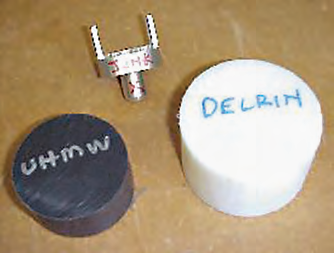
Courtesy of T. Lipton
Labeling material scraps and drops early saves time later.
Communication is accomplished in a metalworking shop in several ways. The more effective you are with these methods, the further you will go in your chosen field. Effective communication is quick, clean, accurate and—most importantly—to the point. A good engineering drawing has all these elements.
Effective written and visual communication can be considered a form of language. If you don’t speak the language, you are condemned to get your information from people who do. A stranger in a strange land is not in a friendly place.
A short note or sketch is worth its weight in gold compared to even the most detailed verbal information. If you just counted the parts in a box, take a second and leave a note for the next person so they don’t have to recount. The note is a physical representation of a single thought that all you have to do is see it and you instantly remember.
If you must receive information in oral form, do yourself a favor and write it down immediately. A few quickly taken notes may make the difference in doing a job correctly. Documentation wins vs. memory when the chips are down and hats are being handed out for rear ends.
Review the print ads from this magazine to continue
This quick advertiser review unlocks the rest of the article and keeps the full-screen reader focused on the ads instead of the page chrome.
Advertisers included in this article experience
Print placements connected to this article
MAG IAS
Finish Titanium at 100 ipm For more information visit
w w w. m a g - i a s . c o m Machine Titanium 100 % Faster with the new MAX-FLUTE End Mill Or call one of our CYCLO specialists at ext. #7 Starting as low as $132 Ideal for Finishing Thin Walls and Floors Make Radial Cuts of 0.035” Proven Tool Life up to 90 minutes , Unique Design Allows up to 15 Regrinds Available up to 1.250”.
Finish Titanium at 100 ipm For more information visit w w w. m a g - i a s . c o m Machine Titanium 100 % Faster with the new MAX-FLUTE End Mill Or call one of our CYCLO specialists at 800 934 0735 ext. #7 Starting as low as $132 Ideal for Finishing Thin Walls and Floors Make Radial Cuts of 0.035”
Visit MAG IAS View this placement in the issue recordPrint ads from this magazine
w w w. m a g - i a s . c o m Machine Titanium 100 % Faster with the new MAX-FLUTE End Mill Or call one of our CYCLO specialists at ext. #7 Starting as low as $132 Ideal for Finishing Thin Walls and Floors Make Radial Cuts of 0.035” Proven Tool Life up to 90 minutes , Unique Design Allows up to 15 Regrinds Available up to 1.250”.
Finish Titanium at 100 ipm For more information visit w w w. m a g - i a s . c o m Machine Titanium 100 % Faster with the new MAX-FLUTE End Mill Or call one of our CYCLO specialists at 800 934 0735 ext. #7 Starting as low as $132 Ideal for Finishing Thin Walls and Floors Make Radial Cuts of 0.035”
Continue reading
May 2010
In addition, make accurate physical templates and take copious written notes in the field. The template made in the field and the written notes are gold when you’re back at the bench. Typically, it’s a real pain to get a second chance to take field measurements. Therefore, when you do have the chance, overdo it. Pretend a lawyer will be looking at your templates and field notes and asking the kinds of questions only a lawyer can.
An inexpensive digital camera can collect information faster than an army of draftsmen. There is no excuse for a shop not to have one. Be sure to take extra shots from slightly different angles because you never know which photo will become the real lifesaver. My rule is when I think I have enough pictures, I take 10 more for good measure. It’s the pits when you get back to find out some photos are out of focus or the flash washed out a critical detail.
Mark or otherwise identify bad parts as soon as you know they are bad. They may still have some other use, but the parts must be unmistakable and easily identifiable from the good ones. This labeling communicates to others without interpretation or question what the status of a part is. If you don’t mark them immediately, then others who pick up the part will have to figure it out themselves, driving the cost of the scrapped part even higher.
Leave a note for yourself if you need to remember something. I sometimes write on my hand in a pinch. It’s easy to forget something if you have a lot of things to remember, so write as many as practical.
Another trick I have used if it is really important to remember something is to leave my car keys with whatever it is I’m supposed to remember. You won’t get very far without realizing you are supposed to remember something.
Also, mark your material drops and scraps early. If something is worth saving, you had best know what it is.
Ask questions early and make sure you understand the answers. There is nothing worse than missing something and having to ask again and again. It’s really easy to say “I don’t understand” or “I’m not with you” early on. It’s much harder to ask later after you were supposed to know. CTE
About the Author: Tom Lipton is a career metalworker who has worked at various job shops that produce parts for the consumer product development, laboratory equipment, medical services and custom machinery design industries. He has received six U.S. patents and lives in Alamo, Calif. Lipton’s column is adapted from information in his book “Metalworking Sink or Swim: Tips and Tricks for Machinists, Welders, and Fabricators,” published by Industrial Press Inc., New York. The publisher can be reached by calling (888) 528-7852 or visiting www.industrialpress.com. By indicating the code CTE-2010 when ordering, CTE readers will receive a 20 percent discount off the book’s list price of $44.95.
Related




Subscribers can use MFGAxis notes, saves and discussion tools with their innoNET account.


