

Coolant bursts bubble on foam problem
Eliminate coolant foam and chip accumulation in chucks and increase coolant pressure. A nonfoaming coolant.
END USER: LB Pipe & Coupling Products LLC, (832) 934-1850, www.lbpipeandcouplingproducts.com.
CHALLENGE: Eliminate coolant foam and chip accumulation in chucks and increase coolant pressure.
SOLUTION: A nonfoaming coolant.
SOLUTION PROVIDER: QualiChem Inc., (540) 375-6700, www.qualichem.com.
Coolant choice is not usually at the top of the to-do list when installing a new machine. That can be a costly mistake, however, because coolant selection can make a huge difference in how equipment operates—just ask Jim Legg, general manager of LB Pipe & Coupling Products LLC, Magnolia, Texas.
LB Pipe had purchased and installed an automated cell from Okuma America Corp., Charlotte, N.C., which was the centerpiece of a new facility for automating the production of API couplings, which meet American Petroleum Institute specifications. The cell included a pair of Okuma 2SP-V60 machines with CV-50 high-pressure coolant delivery systems from ChipBLASTER Inc., Meadville, Pa., and a high-speed robotic arm from KUKA Robotics Corp., Shelby Township, Mich. The system sprays coolant at up 1,000 psi (69 bar) at the tool/workpiece interface to help with lubrication, cooling and chip removal.
Courtesy of Okuma America
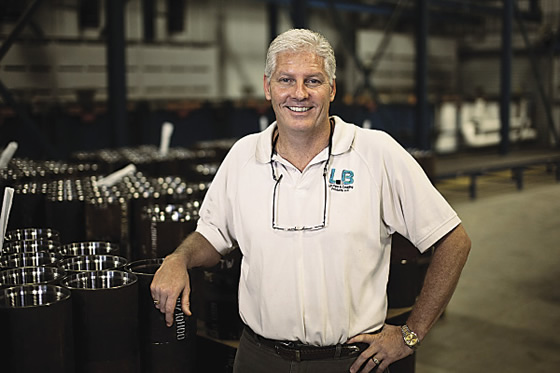
Jim Legg, general manager of LB Pipe & Coupling Products, is pleased that a heavy-duty semisynthetic coolant from QualiChem eliminated a coolant foaming problem.
Courtesy of Okuma America
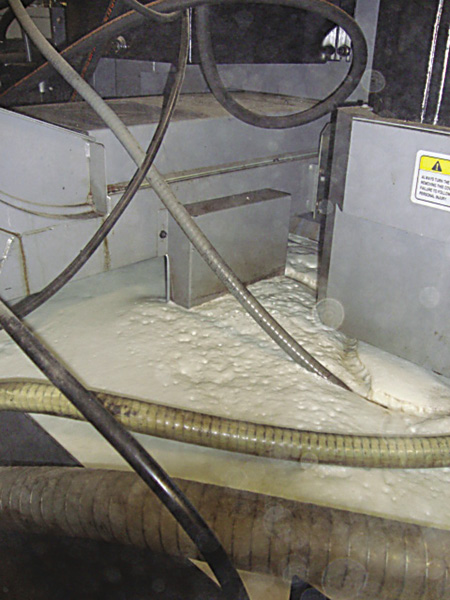
When coolant foams, downtime, coolant consumption, cycle times and part rejections increase.
At the initial machine startup, foam resembling shaving cream started billowing out of the machine and onto the floor, shutting down the high-pressure pumps and creating a maintenance and safety nightmare. “We couldn’t make one part,” Legg said. “Even when operating at 500 psi—half the recommended pressure for the machine—the foaming was so severe we had to keep a pallet of liquid absorbent on hand to capture coolant that spilled onto the floor.”
That wasn’t all. When running at 500 psi, pressure was insufficient to clear chips from the cutting area. As metal chips accumulated in the chuck, the robotic arm could not safely engage and grab the finished part. LB Pipe frequently halted production to manually remove chips and wait for the foam to dissipate. LB Pipe’s multimillion dollar investment in new technology was beginning to look like a disaster. “We couldn’t use the machines unless we could get rid of the foam,” Legg said.
Greg Antoun, president of ChipBLASTER explained: “When coolant foams, it entrains air bubbles, and the density of the coolant drops dramatically. Because the foam itself is so much lighter than water-based coolant, it can’t exert the force required to make a high-pressure system work. For practical purposes, water-based coolant is not compressible, but when coolant foams, the air bubbles are compressible so it can’t be effectively pumped at all. It’s like trying to hammer a nail with a sponge.”
When coolant foams, downtime, coolant consumption, cycle times and part rejections increase. In addition, slippery foam on a factory floor is a safety hazard and boosts coolant disposal costs.
Review the print ads from this magazine to continue
This quick advertiser review unlocks the rest of the article and keeps the full-screen reader focused on the ads instead of the page chrome.
Advertisers included in this article experience
Print placements connected to this article
Dormertools
For over 100 years Dormer Tools has
brought you the dependable cutting tools you need with the quality you have come to expect from Dormer. We are very excited about the new indexable tooling that was introduced at the International Manufacturing Technology Show (IMTS) in Chicago, IL this September. With this new line of tooling, Dormer Tools will become a.
For over 100 years Dormer Tools has brought you the dependable cutting tools you need with the quality you have come to expect from Dormer. We are very excited about the new indexable tooling that was introduced at the International Manufacturing Technology Show (IMTS) in Chicago, IL this September. With this new line of tooling, Dormer
Visit Dormertools View this placement in the issue recordPrint ads from this magazine
brought you the dependable cutting tools you need with the quality you have come to expect from Dormer. We are very excited about the new indexable tooling that was introduced at the International Manufacturing Technology Show (IMTS) in Chicago, IL this September. With this new line of tooling, Dormer Tools will become a.
For over 100 years Dormer Tools has brought you the dependable cutting tools you need with the quality you have come to expect from Dormer. We are very excited about the new indexable tooling that was introduced at the International Manufacturing Technology Show (IMTS) in Chicago, IL this September. With this new line of tooling, Dormer
Continue reading
September 2014
The supplier of the frothy fluid recommended adding defoamer, which initially seemed to help, but within 2 hours of operation the foaming was as bad as ever.
Okuma called ChipBLASTER and several tooling manufacturers to help. Together, they worked around the clock with LB Pipe’s engineering team and operators to find a solution.
Antoun made several modifications to the coolant delivery unit, which included rerouting the coolant output and return lines and altering the pump, tank, piping, tooling and nozzle configurations, but nothing helped.
After extensive troubleshooting, the group concluded foam was forming at the point of cut. Adjustments were made to the tooling and different tooling was tested, but the foam persisted and chips continued to accumulate in the chucks.
Antoun then suggested contacting QualiChem Inc., Salem, Va., based on his experience with the manufacturer of metalworking fluids and its products’ ability to eliminate foaming. Jerry Peck, executive sales engineer for QualiChem, drove 300 miles through the night to arrive on-site the next morning. He assessed the situation and recommended XTREME CUT 250C, a heavy-duty semisynthetic coolant formulated to optimize tool life and surface finish in high-pressure applications.
LP Pipe charged one of the CV-50s with the QualiChem coolant, started production and immediately increased coolant pressure. After running 7 hours at 1,000 psi, there was no foam or chip buildup.
QualiChem’s premium coolants are designed to lower foam and reduce air entrainment. Fluids that do not foam or compress enable high-pressure coolant systems to operate at or above 1,000 psi, according to QualiChem. This allows the fluid to penetrate the vapor barrier formed at the point of cut. In addition, this chemistry provides clean machine tools and low drag-out rates and extends sump life.
Meanwhile, the other Okuma machine ran at 500 psi with the original coolant and overflowed with foam while chips accumulated inside the chuck. The decision was made to immediately clean that machine and recharge it with the new coolant.
“The difference is dramatic,” ChipBLASTER’s Antoun said. “Foaming and chip accumulation have been totally eliminated.”
Okuma’s Rick Kimmins added: “LB Pipe was able to immediately run production at the machine’s full design capacity. Shortly afterward, we invited QualiChem, as a metalworking fluid manufacturer, to join the select group of experts in our Partners in THINC program. This allows us to leverage their expertise and knowledge to solve coolant problems experienced by our customers.”
Related



Subscribers can use MFGAxis notes, saves and discussion tools with their innoNET account.


