Skip to content
Operation / Process

Drilling & Boring

Optional: narrow results to one content type.
Select one or more.
Select one or more.
Select one or more.
Reset

Latest in Drilling & Boring

The Need for Feed Units
Article February 1, 1997 Tom Lingafelter
The Need for Feed Units
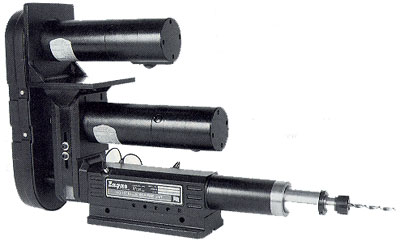
There are several types of feed units for drilling and tapping on the market, varying in capability and the type of drive. This article discusses the difference between units and suggests questions users should ask themselves before selecting a unit. Factors to be considered include the volume of production, cost engineering and tool requirements.
Hole in One: Drilling Performance
Article October 1, 1996 Timothy White
Hole in One: Drilling Performance
Solid-carbide drills made with advanced submicrograin carbide are capable of producing holes that meet tight specifications without secondary operations. This article explains how these tools produce reamer-like finishes while offering extended tool life and shortened cycle times. An accompanying article discusses coatings for solid-carbide drills.
Indexed for Success: Drilling Performance
Article March 1, 1996 Thomas Benjamin
Indexed for Success: Drilling Performance
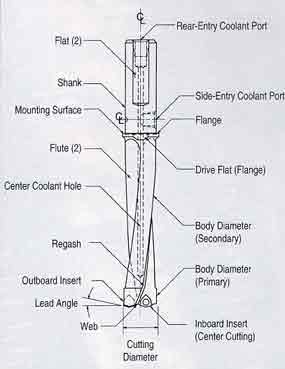
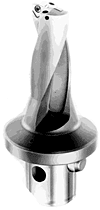
Indexable-insert drills offer several advantages for producing short holes. This article describes the drills' features, uses and benefits. Tips are provided to help select the optimal tool, insert and machine settings. A trouble-shooting chart is included.
Drills Inch Toward Metric: Drilling Performance
Article February 1, 1996 Christina Dunlap
Drills Inch Toward Metric: Drilling Performance
U.S. manufacturers are in a transition period, moving from inch to metric specifications. This article looks at the impact this change is having on the manufacturing and use of drills. The discussion also covers the advantages and disadvantages of going metric and the availability of metric drill sizes in the United States.
Strictly Boring: Turning Performance
Article October 1, 1995 Harvey Patterson
Strictly Boring: Turning Performance
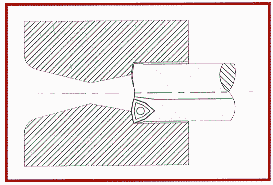
When machinists plan a boring operation, they must rely on general turning data. Typically, this data is developed from OD turning operations, not boring operations. This article provides cutting data and recommendations specifically for boring that take into account such unique problems as boring bar deflection and chips trapped inside the bore.
Bushings Get It Straight
Article February 1, 1995 George Taylor
Bushings Get It Straight
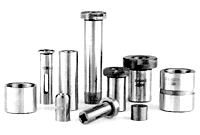
Guide bushings are used in difficult holemaking applications to ensure that the drill produces round straight holes. This article discusses the types of bushings commonly used and the materials they are made from. Guidelines for sizing bushings for a given operation are also supplied.
Switch Drills?: Drilling Performance
Article February 1, 1995 Jack Burley
Switch Drills?: Drilling Performance
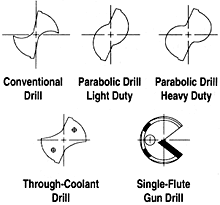
For drilling standard holes in metal, there are three primary types of drills: twist, spade and indexable insert. This article discusses the pros and cons of each design and the applications for which each might be appropriate. Factors considered include hole depth, tool cost, drill speed, coolant delivery, tool inventory required, machine tool requirements and expected tool life.
Deep Thoughts: Drilling Performance
Article February 1, 1995 Raymond Moring
Deep Thoughts: Drilling Performance
When hole depths exceed four times the drill diameter, problems with cooling and chip evacuation can arise. This article discusses these problems and the drill geometries, machining parameters and coolant options that can minimize them. Charts are included giving speeds and feeds for various workpieces and drill diameters.

1 34 35 36