Accurate shop floor scheduling is important, but often hard to achieve
Without a manufacturing schedule, workpiece materials don't arrive on time, machine tools sit idle and customers fume. However, scheduling is difficult, especially when multiple-level assemblies and large numbers of components are involved. To meet this need, software companies have developed complex, integrated enterprise resource planning (ERP) systems.
Without a manufacturing schedule, workpiece materials don’t arrive on time, machine tools sit idle and customers fume. However, scheduling is difficult, especially when multiple-level assemblies and large numbers of components are involved.
To meet this need, software companies have developed complex, integrated enterprise resource planning (ERP) systems. Hundreds of such systems exist, from giant multisite suites able to manage (OEMs’) needs to those suitable for a job shop with a handful of employees.
Despite their wide array of capabilities, most ERP systems have one thing in common: some level of production-floor scheduling.
Get Real
For any shop that is looking for a scheduling system or has one already but is unhappy with its output, there are several important factors to keep in mind if accurate dates are a priority. First, be realistic about expectations.
“If you’re looking for some magic wand to solve a shop’s scheduling problems, that hasn’t been invented yet,” said Paul Ventura, marketing vice president at Shoptech Software Corp., Cincinnati.
In addition, part manufacturers must carefully consider the environment in which any software will be used, he said. The low-volume, high-mix work typical of most job shops is generally more difficult to schedule than high-volume manufacturing. That’s because the cycle-time “guesstimates” common in job shops are the bane of any scheduling engine, while clean, accurate routings—the sequence of operational instructions used to drive work across the shop floor—should, in theory, be more accurate in a repeating-job environment, where cycle times are predictable.

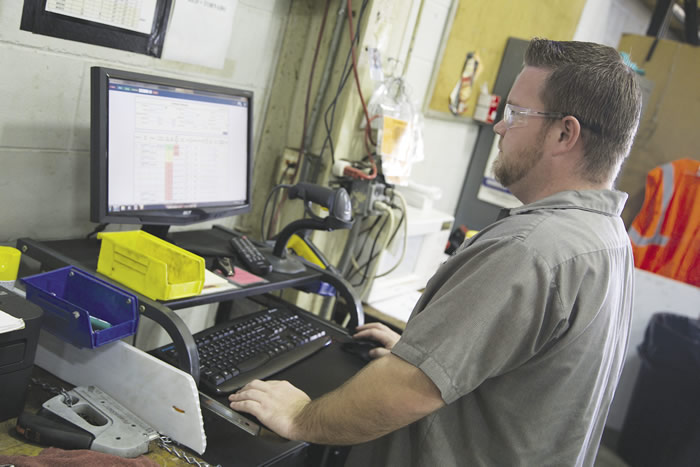
Employees should have easy access to data collection terminals in order for valuable shop floor production data
to flow smoothly. Image courtesy Avon Gear.

Accurate routing information, as shown on this job traveler, is critical to scheduling success.
Image courtesy Shoptech Software.
Accurate data goes hand in hand with another requirement of successful scheduling: shop floor discipline. “Job one is to route everything accurately, but you then have to consistently update the system with the actual production data collected from the shop floor,” Ventura said. “In order to do that, however, people have to scan the bar codes on the job traveler, clock in and out of jobs, and record the right piece counts and scrap. You can’t just install the software and expect it to function on its own.”
Shops need the equivalent of a personal trainer, driving everyone to stay on the clean-data treadmill. “People make mistakes,” Ventura said. “Joey forgot to clock out last night, or he entered 500 pieces instead of 50 pieces. Someone has to fix these things. But a 20-person shop doesn’t have anyone to sit in front of the computer all day scheduling jobs and maintaining data. Everyone’s on the floor making parts.”
Feeding the Machine
Sadly, many have resigned themselves to the notion that proper scheduling of the shop floor can’t be done. “That’s simply not true,” said Bob Geiss, a senior implementation consultant with Global Shop Solutions, The Woodlands, Texas. “It may not be easy, but it’s definitely possible.”
One key factor in successful scheduling is keeping the scheduling database current. “Customers need to understand up front the need for accurate data,” Geiss said. “They don’t always like to hear it, but the ones that make the effort to properly feed the scheduling system are far more efficient than those with a poorly implemented system or no system at all, who spend their days in production meetings and chasing down paperwork.”
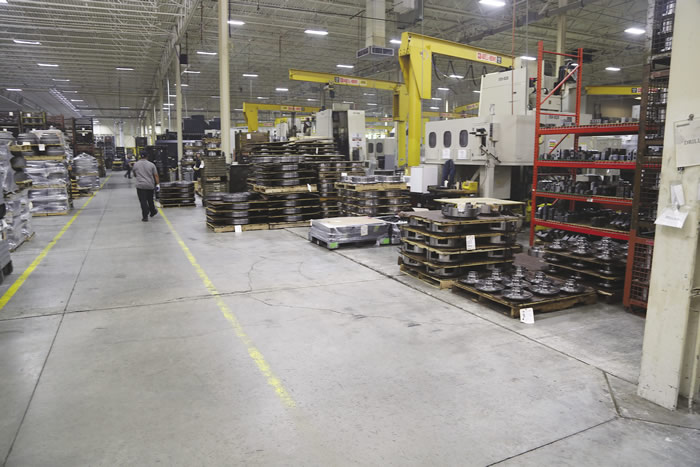
Without a good scheduling system in place, large amounts of raw material and work in process appear on the shop floor, tying up cash and increasing product lead times. Image courtesy Avon Gear.
Geiss noted one aspect of shop floor scheduling that many shops would rather avoid: selecting finite vs. infinite capabilities. In an infinite system, the scheduling engine takes whatever workload is thrown at it, optimistically scheduling each job as if it were the only one in the shop. The result is a complete disregard of constraints, leading to overly bullish delivery dates. In a finite environment, the system recognizes that each person or piece of equipment can work on only one operation at one time.
At first glance, finite would seem the only proper way to schedule shop floor activities, because, as Geiss pointed out, we live in a finite world, with 24 hours in a day. But finite scheduling requires more accurate data both in and out of an ERP system and is quite unforgiving. Also, shop floor resources must be clearly defined and maintained. So you better tell the scheduler if you’re taking a machine down Friday afternoon for maintenance, or you’ll be in big trouble come Monday morning.
The best-of-both-worlds solution is to set the shop bottlenecks as finite resources and the rest as infinite. “Chances are good that you can shuffle people around or hire a temp if you get backed up on an infinite resource,” Geiss said. “But if you have limitations with a certain machine tool, for example, it should definitely be made finite. Once folks understand that part of scheduling, finite becomes a no-brainer for them.”
Work Wisely
Harry Mosesian agreed. A senior consultant at Menomonee Falls, Wis., software provider WorkWise LLC, Mosesian said the need for shop floor scheduling is widespread. “Probably 90 percent of shops lack a good scheduling system. Take a walk on the production floor—if there’s raw material and half-completed jobs sitting around, a better scheduler is in order.”
Mosesian said shops should avoid overly complicated software. Basic forward scheduling (How soon can I get it done if I start today?) and backward scheduling (When should I start to meet a future due date?), along with a modicum of finite scheduling, is all that’s typically needed. Making schedule adjustments should be easy, and the interface where operators clock their time must be simple to use, preferably with the touch of a screen or the swipe of a bar code.
Review the print ads from this magazine to continue
This quick advertiser review unlocks the rest of the article and keeps the full-screen reader focused on the ads instead of the page chrome.
Advertisers included in this article experience
Print placements connected to this article
Indextraub
More operations. Less handling.
MORE Turn, mill, drill, grind, hob, tap, groove and more in a single setup. Even 6 -sided machining. DONE More precision. Accuracies to microns – best possible turned surface finishes. More profit for you. IN ONE. With our precision turning solutions, you can cut your cycle times dramatically. Up to 60% or more. Less really is more
MORE More operations. Less handling. Turn, mill, drill, grind, hob, tap, groove and more in a single setup. Even 6 -sided machining. DONE More precision. Accuracies to microns – best possible turned surface finishes. More profit for you. IN ONE.
Visit Indextraub View this placement in the issue recordPrint ads from this magazine
MORE Turn, mill, drill, grind, hob, tap, groove and more in a single setup. Even 6 -sided machining. DONE More precision. Accuracies to microns – best possible turned surface finishes. More profit for you. IN ONE. With our precision turning solutions, you can cut your cycle times dramatically. Up to 60% or more. Less really is more
MORE More operations. Less handling. Turn, mill, drill, grind, hob, tap, groove and more in a single setup. Even 6 -sided machining. DONE More precision. Accuracies to microns – best possible turned surface finishes. More profit for you. IN ONE.
Continue reading
April 2016
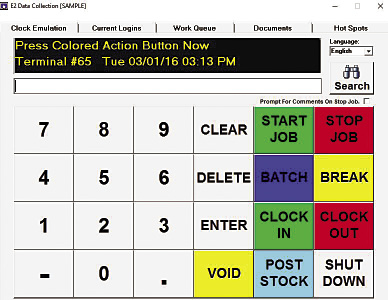
Shop floor terminals allow operators to enter scrap,
suspect and good pieces in real time, giving management
the ability to respond immediately. Image courtesy Shoptech Software.
“And don’t cheap out on the number of shop floor terminals,” Mosesian said. “If a guy has to walk 500′ to clock into a job, he’s more likely to skip it. This is one example where the success of any scheduling implementation is largely determined by upper management. They need to invest in the time and equipment needed to make it work, and then live by what the schedule tells them. No more rush jobs being pushed to the front of the line just because the president’s golf buddy asked him for a favor.”
Change the Culture
“Scheduling is a funny thing,” said Jon Taylor, vice president of development for cloud-based ERP provider KeyedIn Solutions Inc., Minneapolis. “It’s the unicorn of ERP—everybody wants it, but the necessary disciplines make it hard to capture. It takes a cultural change to be successful. The message has to come from the top: ‘We know everyone in the shop works hard and we appreciate everything you do, but you must embrace the system, just as we do in the front office.’ “
This mantra extends to the departments supporting production as well. A shop needs a clean receiving process, so that the system knows when material is available. Inventory levels must be kept accurate, material issues must be made in a timely manner, and scrap must be reported immediately. And those old-timers who argue, “Hey, the system is your problem, I’m just here to make parts,” should be gently but firmly convinced they are an important part of the new scheduling system and that compliance is not an option.
“I see many companies that don’t involve the shop floor employees as part of the implementation,” Taylor said. “This is a mistake. ERP systems offer a great path to collaboration and knowledge sharing, which, ultimately, makes more money for the company.”
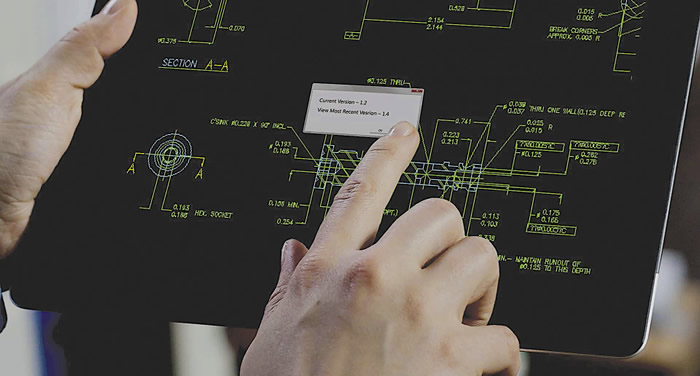
Shop floor ERP integration extends to mobile devices, which give operators access to dimensional data, specifications and other important information. Image courtesy Global Shop Solutions.
One company that did involve its shop floor is Avon Gear Co., Shelby Charter Township, Mich. This contract manufacturer has more than 100 work centers and specializes in low-volume, high-mix components for the heavy truck, agricultural, and oil and gas industries. Avon Gear Plant Manager Geoff Pitts said prior to 2007, before the company implemented cloud-based ERP software from Plex Systems Inc., in nearby Troy, it used Excel spreadsheets to schedule jobs.
“At that time, we were a $7 million company, and I had five people scheduling jobs,” said Pitts. “Considering the volatility of our orders, it was a nightmare. Today, we’re over $50 million in sales, and I can manage 600-plus part numbers with just one scheduler.”
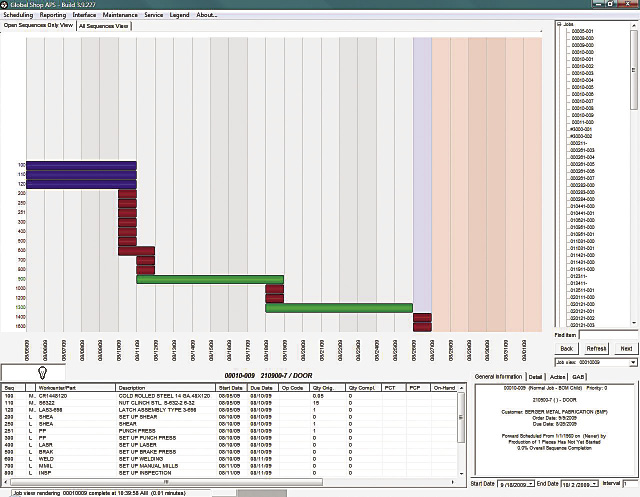
This Gantt chart of pending shop floor activities shows everything needed to make intelligent scheduling decisions, including customer information, jobs and operation sequences, part numbers, resources, quantities and due dates. Image courtesy Global Shop Solutions.
It didn’t happen overnight. Pitts said the company started with infinite scheduling, but worked closely with Plex to enhance the software’s finite capabilities and began using that functionality 2 years ago. “Finite scheduling takes it to the next level. It looks at material availability, manpower and machine capacity, then organizes everything based on lead times and priorities to deliver a dispatch list for the shop to work on.”
The biggest hurdle was believing in the system, he said. “As archaic as spreadsheets are, if that’s what you know and rely on to schedule the shop, it’s difficult for people to let go of that. At first I was using both—my spreadsheets and Plex—until I realized one day I didn’t need the spreadsheets anymore.”

Contributors
Avon Gear Co.
(586) 884-2200
www.avon-gear.com
Global Shop Solutions
(888) 851-1248
www.globalshopsolutions.com
KeyedIn Solutions Inc.
(866) 662-6820
www.keyedin.com/mfg
Shoptech Software Corp.
(800) 525-2143
www.shoptech.com
WorkWise LLC
(800) 490-9010
www.workwisellc.com