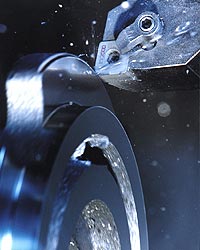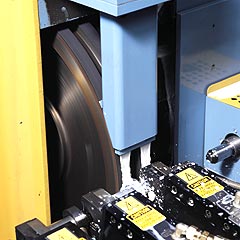
The author offers tips about making interrupted cuts while turning. He also discusses the differences between interrupted cuts in turning and milling and various types of materials.
Discussion of different types of bonds used to make superabrasive grinding wheels. Author provides tables with price comparisons, physical properties and operating parameters for various bonds.
Equipping toolchangers with nylon abrasive-filament brushes can greatly enhance process economics and the flow of parts. Case histories of in-machine deburring operations support these contentions, and the author describes how such systems should work.
Author discusses the advantages of CVD-diamond tools compared to other types of diamond tools. He also explains how CVD-diamond tools are manufactured and gives case histories involving their usage.
Overview of the new machine tool technologies introduced at IMTS 2000. Among them are linear motors for axes travels, ballscrew chillers, a new way to lubricate linear guideways and controlling machining processes via the Internet.
Author explains the different ways to upgrade a used machine tool. He also discusses what users should expect from the company that performs the retrofit, rebuild or remanufacturing job and how long the job should take.
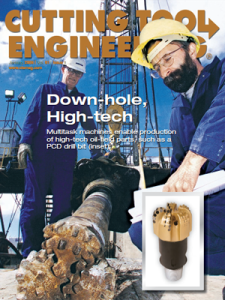
Shop owners who operate multitask machines talk about the time and cost benefits of producing parts in a single chucking. They also discuss some of the problems they had when adopting the technology. Accompanying Articles focus on a multitask users group and machine that hard-turns and grinds.
Author describes applications for the two basic types of ceramic turning inserts–alumina and silicon nitride–as well as the types of parts and materials users have turned with them. Specifics about speeds, feeds and DOCs are given.
Discussion of different types of toolholders for lathes, including collets, drill chucks, bushings and keyless chucks. Author discusses best holder for different applications, based on his experiences.
GE Superabrasives' silver-coated diamond crystal is designed for grinding tungsten carbide. Discussed are the benefits--reduced friction, greater crystal retention and a cooler grinding environment--and how to apply wheels made from the crystal.
The author discusses the advantages and proper application of twin-cutter boring tools. They're recommended for rough-boring applications on castings, forgings and other jobs requiring a tool that can bore a cored hole. Details are provided on the three basic types of methods for rough boring with a twin cutter: balanced, stepped and full profile.