Skip to content
Operation / Process

Machining

Optional: narrow results to one content type.
Select one or more.
Select one or more.
Select one or more.
Reset

Latest in Machining

Driving the Tap: Turning Performance
Article August 1, 1995 Doug Moore
Driving the Tap: Turning Performance
The choice of tapping driver, the component between the spindle and the tap, can affect the quality and accuracy of the threads as well as the rate of wear on the tap and the machine tool. This article discusses how features such as length compensation and self-reversing protect against damage caused by machine and tool errors.
Threads Will Roll: Drilling Performance
Article August 1, 1995 Dan Gajdosik
Threads Will Roll: Drilling Performance
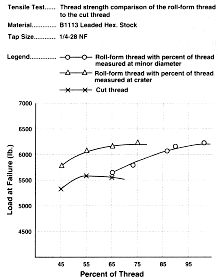
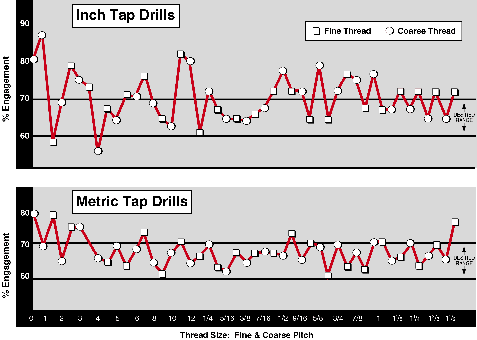
Roll-forming taps produce internal threads by displacing the metal under pressure rather than cutting it. This article explains how to perform the operation to achieve good quality threads. Formulas and charts help the user calculate the proper size hole and the size of tap to use for a desired thread.
Harder Than Anticipated: Turning Performance
Article June 1, 1995 Kevin Ackman
Harder Than Anticipated: Turning Performance
A shop supervisor and education manager recount the evolution of a job that didn't proceed exactly as planned. Because the powder-metal part was harder and its as-pressed dimensions were not as accurate as originally expected, adjustments and improvisations were needed to produce the finished parts as quickly and as cheaply as quoted.
PCBN Turns the Hard Stuff
Article June 1, 1995 Alan Carius
PCBN Turns the Hard Stuff
This article compares hard turning to grinding for finishing hardened steel parts and discusses which operation would be more appropriate for various situations. The article also looks at the machine tool, insert and cutting parameters required during hard turning.
Honing Comes Full Circle: Turning Performance
Article April 1, 1995 Guy Carmichael
Honing Comes Full Circle: Turning Performance
Honing was originally a surface finishing operation that did not remove significant amounts of material. This article discusses brush honing, a process the authors say produces results similar to what honing was originally intended to produce. Proper boring is also discussed, because, according to the authors, a properly bored hole will not require further correction through modern aggressive stone honing techniques.
Optimal Automation
Article April 1, 1995 Anders Utterstrom
Optimal Automation
The efficiency of a die-sinker EDM operation can be enhanced by automating at least part of the work handling or tool handling. This article describes the automation that is available, from the simplest electrode grippers to fully automated toolchanging systems.
Barfeeding Advances: Drilling Performance
Article April 1, 1995 Dave Poling
Barfeeding Advances: Drilling Performance
According to this article, the short-bar barfeeders that are on the market today are not plagued by the drawbacks that have become associated with barfeeding. The units load 5-foot bar stock into a lathe rather than the longer stock loaded by earlier units.
Switch Drills?: Drilling Performance
Article February 1, 1995 Jack Burley
Switch Drills?: Drilling Performance
For drilling standard holes in metal, there are three primary types of drills: twist, spade and indexable insert. This article discusses the pros and cons of each design and the applications for which each might be appropriate. Factors considered include hole depth, tool cost, drill speed, coolant delivery, tool inventory required, machine tool requirements and expected tool life.
Deep Thoughts: Drilling Performance
Article February 1, 1995 Raymond Moring
Deep Thoughts: Drilling Performance
When hole depths exceed four times the drill diameter, problems with cooling and chip evacuation can arise. This article discusses these problems and the drill geometries, machining parameters and coolant options that can minimize them. Charts are included giving speeds and feeds for various workpieces and drill diameters.
Bushings Get It Straight
Article February 1, 1995 George Taylor
Bushings Get It Straight
Guide bushings are used in difficult holemaking applications to ensure that the drill produces round straight holes. This article discusses the types of bushings commonly used and the materials they are made from. Guidelines for sizing bushings for a given operation are also supplied.

1 533 534 535