Skip to content
Operation / Process

Machining

Optional: narrow results to one content type.
Select one or more.
Select one or more.
Select one or more.
Reset

Latest in Machining

A Spark of Intelligence: General Industry Coverage
Article April 1, 1996 K.P. Rajurkar
A Spark of Intelligence: General Industry Coverage
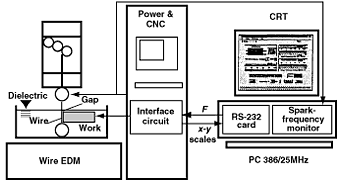
EDM cutting conditions change throughout the cutting process as the part thickness and the level of dielectric contamination fluctuates. This article describes an experimental setup that can monitor these fluctuations and adjust the EDM's settings to maintain an optimal spark.
Understanding EDMed Surfaces
Article April 1, 1996 Lawrence Rhoades
Understanding EDMed Surfaces
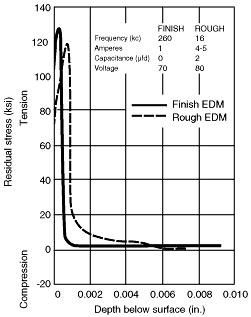
EDMed surfaces have their own texture and integrity considerations. This guide explains why EDM surface condition matters for inspection, finishing, and downstream performance.
Indexed for Success: Drilling Performance
Article March 1, 1996 Thomas Benjamin
Indexed for Success: Drilling Performance
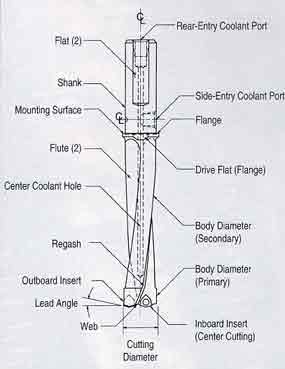
Indexable-insert drills offer several advantages for producing short holes. This article describes the drills' features, uses and benefits. Tips are provided to help select the optimal tool, insert and machine settings. A trouble-shooting chart is included.
Turn with the Right Tool
Article March 1, 1996 Brent Lindsey
Turn with the Right Tool
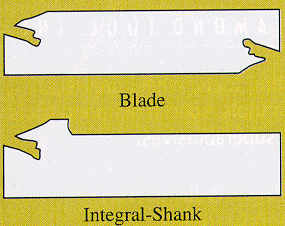
New plunge-and-turn tools make it possible to perform several tasks, such as grooving, turning, back turning and face grooving, with the same tool. This article discusses the design and use of these tools as well as the types of cutoff tools currently on the market. Recommendations for tool selection, speeds and feeds are given for various work materials.
Drills Inch Toward Metric: Drilling Performance
Article February 1, 1996 Christina Dunlap
Drills Inch Toward Metric: Drilling Performance
U.S. manufacturers are in a transition period, moving from inch to metric specifications. This article looks at the impact this change is having on the manufacturing and use of drills. The discussion also covers the advantages and disadvantages of going metric and the availability of metric drill sizes in the United States.
Grinding Holds Its Ground
Article December 1, 1995 Kimberly B. Pigeon
Grinding Holds Its Ground
This article makes the argument that grinding is still a useful and necessary process despite the advancements that have made the turning of hardened workpieces possible. The article discusses the precision and finish possible with grinding, and it compares the cost of grinding to other machining processes.
Good Vibrations: Drilling Performance
Article December 1, 1995 Elliot Stern
Good Vibrations: Drilling Performance
Tunable tools can be adjusted to dampen vibration. However, shops must have the right equipment to tune them quickly and precisely. This article describes an instrument that can provide the necessary feedback. A system that uses a mill's vibration frequency to sense problems with the tool is also described.
Strictly Boring: Turning Performance
Article October 1, 1995 Harvey Patterson
Strictly Boring: Turning Performance
When machinists plan a boring operation, they must rely on general turning data. Typically, this data is developed from OD turning operations, not boring operations. This article provides cutting data and recommendations specifically for boring that take into account such unique problems as boring bar deflection and chips trapped inside the bore.
Selecting Coolants: Why and How
Article October 1, 1995 William Sluhan
Selecting Coolants: Why and How
This is the first in a series of Articles on coolants. It provides a general review of the types of fluids available, their cooling and lubricating abilities and their ease of disposal. Criteria are offered for selecting the appropriate fluid for an operation.
Beyond the Ban: General Industry Coverage
Article October 1, 1995 Norm Semple
Beyond the Ban: General Industry Coverage
The EPA's ban on ozone-depleting chemicals had an impact on the formulation of metalworking fluids containing 1,1,1 trichloroethane. This article looks at the reasons for the ban and the industry's efforts to find replacement substances for the banned chemicals.
Milling Inserts Shape Up
Article September 1, 1995 Ken Booker
Milling Inserts Shape Up
Changes in milling practices have placed new demands on the cutting tool. This article discusses the features toolmakers have added to their milling insert geometries to control chips and cutting forces. The article also reviews the milling process and the forces that act on the insert.
Thread Rolling on CNC Machines
Article August 1, 1995 Al McBride
Thread Rolling on CNC Machines
Thread rolling produces external threads by forming the profile instead of cutting it. This guide covers where CNC thread rolling fits, why it can outperform cutting, and what shops should watch in setup.

Keep exploring