Skip to content
Product Category

General Shop Equipment & Supplies

Optional: narrow results to one content type.
Select one or more.
Select one or more.
Select one or more.
Reset

Latest in General Shop Equipment & Supplies

Saw Change: General Industry Coverage
Articles March 1, 1996 Ann Marie Rooke
Saw Change: General Industry Coverage
Blades for contour bandsawing vary in their materials, their tooth set and selection, their width and the way they are welded. This article discusses how each of these variables contributes to the blades' ability to cut intricate shapes without seizing or wearing prematurely. Blade lubrication is also covered.
Indexed for Success: Drilling Performance
Articles March 1, 1996 Thomas Benjamin
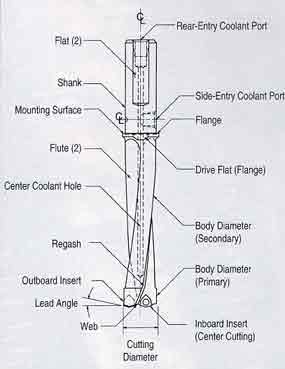
Indexed for Success: Drilling Performance
Indexable-insert drills offer several advantages for producing short holes. This article describes the drills' features, uses and benefits. Tips are provided to help select the optimal tool, insert and machine settings. A trouble-shooting chart is included.
Turn with the Right Tool
Articles March 1, 1996 Brent Lindsey
Turn with the Right Tool
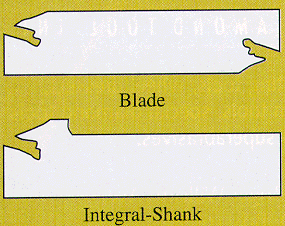
New plunge-and-turn tools make it possible to perform several tasks, such as grooving, turning, back turning and face grooving, with the same tool. This article discusses the design and use of these tools as well as the types of cutoff tools currently on the market. Recommendations for tool selection, speeds and feeds are given for various work materials.
A Bend in the Stream
Articles February 1, 1996 John Olsen
A Bend in the Stream
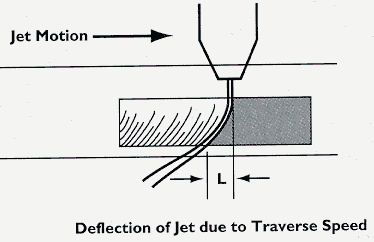
Programming a cut with an abrasive waterjet is complicated by the fact that the stream of water deflects as it passes through the workpiece. This article describes newer controller technology that can adjust the traverse speed to minimize deflection at corners and curves.
Measuring with Moire: Inspection Efficiency
Articles February 1, 1996 Kevin Harding
Measuring with Moire: Inspection Efficiency
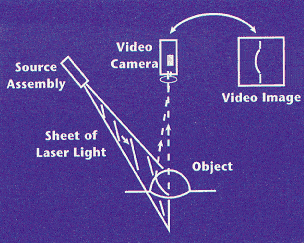
Casting a pattern of light on a part and viewing that pattern at a different angle through a grating with the same pattern creates a moire pattern that can reveal small changes in the part's shape. This article tells how this phenomenon can be used by machine vision systems to measure part dimensions or pinpoint variations from a specified contour.
Drills Inch Toward Metric: Drilling Performance
Articles February 1, 1996 Christina Dunlap
Drills Inch Toward Metric: Drilling Performance
U.S. manufacturers are in a transition period, moving from inch to metric specifications. This article looks at the impact this change is having on the manufacturing and use of drills. The discussion also covers the advantages and disadvantages of going metric and the availability of metric drill sizes in the United States.
Grinding Holds Its Ground
Articles December 1, 1995 Kimberly B. Pigeon
Grinding Holds Its Ground
This article makes the argument that grinding is still a useful and necessary process despite the advancements that have made the turning of hardened workpieces possible. The article discusses the precision and finish possible with grinding, and it compares the cost of grinding to other machining processes.
Strictly Boring: Turning Performance
Articles October 1, 1995 Harvey Patterson
Strictly Boring: Turning Performance
When machinists plan a boring operation, they must rely on general turning data. Typically, this data is developed from OD turning operations, not boring operations. This article provides cutting data and recommendations specifically for boring that take into account such unique problems as boring bar deflection and chips trapped inside the bore.
Thread Rolling on CNC Machines
Articles August 1, 1995 Al McBride
Thread Rolling on CNC Machines
Thread rolling produces external threads by forming the profile instead of cutting it. This guide covers where CNC thread rolling fits, why it can outperform cutting, and what shops should watch in setup.
Driving the Tap: Turning Performance
Articles August 1, 1995 Doug Moore
Driving the Tap: Turning Performance
The choice of tapping driver, the component between the spindle and the tap, can affect the quality and accuracy of the threads as well as the rate of wear on the tap and the machine tool. This article discusses how features such as length compensation and self-reversing protect against damage caused by machine and tool errors.
Threads Will Roll: Drilling Performance
Articles August 1, 1995 Dan Gajdosik
Threads Will Roll: Drilling Performance
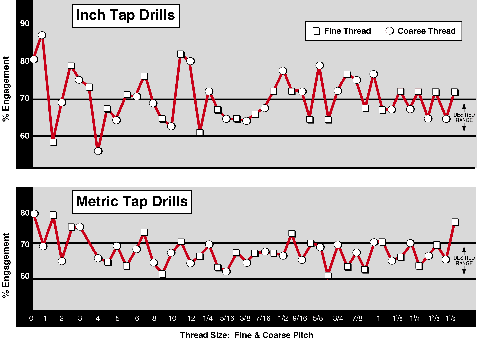
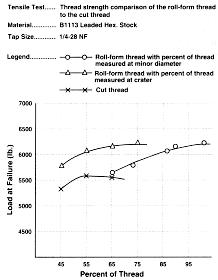
Roll-forming taps produce internal threads by displacing the metal under pressure rather than cutting it. This article explains how to perform the operation to achieve good quality threads. Formulas and charts help the user calculate the proper size hole and the size of tap to use for a desired thread.

Keep exploring