Resources
Blind Resources
Explore 35 published CTE resources related to Blind across 4 articles, 25 products, 2 videos, and 4 news items.
4
Articles
25
Products
2
Videos
4
News
Articles
4 articles
Products
25 products
Videos
2 videos
News
4 news items
Browse
Browse all Blind resources
Browse results

Inserts Show Their True Colors
Insert manufacturers have devised color-coding schemes to help users select the right tool for the job. This article explores the thinking behind these schemes and the toolmakers' efforts to design tools for the specific applications defined in their selection systems.

Continual Improvement: General Industry Coverage
With innovations in technology, EDM has found its place as a reasonable alternative to other precision machining operations. This article reviews five recent developments: the introduction of a new electrode material, operations that replace dielectric fluid with gas, the development of electro-conductive powders, the EDMing of nonconductive materials and a method for producing complex part geometries with simple electrodes.

Standard Issues: Safety, Standards & Compliance
The article looks at concerns being raised over ISO's plans to revise quality standards. An accompanying article discusses a Web site that strongly opposes the announced changes.

Through-Coolant Tools Raise Throughput
Routing coolant out through the tip of the tool can provide greater control of temperatures and chips. This article describes the benefits of through-coolant tools and describes the methods of retrofitting machines to accept through-coolant tools.
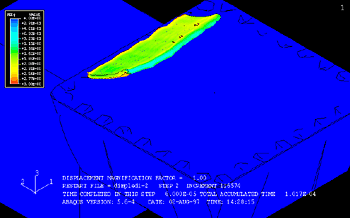
How Simulation Improves Machining Tool Design and Performance
Computer simulations of the cutting process can help tool designers predict the effects of tool-geometry changes. This article describes how one manufacturer is using the most recent advances in computer modeling to reduce the need for producing and testing prototype inserts. An accompanying article describes a commercially available simulation program.

Sawing In-House vs. Outsourcing: What Shops Should Consider
An increasing number of shops are purchasing saws and bringing their cutoff operations in-house. This article discusses the benefits of such a move and explains the factors that must be considered before selecting a saw. Blade selection is also discussed.

Frenzied Feeding: Turning Performance
By changing the nose radius of their finish-turning inserts, toolmakers are producing wiper inserts that allow machinists to turn workpieces at increased feed rates. This article explains the theory behind this innovation and describes the specific wiper-style geometries employed by three manufacturers.

Pain-Free SPC
Experts offer advice for implementing an SPC program in shops. They emphasize that developing an SPC program isn't as difficult as many people think, and that a program can be implemented with few hassles.

The Pressure’s on to Improve Drilling
The author explains how high-pressure, high-volume coolant can provide better control of chips and temperature during drilling operations. He also describes the tools, equipment and shop procedures that can ensure top performance from a high-pressure coolant system.
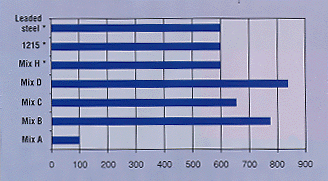
Machinability of Sintered Steel: Drilling Performance
Researchers from Lehigh University report the results of drilling tests conducted using sintered steel samples. The samples were prepared using different machinability-improving additives. The results showed that sintered steel with low-alloy steel and resulferized sintered steel are nearly as machinable as wrought steel.
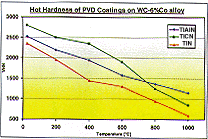
PVD Coatings for Turning
Researchers report on their study of coating performance. Their tests of TiN, TiCN and TiAlN coatings involved turning Inconel 718, medium-carbon steel and ductile cast iron. The wear rates and failure mechanisms of the coated tools are compared.

Getting Peak Performance from Indexable Drills
Indexable-drill performance depends on insert selection, toolholding, coolant, and hole-entry conditions. This guide covers the setup details that most affect results.