

Cutting Time for Facing: Quick Guide
Facing time calculations change depending on whether spindle speed stays constant or surface speed is held constant. This guide explains the math shops use to estimate cycle time.
Quick take: Facing time estimates change depending on whether a process runs constant RPM or constant surface speed. This page is most useful when it is paired with force, equation, and thermal-growth references during turning process planning.
Related references: Calculated Forces When Turning: Quick Guide, Understanding Cutting Equations, and Coefficient of Linear Thermal Expansion: Machining Guide.
Comparison between calculating cutting time when facing at a constant cutting speed vs. a constant rpm.
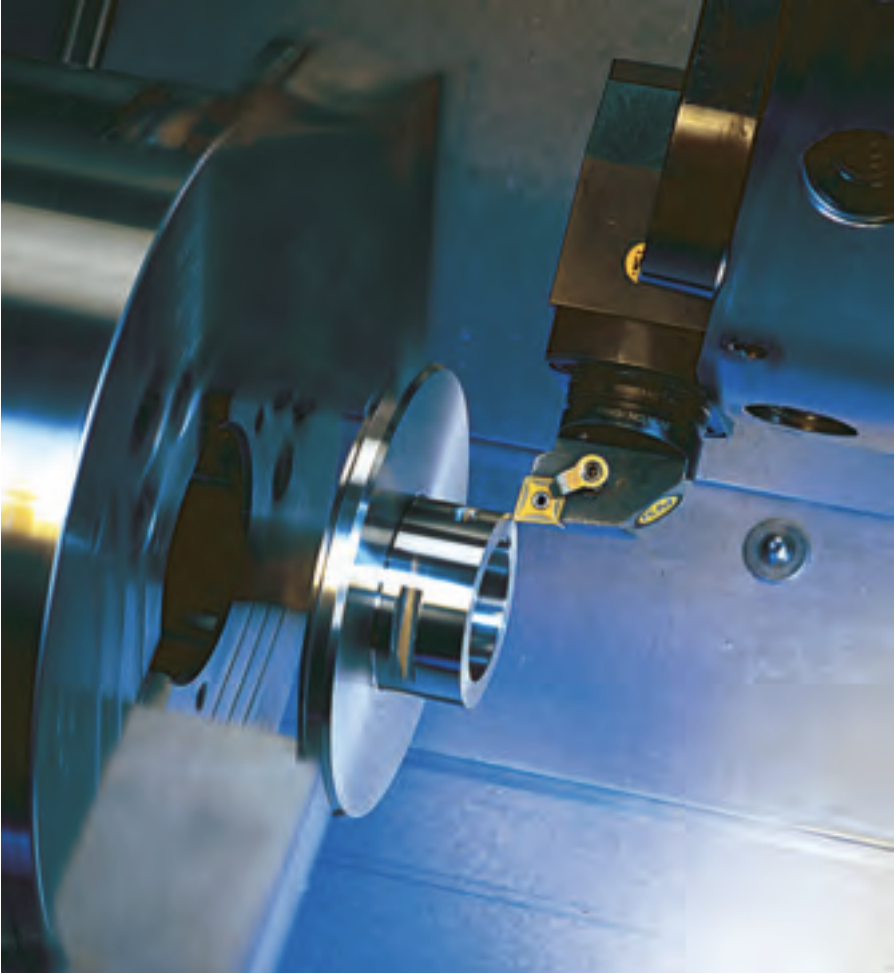
Facing being performed on a tubular workpiece. Image courtesy of Kennametal
Facing is a turning operation in which the workpiece is machined to its center. It involves moving the cutting tool perpendicular to the workpiece’s axis of rotation.
This operation can be performed at a constant surface speed (sfm, m/min.), which is recommended, or at a constant rotational speed (rpm), which is not recommended. Facing at a constant rpm decreases the cutting speed, because the diameter of the facing surface gradually decreases by the amount of a feed per revolution. The closer a cutting tool is to the center of a workpiece, the lower the cutting speed. It approaches zero at the center of a workpiece. A low cutting speed can cause built-up edge.
Cutting Time for Facing at Constant Cutting Speed
function calculateTimeConstantSpeed() { let diameter = parseFloat(document.getElementById(“diameter1”).value); let cuttingSpeed = parseFloat(document.getElementById(“cuttingSpeed”).value); let feedPerRev = parseFloat(document.getElementById(“feedPerRev1”).value); let radius = diameter / 2; let rpm = (12 * cuttingSpeed) / (Math.PI * diameter); let cuttingTime = radius / (feedPerRev * rpm); document.getElementById(“resultConstantSpeed”).innerText = “Cutting Time: ” + cuttingTime.toFixed(3) + ” minutes”;}
Formula: Cutting Time = (Initial Radius) / (Feed per Rev × RPM), where RPM = (12 × Cutting Speed) ÷ (π × Diameter)
Check out a more advanced Face Turning calculator here!
Therefore, end users have a dilemma: facing at a constant speed or a constant rpm. One way to calculate cutting time for facing is to use Web sites such as www.calculatoredge.com, which offers online calculators for engineers at no charge. Among the numerous categories, the lathe operations calculator provides a variety of calculations, including cutting time for facing. It calculates time for facing as a function of the constant rpm, workpiece diameter and feed per revolution. A representation of this calculator and an example of calculating time for facing at selected cutting parameters is shown in Figure 1.
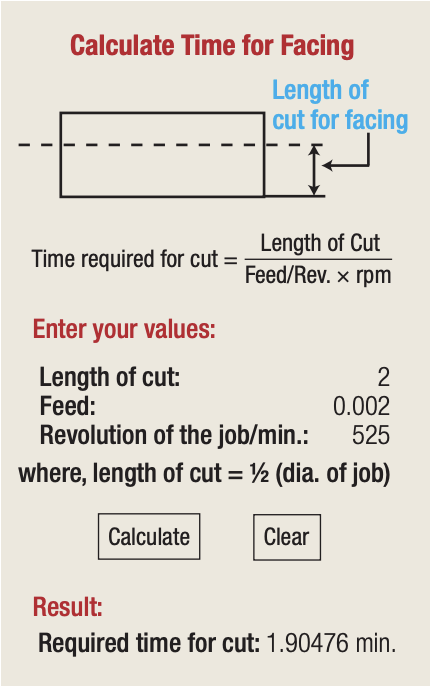
Figure 1. The lathe operations calculator page for cutting time for facing from www.calculatoredge.com. Courtesy of Calculator Edge
The following are the author’s comments regarding this calculator:
- The formula for calculating time for facing contains a value “Feed/Rev.,” which is confusing because it can be interpreted as feed divided by revolution. These two words should be replaced by fpr (feed per revolution), which is the most commonly used value.
- Revolution of the job/minute is an awkward definition of the machine tool’s spindle speed, which is defined in rpm.
- Required time for cut is given in five decimal points, such as 1.90476 minutes in this article’s example. Such precise “astronomical” accuracy is unjustified. Two (maybe three) decimal places are more than enough for practical accuracy.
In many of today’s CNC machines, most operations, including facing, are programmed using constant cutting speed, which is specified in sfm in inch mode or m/min. in metric mode. At constant cutting speed, a CNC lathe automatically applies the correct rpm based on the following formulas for inch and metric systems:
rpm = 12 × sfm ÷ (π × cutting diameter in inches),
rpm = 1,000 × m/min. ÷ (π × cutting diameter in millimeters).
Review the print ads from this magazine to continue
This quick advertiser review unlocks the rest of the article and keeps the full-screen reader focused on the ads instead of the page chrome.
Advertisers included in this article experience
Print placements connected to this article
[email protected], www.iscarmetals.com
ISCAR METALS INC. 300 Westway Place, Arlington,
TX 76018-1021 Tel+1 817 258 3200, Fax+1 817 258 3221,Tech Tel 1-877-BY-ISCAR.
ISCAR METALS INC. 300 Westway Place, Arlington, TX 76018-1021 Tel+1 817 258 3200, Fax+1 817 258 3221,Tech Tel 1-877-BY-ISCAR [email protected], www.iscarmetals.com
Visit [email protected], www.iscarmetals.com View this placement in the issue recordPrint ads from this magazine
TX 76018-1021 Tel+1 817 258 3200, Fax+1 817 258 3221,Tech Tel 1-877-BY-ISCAR.
ISCAR METALS INC. 300 Westway Place, Arlington, TX 76018-1021 Tel+1 817 258 3200, Fax+1 817 258 3221,Tech Tel 1-877-BY-ISCAR [email protected], www.iscarmetals.com
Continue reading
March 2011
Constant Surface Speed Pros
Mike Lynch, president of CNC Concepts Inc., Cary, Ill., described four advantages of constant surface speed in his article “The Pros and Cons of Constant Surface Speed” (Modern Machine Shop, January 2009, pp. 62, 64).
- It simplifies programming. Speed can be directly specified in sfm or m/min., the units used by most cutting tool manufacturers for recommending speed. This eliminates the need to calculate rpm.
- It provides consistent workpiece finish. When used in conjunction with feed per revolution (feed rate mode), finish will be consistent regardless of the diameters machined.
- It optimizes tool life. Tools will always machine at the appropriate speed.
- It optimizes machining time. Cutting conditions will always be properly set, which translates to minimal machining time.
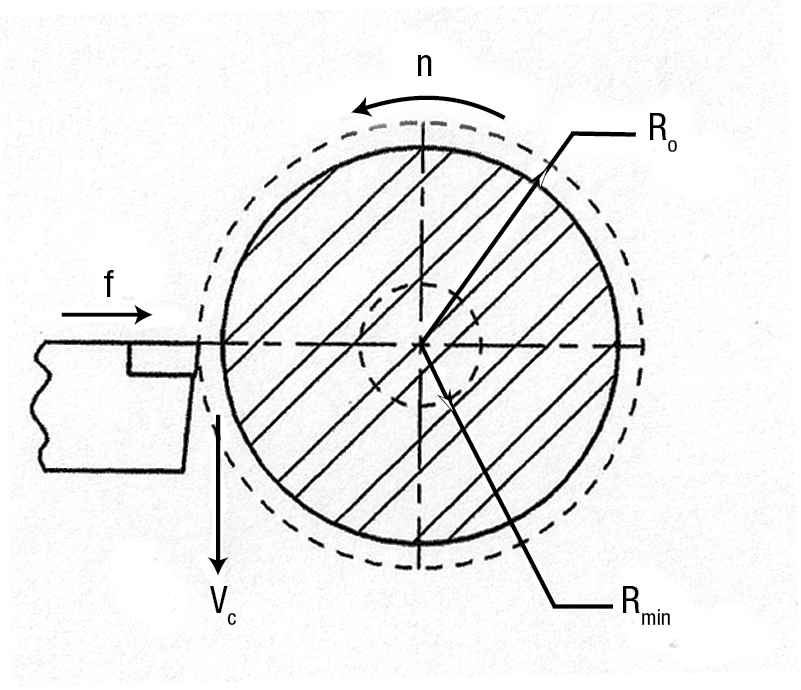
Schematic of a facing operation, where n is the spindle speed, Ro is the workpiece radius at the start of facing, Rmin is the workpiece radius at which the machine tool’s spindle is running at its maximum speed (nmax), Vc is the cutting speed, and f is the feed rate.
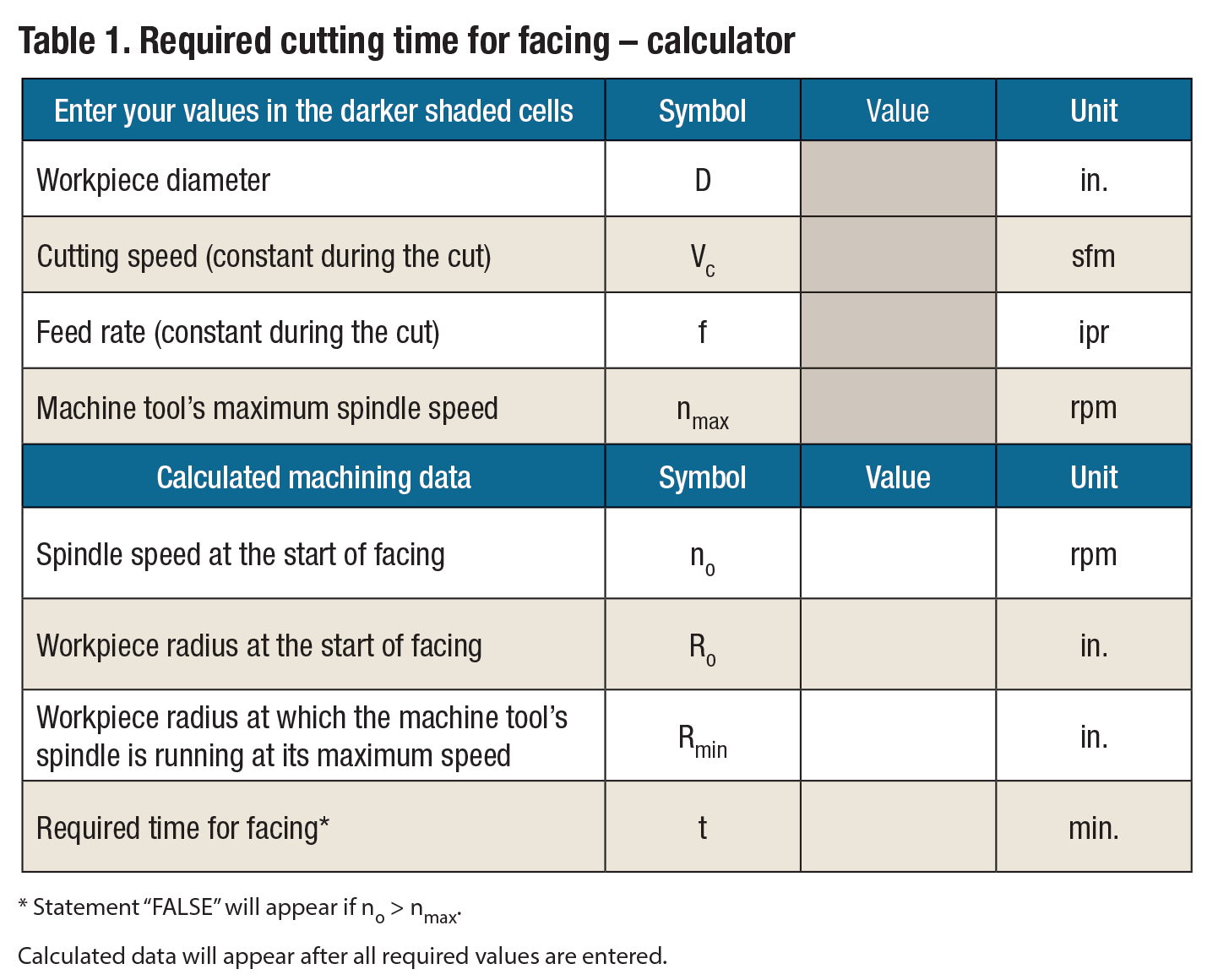
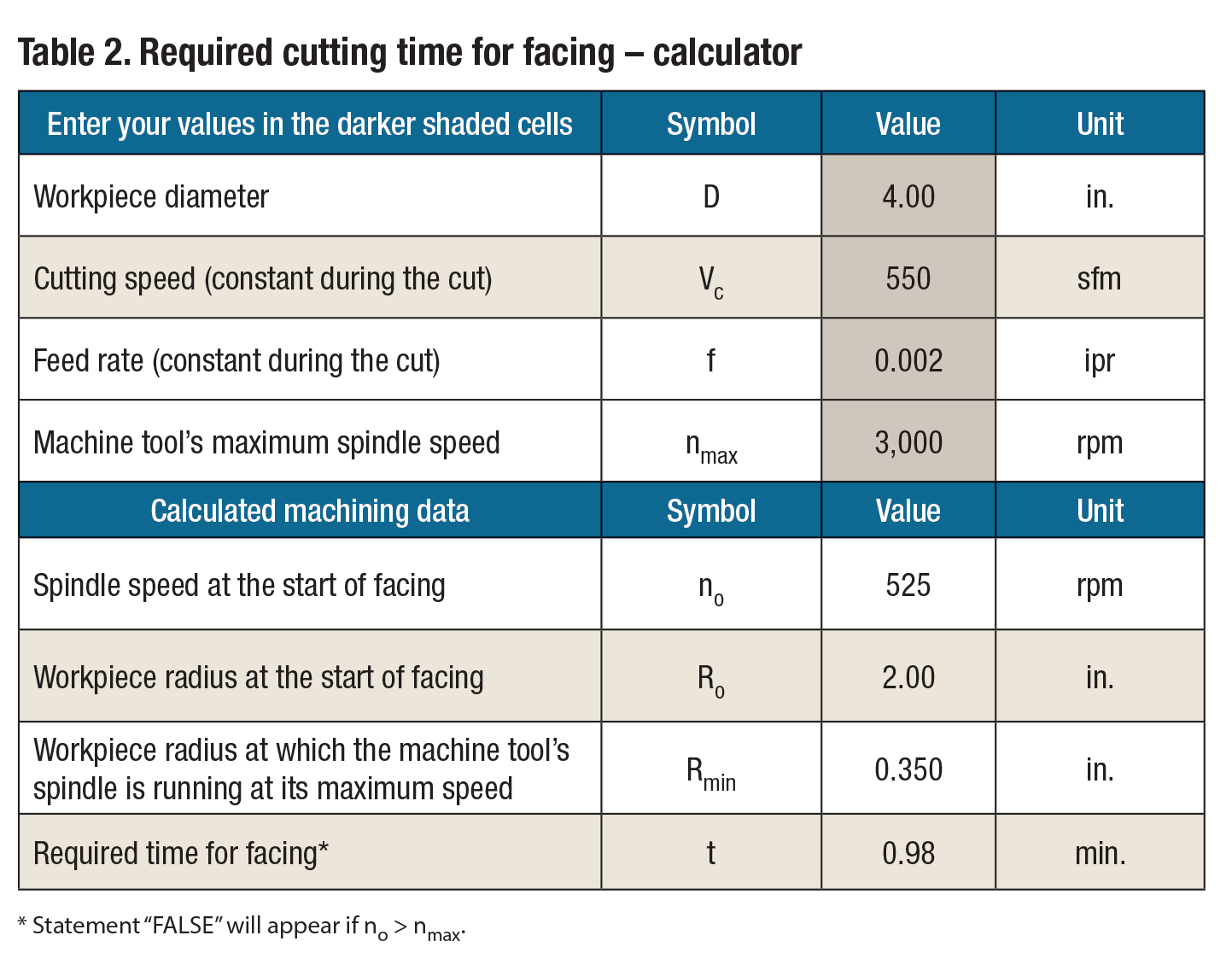
This article’s author developed a formula and designed a calculator for required cutting time when facing at constant cutting speed. The calculator is developed in Microsoft Excel and available in inch and metric units. Table 1 shows its computational worksheet (inch units) before the required values for computation of the cutting time are entered. Table 2 shows the calculator after process parameter values have been entered and cutting time calculated.
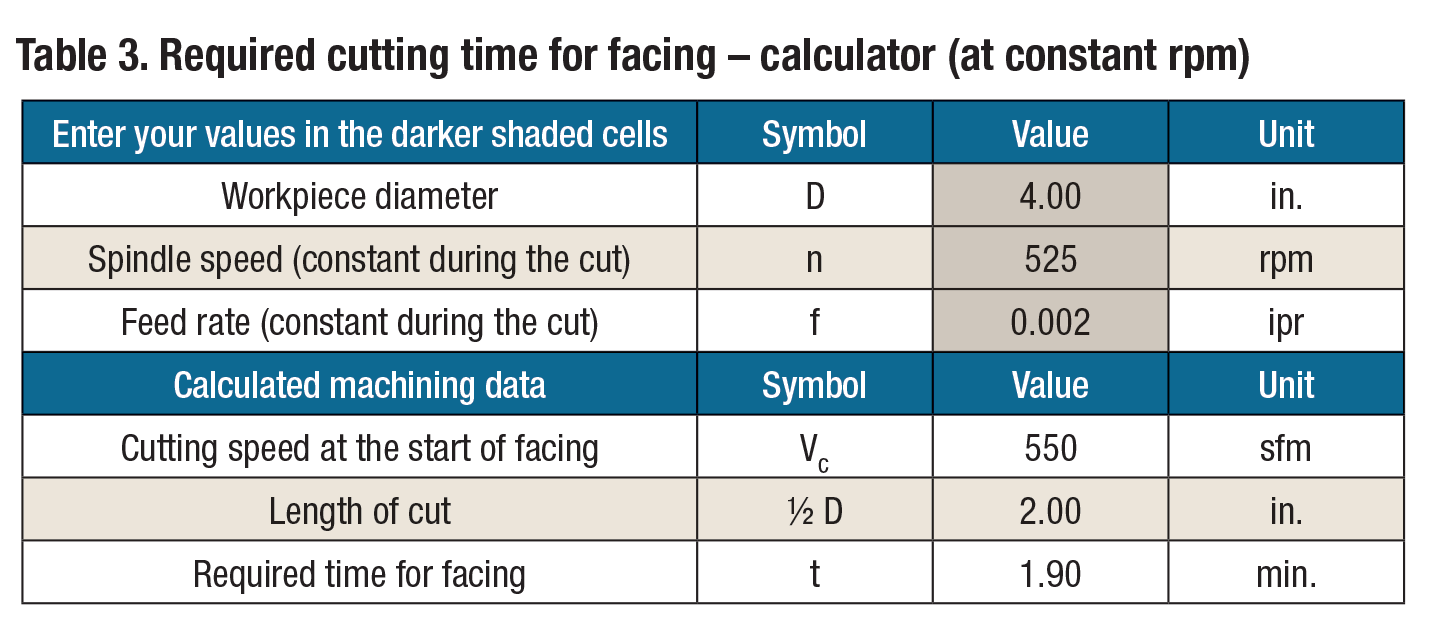
The author also developed a similar calculator based on constant rpm. A sample calculation using the same workpiece diameter, feed rate and rpm instead of the cutting speed is shown in Table 3. Comparison between the two methods of facing shows that machining at a constant sfm (0.98 minutes) requires significantly less time than machining at a constant rpm (1.90 minutes).
Cutting Time for Facing at Constant RPM
function calculateTimeConstantRPM() { let diameter = parseFloat(document.getElementById(“diameter2”).value); let spindleSpeed = parseFloat(document.getElementById(“spindleSpeed”).value); let feedPerRev = parseFloat(document.getElementById(“feedPerRev2”).value); let radius = diameter / 2; let cuttingTime = radius / (feedPerRev * spindleSpeed); document.getElementById(“resultConstantRPM”).innerText = “Cutting Time: ” + cuttingTime.toFixed(3) + ” minutes”;}
Formula: Cutting Time = (Initial Radius) / (Feed per Rev × Spindle Speed)
Terry Ashley, training manager for Walter USA LLC, Waukesha, Wis., provided the following technical information on facing aluminum alloy wheels:
- 15 “- and 17 “-dia. aluminum alloy wheels are the most common for automotive applications, although there are truck wheels that are much bigger, starting at 19 “.
- Recommended cutting speeds are from 1,000 to 1,300 sfm.
- Common feeds for “beauty face” are from 0.004 to 0.006 ipr.
- PCD-tipped grooving-type inserts are applied.
- A 45- to 55-hp machine tool’s maximum spindle speed is 3,000 rpm.
- Okuma makes the most common machine for this operation.
- Special workholding is required.
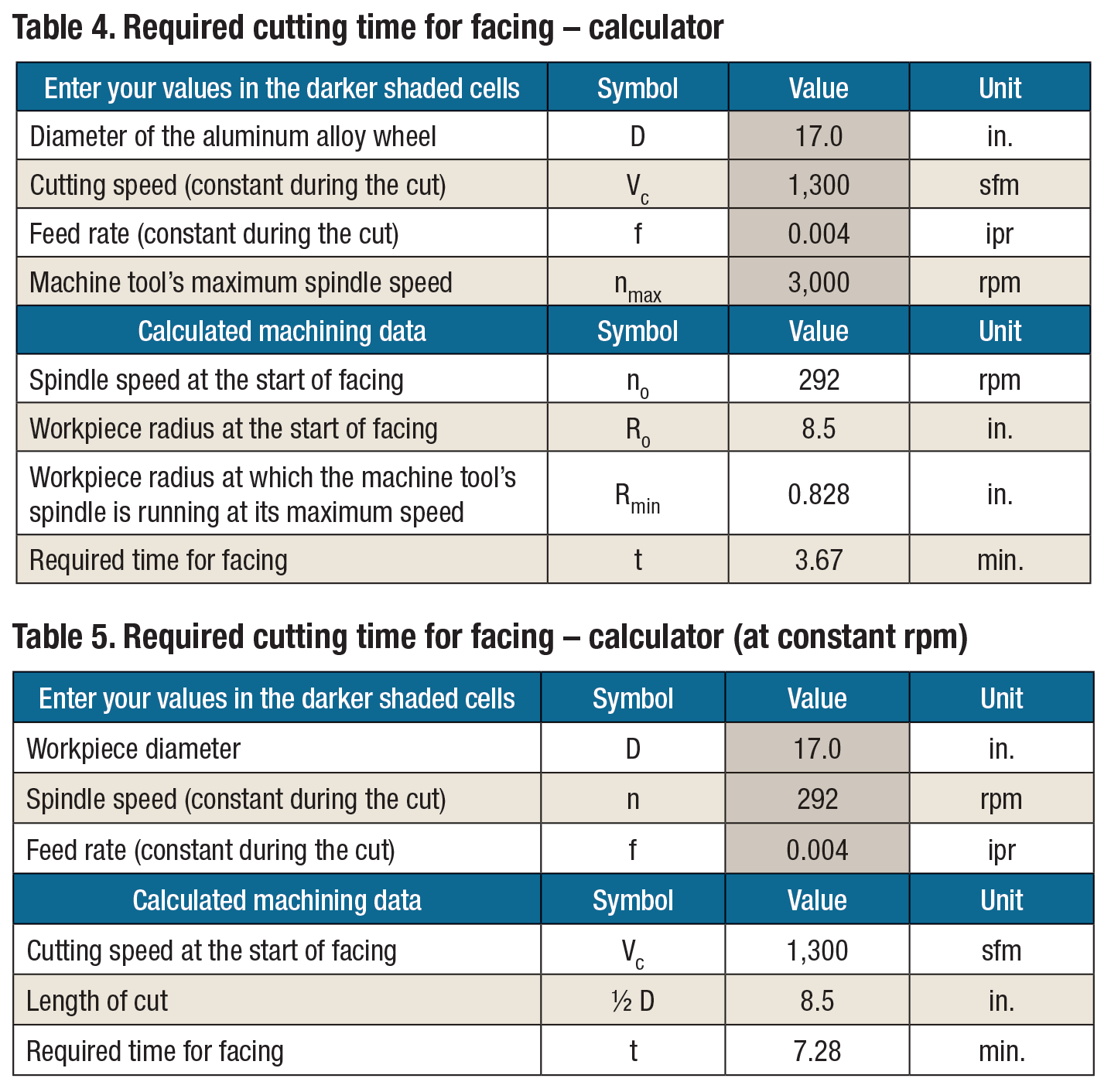
Based on this information, the author calculated the required time for facing using his calculator (Table 4.)
If the facing of the same wheels were performed at a constant rpm (equivalent to the same cutting speed) and the same feed rate, the cutting time would be significantly longer—about twice as long (Table 5).
Related Reading
- Related guide: Cutting Force Resources.
Glossary terms in this article
Related




 MFGAxis Discussion
Be part of the shop-floor conversation
Like, save, or comment on this CTE story.
MFGAxis Discussion
Be part of the shop-floor conversation
Like, save, or comment on this CTE story.


MFGAxis Discussion