Tips and Tools for Tapping Threads in Hardened Materials
Tips and Tools for Tapping Threads in Hardened Materials
When choosing to tap hard material internal threads, the material hardness should be less than 55 HRC. Tapping materials greater than that isn't practical.
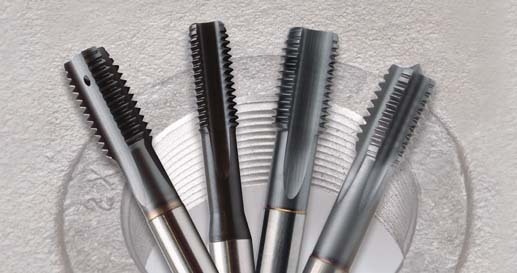
The EMUGE A-H family of taps is suitable for short chipping hardened steel and cast iron. EMUGE-FRANKEN
Depending on a part's design and function, a hard material may be required. Specific materials and hardnesses are used to reduce part wear and increase longevity. Hard materials, typically alloy steels, are classified as greater than or equal to 44 HRC. When choosing to tap hard material internal threads, the material hardness should be less than 55 HRC. Tapping materials greater than 55 HRC isn't practical.
In fact, threading hardened materials with taps can be a secondary consideration because thread milling is typically the preferred method in very hard materials. There is less load on the tool and reduced heat, as well as greater wear resistance when using thread mills.
To determine if tapping is viable for your hard material application, first establish its hardness rating. Once you know the hardness of the material, ask yourself: "Why am I trying to tap this versus thread mill this?" If the choice is still to tap, the most practical scenario is when you tap sizes UNC ¼" to ½", and M6 to M12. On holes smaller than ¼" and M6, a tap cannot withstand the torque required. In holes larger than ½" and M12, the thread pitch is coarse, radially deep and has a large diameter, resulting in high torque and heat when tapping.
Here are some additional tips:
- Use a tap designed with a substrate, geometry and coating specifically engineered for hard materials. A coated tool must be used to reduce the wear of the substrate. Also, the tap must be made of a material that has the properties to withstand high torque and high heat at the cutting edge, and abrasion of the material. Taps comprised of tool steels with powder metallurgy (PM) construction and solid carbide should be used. For example, the EMUGE A-H family of taps is comprised of premium HSSE and HSSE-PM taps for hardened steel and cast iron materials. A-H taps are available with or without coolant through holes, and with TiCN coating, or NT nitride surface treatment, for improved tool life. Premium HSS-E A-H taps are for materials up to 48 Rc hardness. Emuge HSSE-PM A-HCUT taps are for materials between 44 Rc and 55 Rc hardness and feature a hard, heat-resistant, powdered metal substrate for enhanced cutting performance and extended tool life. The taps with TiCN coating enhance the surface hardness and help increase the tools' abrasion resistance.
- Use a tap drill that is at the maximum minor diameter tolerance.
- Since tapping hard materials produces a lot of heat, coolant isn't adequate. Coolant doesn't have enough lubricity to assist the tap. It is advisable to use tapping oil or paste to provide high lubrication to reduce the development of heat from cutting and friction.
- The toolholder is extremely important and integral to the success of the tap, and it is recommended to use an axial floating tap holder. Hardened materials do not move — they are very strong. Any pitch error of the machine tool will wear or break the tap quickly because of the excessive torque and pressure. Using an Emuge Softsynchro® tap holder or an Emuge KSN tension compression tap holder will compensate for the machine tool pitch error. These holders ensure that the tap performance is only impacted by the material type and hardness, not the machine tool.
- Hard tapping is a slow process, and the primary goal is to achieve a thread to tolerance without breaking the tap. Use a low cutting speed, 5 sfm for 44 HRC to 50 HRC, and 3 sfm for 50 HRC to 55 HRC.