Author

Kip Hanson

Kip Hanson is a contributing editor for Cutting Tool Engineering magazine. Contact him by phone at (520) 548-7328 or via e-mail at [email protected].

Contributing Editor
Phone: 520-548-7328
Optional: narrow results to one content type.
Select one or more.
Select one or more.
Select one or more.
Select one or more.
Select one or more.
Select one or more.
Reset
Articles May 1, 2016 Kip Hanson
Benefits of micromachining with lasers
Lasers are good for far more than slicing sheet metal and defending against alien space invaders. Without them, many of today's high-tech products would be impossible to manufacture. Microfluidic devices, integrated circuits, medical stents and catheters, automotive fuel injector nozzles are all drilled, milled, surface-textured and ablated via laser micromachining.
Articles May 1, 2016 Kip Hanson
Challenges in the micro-EDM world
Say "EDM" and most manufacturing folks think mold, tool and die work. Yet sinker, wire and hole-popping EDMs are often employed in conjunction with, or as alternatives to, traditional part-making processes, such as milling and turning.
News April 29, 2016 Kip Hanson
MQL as a complement to flood coolant?
Standing in front of a ma-chining center, waiting for the drilling cycle to end so you can squirt some tapping compound into the holes is a big waste of time. But with challenging materials, such as Hastelloy or Inconel, it's the only way to avoid a broken tap. Or is it?
Articles April 1, 2016 Kip Hanson
Gangs vs. turrets
If you're shopping for a Swiss-style CNC lathe, the available options and machine configurations are truly staggering. Spindle speeds that compete with many machining centers, convertible spindles that turn a sliding-headstock machine into a chucker, thread whirling capabilities, laser cutting heads and enough axis letters to become the next Words With Friends champion.
Articles April 1, 2016 Kip Hanson
Accurate shop floor scheduling is important, but often hard to achieve
Without a manufacturing schedule, workpiece materials don't arrive on time, machine tools sit idle and customers fume. However, scheduling is difficult, especially when multiple-level assemblies and large numbers of components are involved. To meet this need, software companies have developed complex, integrated enterprise resource planning (ERP) systems. Hundreds of such systems exist, from giant multisite suites able to manage (OEMs') needs to those suitable for a job shop with a handful of employees.
Articles March 1, 2016 Kip Hanson
Better Threaders
When CNC wire EDMs came on the market in the mid-'70s, feeding wire from a spool through a machine's elaborate series of rollers and guides was a tedious manual exercise. Luckily, electrical discharge machining was an exceedingly slow process back then, so replacing wire had to be done less frequently than on today's machines, which erode conductive metal 10 to 20 times faster than earlier models.
News March 1, 2016 Kip Hanson
Inventing enthusiasm for manufacturing
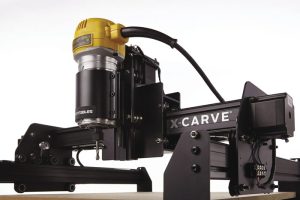
When Zach Kaplan visited the White House last June for a National Week of Making event, he had no idea it would mean giving away 50 of his company's 3D carvers (tabletop milling machines). The CEO of Inventables Inc. (www.inventables.com), Chicago, Kaplan and 99 other conference attendees were challenged to provide ideas on how they could help President Barack Obama with his "Nation of Makers" initiative. Kaplan's suggestion? Put an Inventables 3D carver in one school in each of the nation's 50 states. What's more, Kaplan wants to have a 3D carver in every school in the U.S. by the end of this decade.
News March 1, 2016 Kip Hanson
Machining process targets moldmakers and more
Imagine a machining process that removes material five times faster than milling and 10 times faster than sinker EDMing, machines Inconel and hardened steel with ease, holds tolerances to ±0.0006" and utilizes the same tool to process thousands of parts with virtually no tool wear. Machine builder EMAG LLC USA, Farmington Hills, Mich., calls this process pulsed electrochemical machining (PECM). A subset of electrochemical machining, PECM is far more accurate than the decades-old ECM and has matured into a viable alternative to more-traditional machining processes over the past few years, according to the company.
Articles February 1, 2016 Kip Hanson
Horizontal machining centers’ enhanced capabilities shorten payback periods
At roughly twice the price of a vertical machining center, do horizontal machining centers make sound financial sense? Absolutely, according to Scott Baldus, product specialist at Okuma America Corp. The Charlotte, N.C., machine builder offers both VMCs and HMCs, yet, Baldus noted, HMCs provide, on average, more than three times the spindle utilization of VMCs.
Articles February 1, 2016 Kip Hanson
Gripping threaded parts
Cutting external threads is one of the more difficult machining operations. Achieving the proper thread form can be challenging, and tool chipping and premature tool wear are often problematic because of insufficient surface speeds and high cutting pressures.
Articles January 1, 2016 Kip Hanson
Hold tight, and right
Your shop just bought its first 5-axis machining center. Now what? Not only are there new and more complex programming techniques to learn—never mind the mind-boggling variety of part processing options to contend with—there's also the pesky problem of how to grip workpieces. With the ability to tilt, rotate and position parts in ways never before possible, machining five sides of a workpiece in a single setup is a challenging but straightforward exercise—provided clearance between the workpiece, machine table and spindle head is maintained.
Articles January 1, 2016 Kip Hanson
Conventional thinking
Anyone who's drilled a deep hole on a CNC lathe or mill knows it's not easy. Go much deeper than 10 or 20 diameters and out-of-tolerance hole straightness, chip packing and premature tool failure become real concerns. Some machine shops turn to gundrilling houses, where specialty machines and tools make easy work of holes hundreds of diameters deep or more. Unfortunately, this means shipping the parts, incurring additional costs and increasing lead time to customers. Surely there's a better way.
1 8 9 10 11 12 17