


Case Hardening Do-It-Yourself: Quick Guide
Learn a practical torch-based case-hardening method for in-shop hardening, including safety, quench and soak steps plus when to send work to a heat-treating shop.
If you make steel tools like I do, sometimes a hard surface is in order. There is a way to case-harden steel that is inexpensive and quick and can be done with an acetylene torch as the heat source. It uses a powder called Cherry Red that is available from tool supply houses.
Use this method when you need a local repair or prototype touch-up. If the part requires greater depth or strict metallurgical consistency, outsource hardening to a qualified heat-treat facility.
I use a heat-treating company to do the work if the part requires a certain depth of the case and hardness. For example, I get parts that require a case 0.003″ to 0.005″ thick and 62 HRC. I would not try to do that with the Cherry Red process, but if I make a tool or die for in-house use and want a case with an HRC above 55, then I’ll use it.
The heat treater that I use has a lot charge of $150. If I want a case on the end of a punch that is 0.75″ dia., I can do that with my acetylene torch for about $5 of material and 10 minutes of time. I like those numbers.
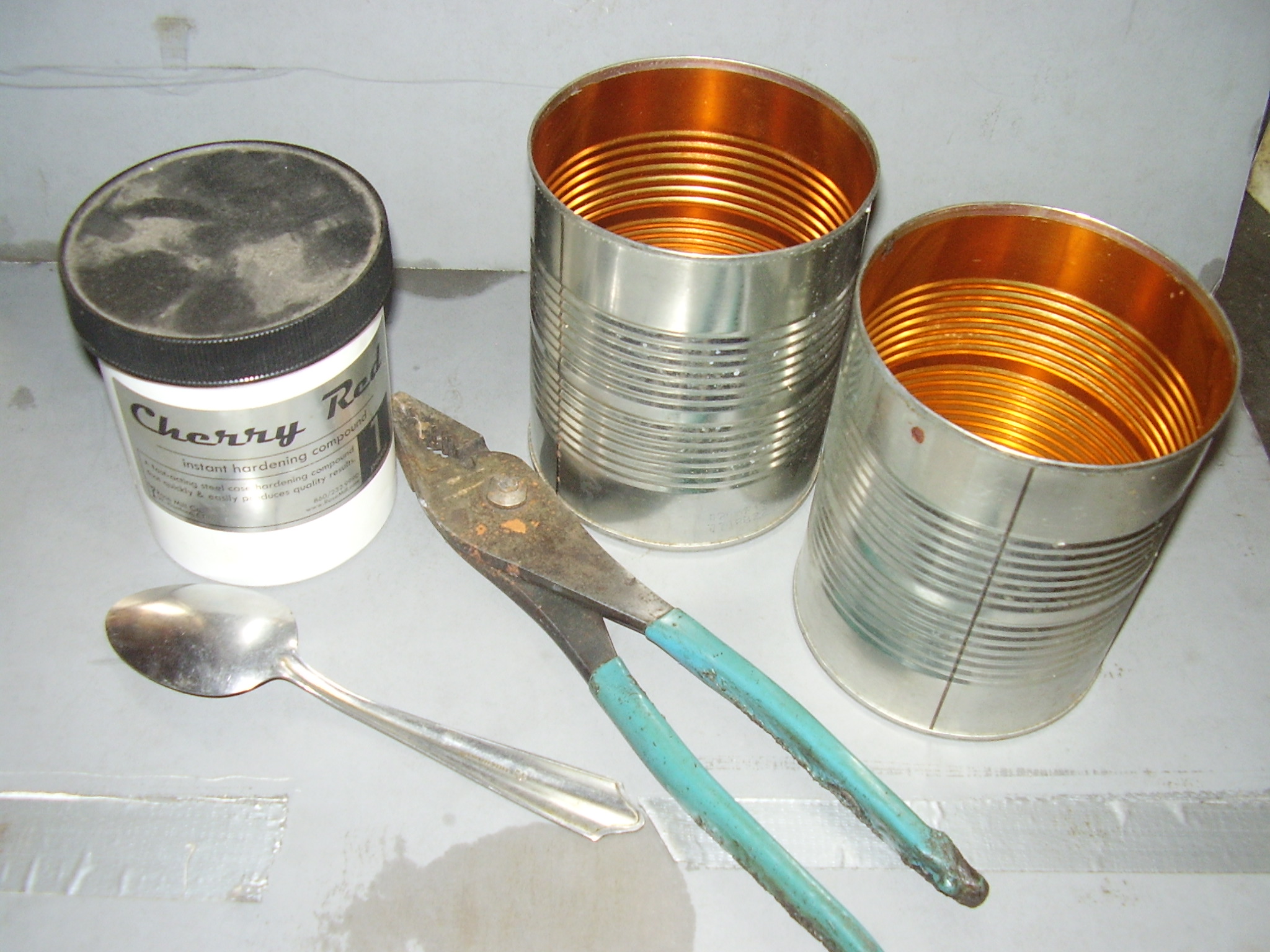
You don’t need much to get started. Image courtesy of B. Taylor
The process is simple.
1. Heat the area to be heat-treated to a cherry red color.
2. Coat the red area with the heat-treating compound. When I do the end of a punch, I put some compound in a tin can and plunge the tool in. Use a well-ventilated area or, better yet, do it outdoors because it gives off ammonia fumes when the compound is heated. Cherry Red comes in a plastic container, so don’t put hot metal in the container. And take care because the compound can irritate skin.
3. Reheat the area to be hardened to the cherry red color.
4. Quench the part in water or oil, and let cool.
5. Soak the part in water to remove the compound from the part.
The process causes a layer of the compound to become stuck on the steel, but it is water-soluble and so not too hard to remove. The compound dissolved in water is alkali and can irritate skin, so it’s a good idea to use rubber gloves and flush with plenty of water.
The picture on Page 10 shows what is needed: a container of Cherry Red; two tin cans — one to hold the compound and one for the quench; pliers to grab your part; and a spoon to coat the part if that’s appropriate. You also need an acetylene torch. Plan your process beforehand, and check to see that everything will work smoothly. You want the part to be bright red when coated by the hardening compound. You’ll be dealing with hot stuff, so having a plan is worthwhile.
Years ago, there were compounds to do this that had cyanide in the mix. You sure don’t want that. Cherry Red has no cyanide, but you don’t want to eat the stuff or get it in your eyes. Like every process at a metalworking shop, you have to be reasonable about safety.
That’s it. Quick, cheap and easy. And as hard as the back of Superman’s head.
Related Reading
- For more on metal cutting tools market, see this related guide.
- For more on us metal cutting tools market, see this related guide.
Glossary terms in this article
Related



Subscribers can use MFGAxis notes, saves and discussion tools with their innoNET account.