

Resources
Why Resources
Explore 121 published CTE resources related to Why across 47 articles, 19 products, 20 videos, and 35 news items.
47
Articles
19
Products
20
Videos
35
News
Articles
47 articles
Products
19 products
Videos
20 videos
News
35 news items
Tungaloy responds to rising carbide costs
BIG Daishowa Hosts Breakfast & Learn Event
ZOLLER Open House Focuses on Integrating Success
The power of density determination in additive manufacturing
5 reasons why CFexpress is the future of industrial memory cards
Tricks and techniques for specifying surface texture parameters
Browse
Browse all Why resources
Browse results
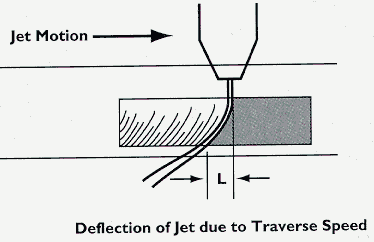
A Bend in the Stream
Programming a cut with an abrasive waterjet is complicated by the fact that the stream of water deflects as it passes through the workpiece. This article describes newer controller technology that can adjust the traverse speed to minimize deflection at corners and curves.
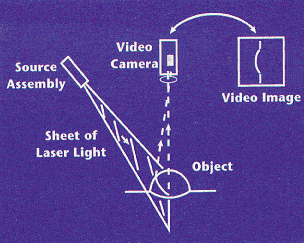
Measuring with Moire: Inspection Efficiency
Casting a pattern of light on a part and viewing that pattern at a different angle through a grating with the same pattern creates a moire pattern that can reveal small changes in the part's shape. This article tells how this phenomenon can be used by machine vision systems to measure part dimensions or pinpoint variations from a specified contour.

Coating for Speed: General Industry Coverage
To meet their customers' demands, mold and die shops are milling hardened steels at high speeds. This article discusses the use of coated carbide inserts to handle the heat generated by these operations. Specifically, the article talks about recently developed aluminum-titanium-nitride coatings, which reportedly are much more stable at elevated temperatures than other coatings.
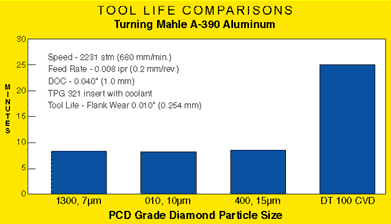
CVD Diamond Inserts Stick: Turning Performance
The development of the CVD thick-film diamond process has made it possible to produce tools that can machine abrasive work materials without losing their cutting edge. In this article, the technology for producing the diamond film and the brazing of these thick-film chips onto inserts is described.
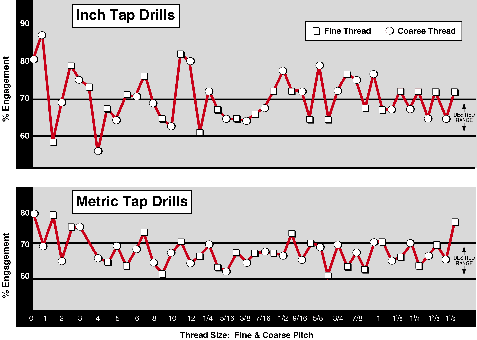
Drills Inch Toward Metric: Drilling Performance
U.S. manufacturers are in a transition period, moving from inch to metric specifications. This article looks at the impact this change is having on the manufacturing and use of drills. The discussion also covers the advantages and disadvantages of going metric and the availability of metric drill sizes in the United States.
For Good Measure: Inspection Efficiency
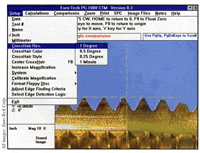
Software-based video tool inspection systems can read tool geometries much more precisely than other measurement systems. This article looks at the technology behind these systems and explains how this technology detects and measures tool edges and angles.
Good Vibrations: Drilling Performance
Tunable tools can be adjusted to dampen vibration. However, shops must have the right equipment to tune them quickly and precisely. This article describes an instrument that can provide the necessary feedback. A system that uses a mill's vibration frequency to sense problems with the tool is also described.

The Real Price of Automation
While CNCs and part-handling equipment offer labor, time and money savings, they also require dramatic changes in the way a shop operates. This article looks at the investment in equipment, personnel and training that shops have to make over and above the cost of the automated machines themselves.
Grinding Holds Its Ground
This article makes the argument that grinding is still a useful and necessary process despite the advancements that have made the turning of hardened workpieces possible. The article discusses the precision and finish possible with grinding, and it compares the cost of grinding to other machining processes.
Selecting Coolants: Why and How
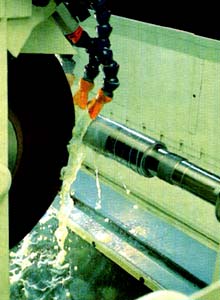
This is the first in a series of Articles on coolants. It provides a general review of the types of fluids available, their cooling and lubricating abilities and their ease of disposal. Criteria are offered for selecting the appropriate fluid for an operation.

Beyond the Ban: General Industry Coverage
The EPA's ban on ozone-depleting chemicals had an impact on the formulation of metalworking fluids containing 1,1,1 trichloroethane. This article looks at the reasons for the ban and the industry's efforts to find replacement substances for the banned chemicals.
Reassessing Recessing: Turning Performance
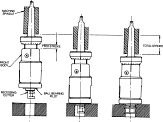
Automatic recessing heads feed a cutter out at a right angle to the spindle's rotation axis as downward pressure is applied to the housing. This article looks at the advantages of using these units and reviews the different types of head available, including heads for special applications and multispindle automatics.


