

Resources
Why Resources
Explore 121 published CTE resources related to Why across 47 articles, 19 products, 20 videos, and 35 news items.
47
Articles
19
Products
20
Videos
35
News
Articles
47 articles
Products
19 products
Videos
20 videos
News
35 news items
Tungaloy responds to rising carbide costs
BIG Daishowa Hosts Breakfast & Learn Event
ZOLLER Open House Focuses on Integrating Success
The power of density determination in additive manufacturing
5 reasons why CFexpress is the future of industrial memory cards
Tricks and techniques for specifying surface texture parameters
Browse
Browse all Why resources
Browse results
Creep-Feed Exam: General Industry Coverage
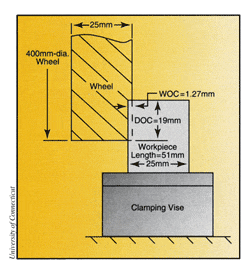
Researchers at the Center for Grinding Research performed a series of creep-feed grinding tests to determine the causes of the heat damage and striations they observed. The tests involved grinding slots and vertical faces. This report discusses the dynamics behind these problems and suggests ways to avoid them.
Powder Particulars: General Industry Coverage
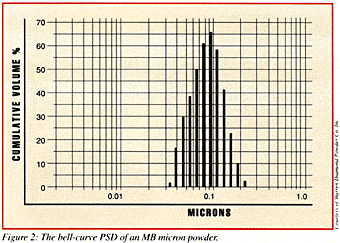
This article describes the shapes and sizes of diamond particles produced through standard manufacturing processes. The uses for these different types of particles are also explained, with an emphasis on particles used in superfinishing powders and slurries.

Superabrasive Safety: Safety, Standards & Compliance
Standards governing grinding-wheel safety testing do not cover all superabrasive wheels. This article suggests that these standards should include them. The author explains why as he describes a typical superabrasive wheel and the dynamics of superabrasive wheel failure.

Modular Moneymakers: Drilling Performance
Modular toolholding systems save shops money in several ways, according to this article. By making it possible to use the same tools on several machines, for example, a modular toolholding system can allow a shop to reduce its tool inventory. This article explains many other savings in addition to tool inventory reduction.

EDM Wire Covers All the Angles
With wire EDM, the properties of the wire will have a large impact on the performance of the operation as well as the ease of rethreading. This article discusses the properties that ensure a good spark and reliable performance even when cutting at an angle.
A Spark of Intelligence: General Industry Coverage
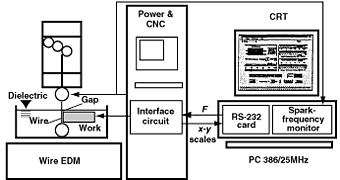
EDM cutting conditions change throughout the cutting process as the part thickness and the level of dielectric contamination fluctuates. This article describes an experimental setup that can monitor these fluctuations and adjust the EDM's settings to maintain an optimal spark.
Understanding EDMed Surfaces
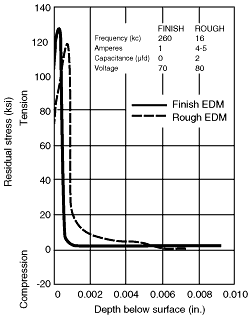
EDMed surfaces have their own texture and integrity considerations. This guide explains why EDM surface condition matters for inspection, finishing, and downstream performance.
Saw Change: General Industry Coverage
Blades for contour bandsawing vary in their materials, their tooth set and selection, their width and the way they are welded. This article discusses how each of these variables contributes to the blades' ability to cut intricate shapes without seizing or wearing prematurely. Blade lubrication is also covered.

Stress Management: General Industry Coverage
High-performance aluminum-alloy workpieces are prone to residual stresses that can lead to part distortion. This article reviews the milling tools and practices that affect these stresses. Some tools and practices alleviate the stress, while others allow the machinist to mill the part without adding more stress.
Indexed for Success: Drilling Performance
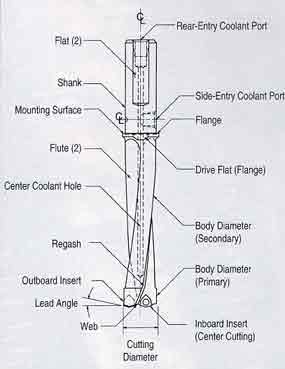
Indexable-insert drills offer several advantages for producing short holes. This article describes the drills' features, uses and benefits. Tips are provided to help select the optimal tool, insert and machine settings. A trouble-shooting chart is included.
Turn with the Right Tool
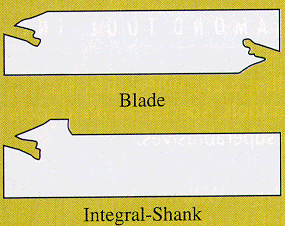
New plunge-and-turn tools make it possible to perform several tasks, such as grooving, turning, back turning and face grooving, with the same tool. This article discusses the design and use of these tools as well as the types of cutoff tools currently on the market. Recommendations for tool selection, speeds and feeds are given for various work materials.
The Time is Right for Cermets
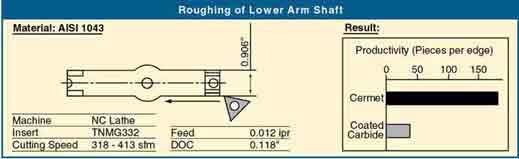
Cermet inserts have evolved into cutting tools capable of finish-turning steel reliably at high speeds. This article traces the developments that have led to modern cermets and describes the properties that enhance the performance of these tools. The development of coatings for cermets is also covered.


