

Resources
Why Resources
Explore 121 published CTE resources related to Why across 47 articles, 19 products, 20 videos, and 35 news items.
47
Articles
19
Products
20
Videos
35
News
Articles
47 articles
Products
19 products
Videos
20 videos
News
35 news items
Tungaloy responds to rising carbide costs
BIG Daishowa Hosts Breakfast & Learn Event
ZOLLER Open House Focuses on Integrating Success
The power of density determination in additive manufacturing
5 reasons why CFexpress is the future of industrial memory cards
Tricks and techniques for specifying surface texture parameters
Browse
Browse all Why resources
Browse results
Bonded Graphite Electrodes: General Industry Coverage
To produce graphic electrodes for EDMing large cavities, shops sometimes must machine the piece in smaller sections and bond them together. This article explains how to build and use a bonded graphite electrode so that a ridge at the electrode's bond line can be avoided.
Wire EDM Filtration Comes of Age
Centralized mineral filtration for wire-EDM dielectric fluid can remove contaminants down to the 1-micron level and dispose of them in an environmentally responsible way. This article describes the mineral filtration process and compares it to the other common filtration methods.
Tantalum and Niobium: Drilling Performance
Tantalum and Niobium are important components in the composition of carbide tools. They are also among the most expensive. This article explores how recent trends in metalcutting and tool usage will effect the supply of these two components.
From Presetting to Tool Management
This article explains how state-of-the-art tool presetting-and-measuring machines can reduce a shop's tool setup time while increasing precision. The article also describes how the additional functions of these high-end units can turn them into sophisticated tool-management systems.
Balancing on the Fly: General Industry Coverage
With the introduction of high-speed milling, tool balancing has become increasingly important. This article describes a system that can balance tools while they are mounted in the machine tool's spindle and rotating.
Harder, Faster: Turning Performance
The growing use of difficult-to-machine materials has driven the metalcutting industry to high-performance tools. This article reviews the trends that are behind most cutting tool research today, and it looks at the state-of-the art results of that research.
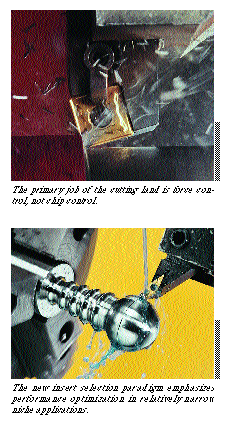
Top-Form Geometry: Turning Performance
This article makes the argument that an insert is really a system made up of a combination of factors. The focus of the article is on one of these factors: the top-form geometry, which has evolved from the chipbreaker designs used primarily on turning inserts.
Use a Saw to Upgrade Your Cutoff
Rotary saw cutting (RSC), using a self-contained, motorized attachment that is mounted in a machine's standard cutoff position, can provide an alternative to single-point tooling for cutoff operations. This article details the ways that RSC provides results that are better than single-point tooling while advising readers on ways to optimize the operation.
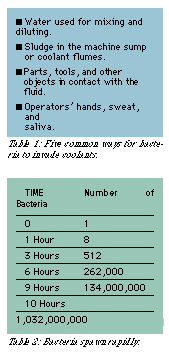
The Good, the Bad and the Smelly
The presence of bacteria and fungi can seriously compromise the effectiveness of metalworking fluids. This article looks at the most harmful microbes and the conditions that allow them to flourish. Preventive measures are also discussed.
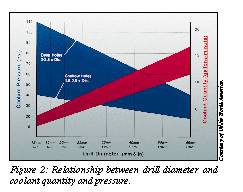
Stop Drill Breakage: Drilling Performance
Several factors influence the effectiveness of a drilling operation. This article looks at a number of them, including coolant delivery, speeds and feeds, and tool selection.
Hot Properties: Drilling Performance
The benefits of TiN and TiCN coatings are list in high-temperature applications such as the machining of exotic metals. TiAlN coatings, on the other hand, perform better at higher temperatures. This article describes the properties of TiAlN that make it the coating to use with high-temperature work.
What Makes Diamond Coatings Work?
Researchers studying the performance of diamond coatings have found a number of factors of the coating process that determine the ultimate success of the coating. This article looks at factors such as substrate preparation, stresses in the coating and substrate and the diamond coating's formation patterns.


